AGENDA
Governance Committee Meeting
18 February 2025
Level 11, 50 Scott
Street, Liverpool NSW 2170

You are hereby notified
that a Governance Committee Meeting of Liverpool City Council will be
held at Level 11, 50 Scott Street,
Liverpool NSW 2170 on Tuesday, 18 February 2025
commencing at 10:00 AM.
Please note this meeting
is closed to the public. The minutes will be submitted to the next Council meeting.
If you have any enquiries, please contact Civic and Executive Services on
8711 7441.
 Mr Jason Breton
ACTING CHIEF EXECUTIVE
OFFICER
Opening
Acknowledgment of Country and Prayer
Apologies
Condolences
Declarations of Interest
Infrastructure and Planning
Committee
ITEM 01 Inclusion
of a Minimum Lot Width for Dual Occupancies in the Liverpool Local
Environmental Plan 2008 4 1
ITEM 02 School
Access and Safety 25 2
Budget Committee
ITEM 03 Budget
FY 2025/26 Information: Council Activity Report 32 3
Strategic Priorities Committee
ITEM 04 Grants
Donations and Sponsorship Program 45 4
Strategic Performance Committee
ITEM 05 Review
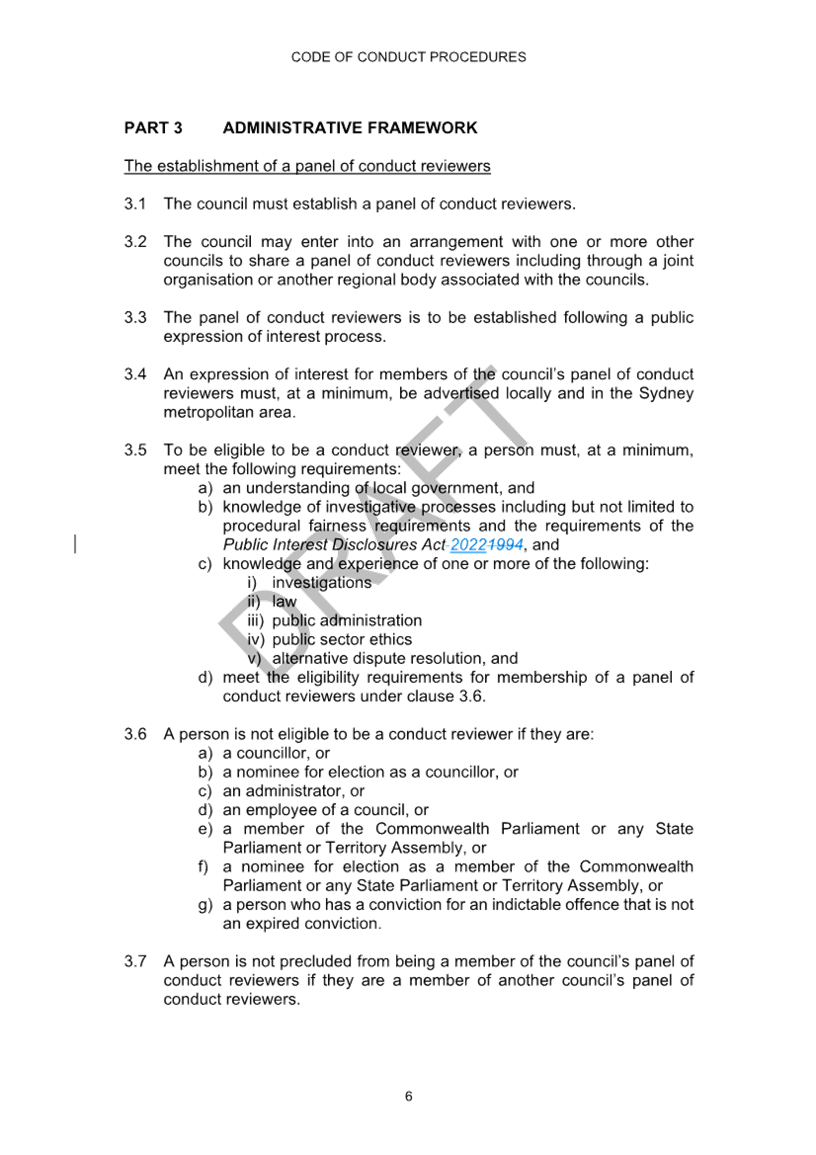
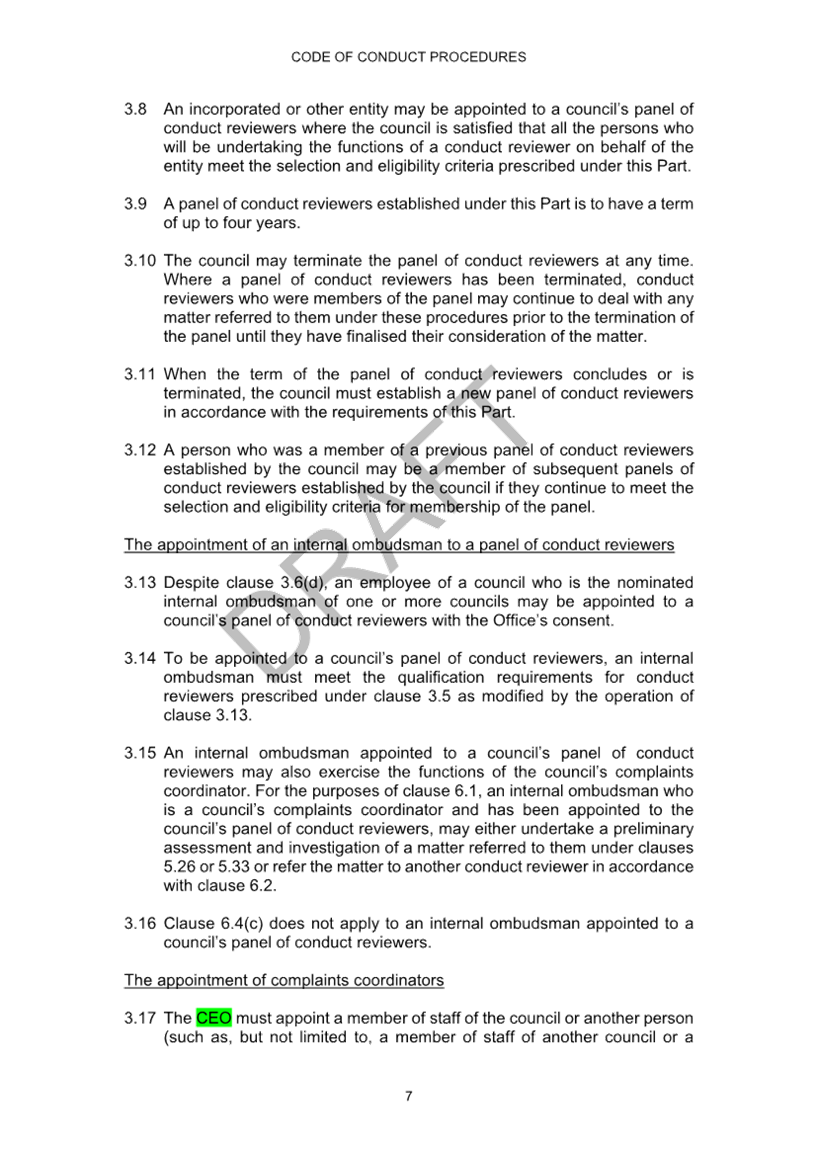
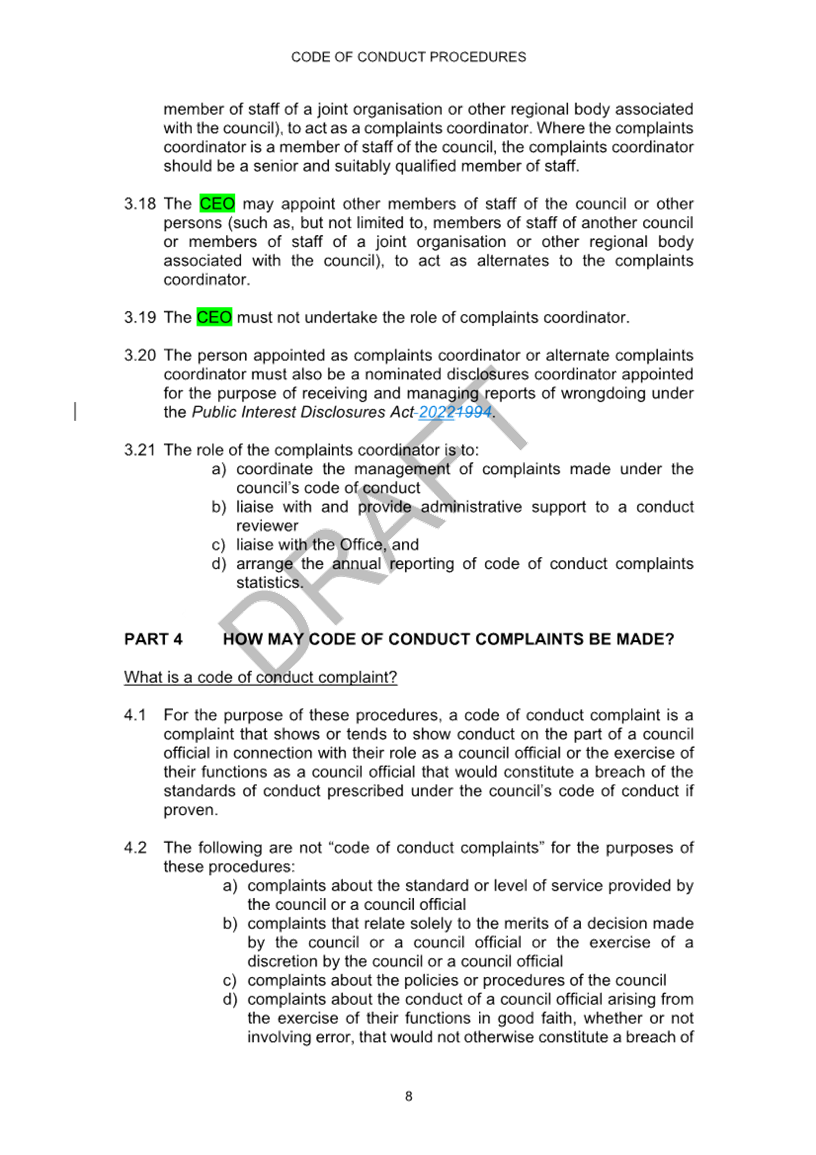
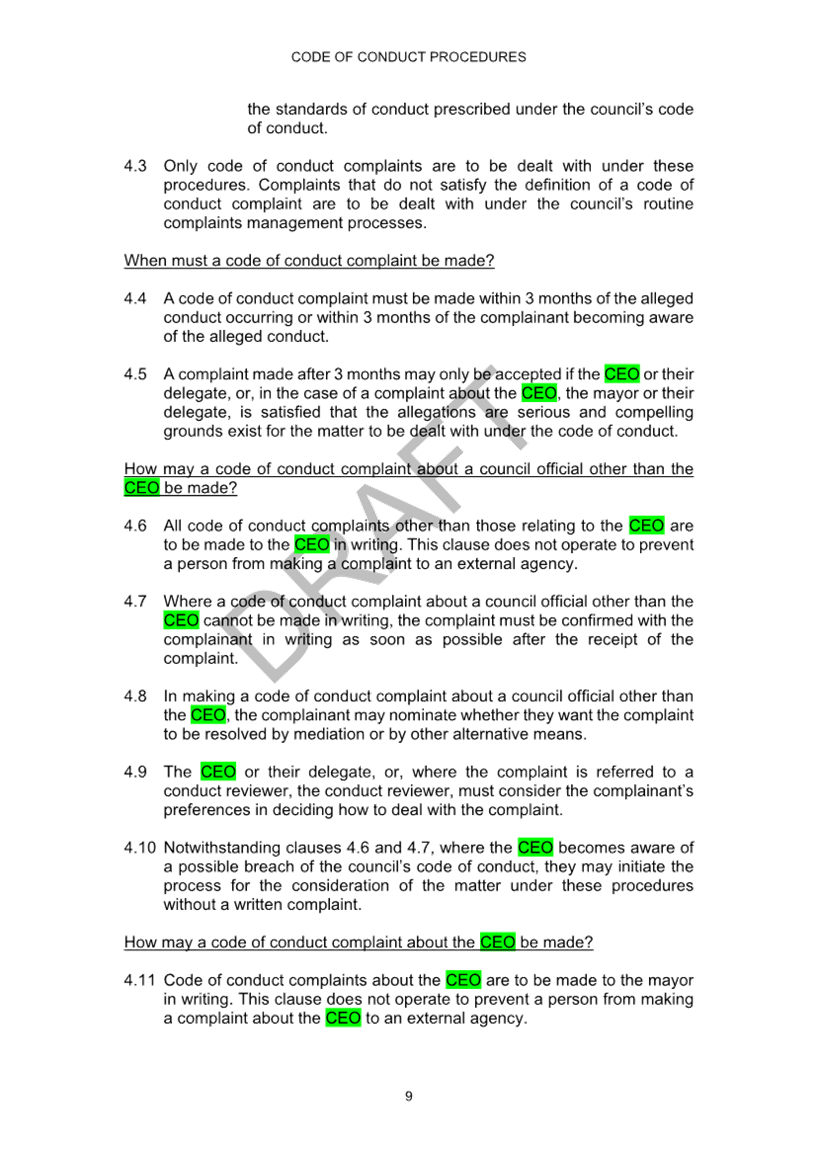
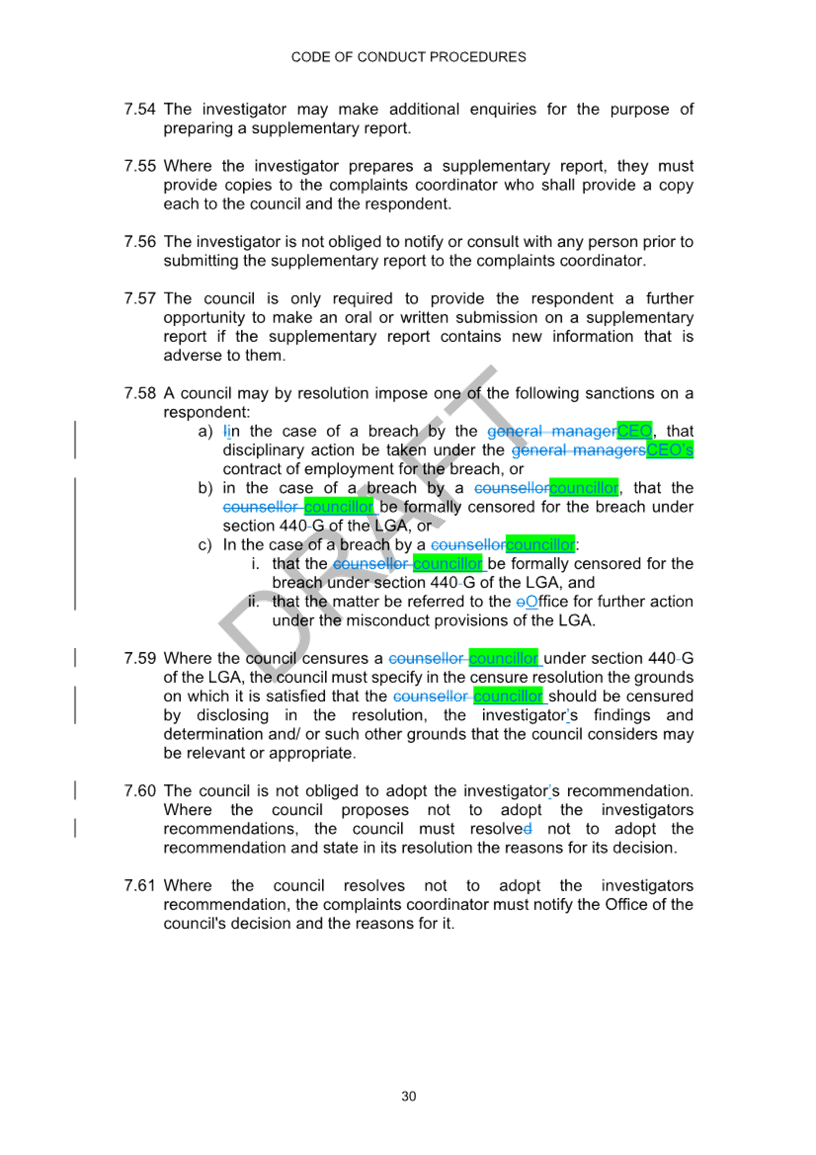
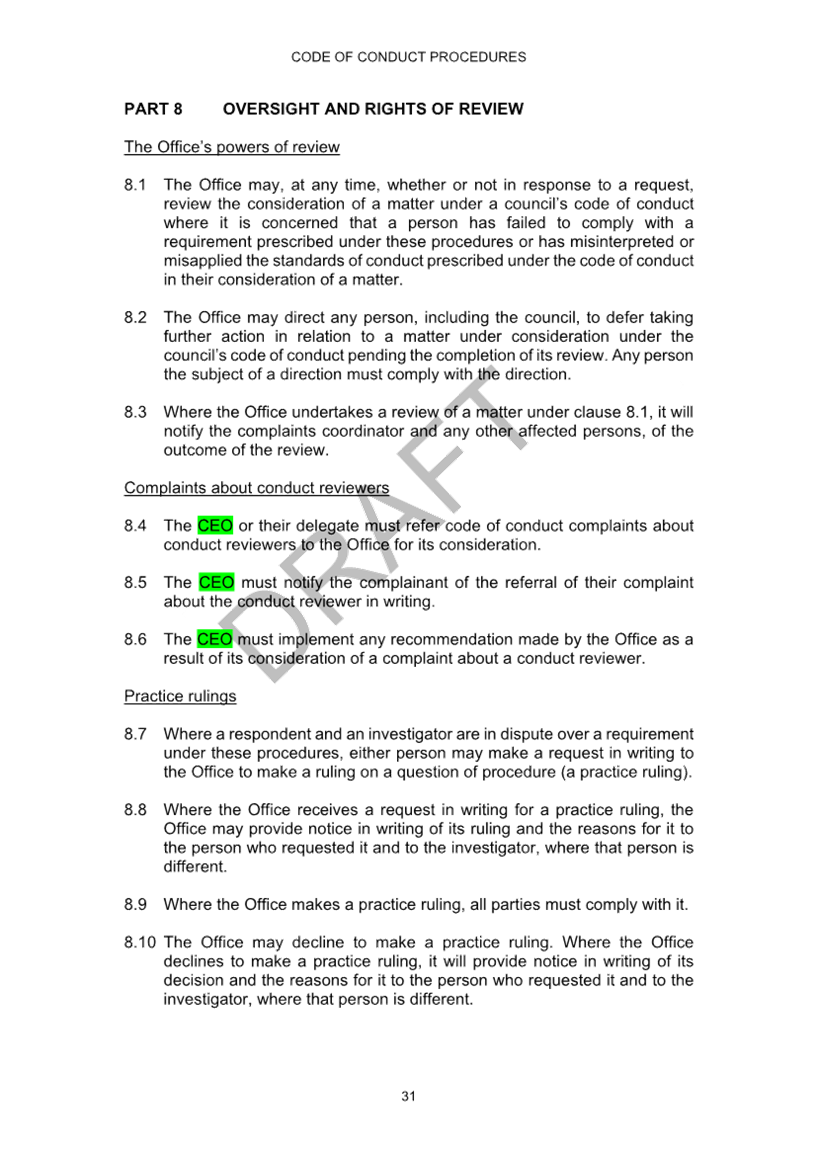
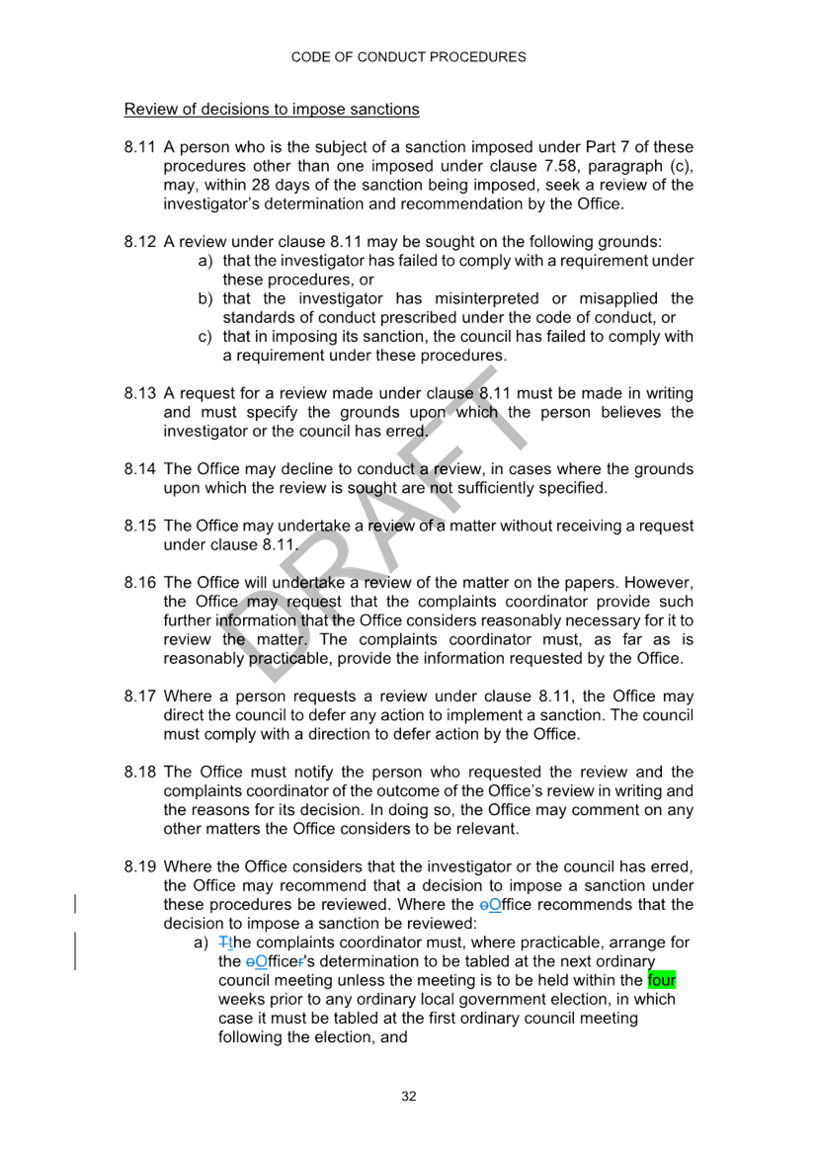
of the Code of Conduct and Code of Conduct Procedures 69 5
Presentations by Councillors
Close
Governance
Committee Meeting
18 February 2025
Infrastructure and Planning Committee Report
|
ITEM 01
|
Inclusion of a Minimum Lot Width for
Dual Occupancies in the Liverpool Local Environmental Plan 2008
|
|
Strategic Objective
|
Liveable,
Sustainable, Resilient
Deliver
effective and efficient planning and high-quality design to provide best
outcomes for a growing city
|
|
File Ref
|
016978.2025
|
|
Report By
|
Lilyan Abosh - Acting
Senior Strategic Planner
|
|
Approved By
|
Lina Kakish - Director
Planning & Compliance
|
At
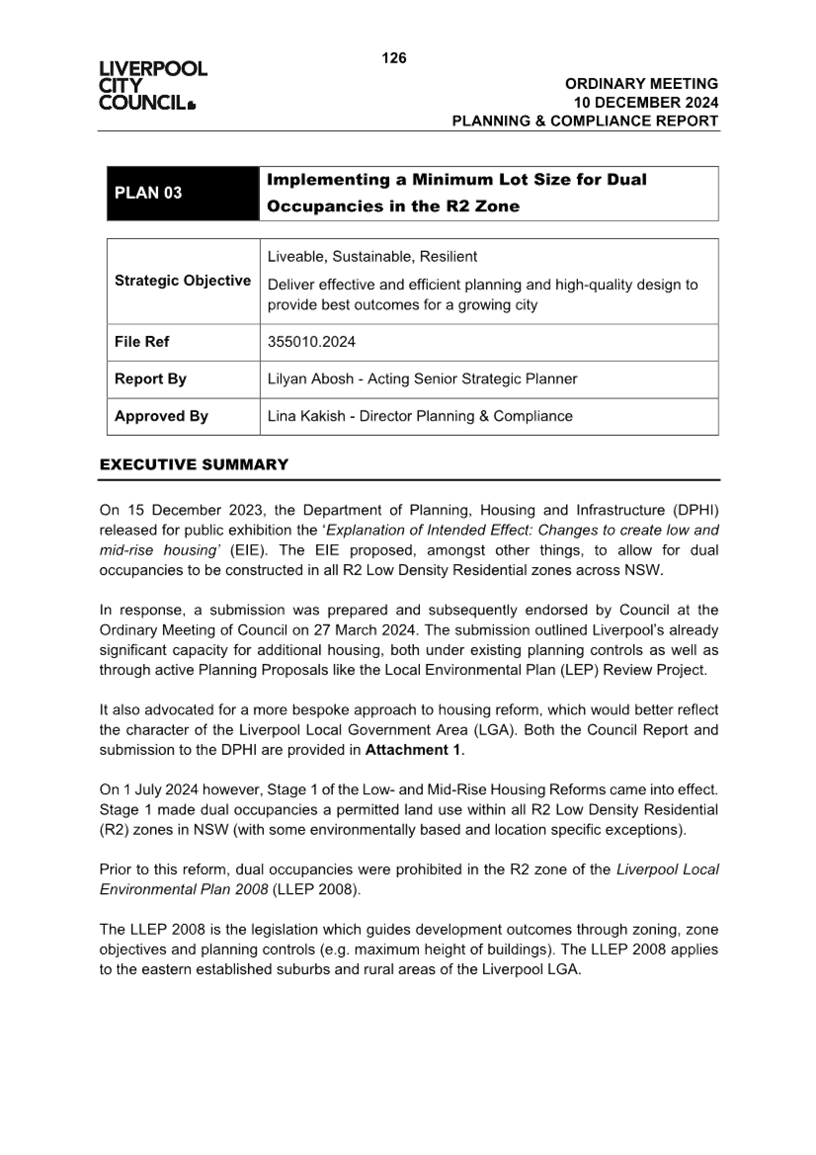
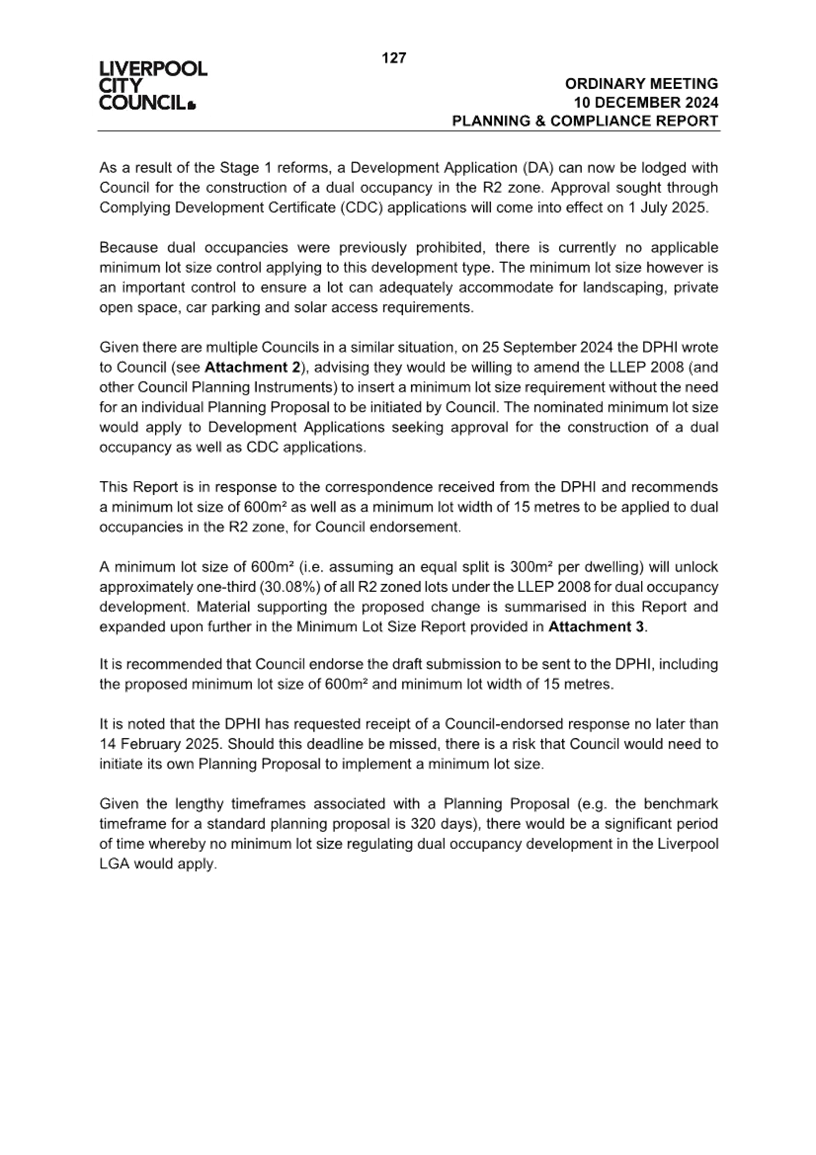
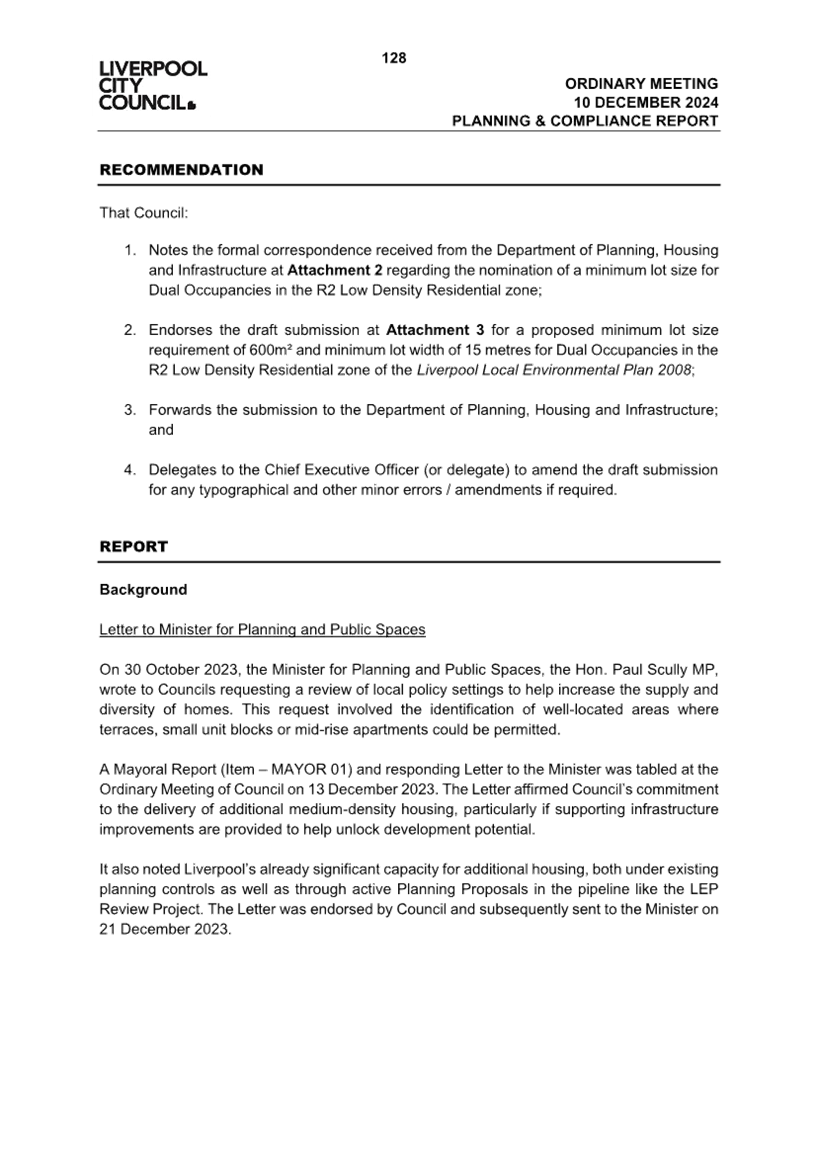
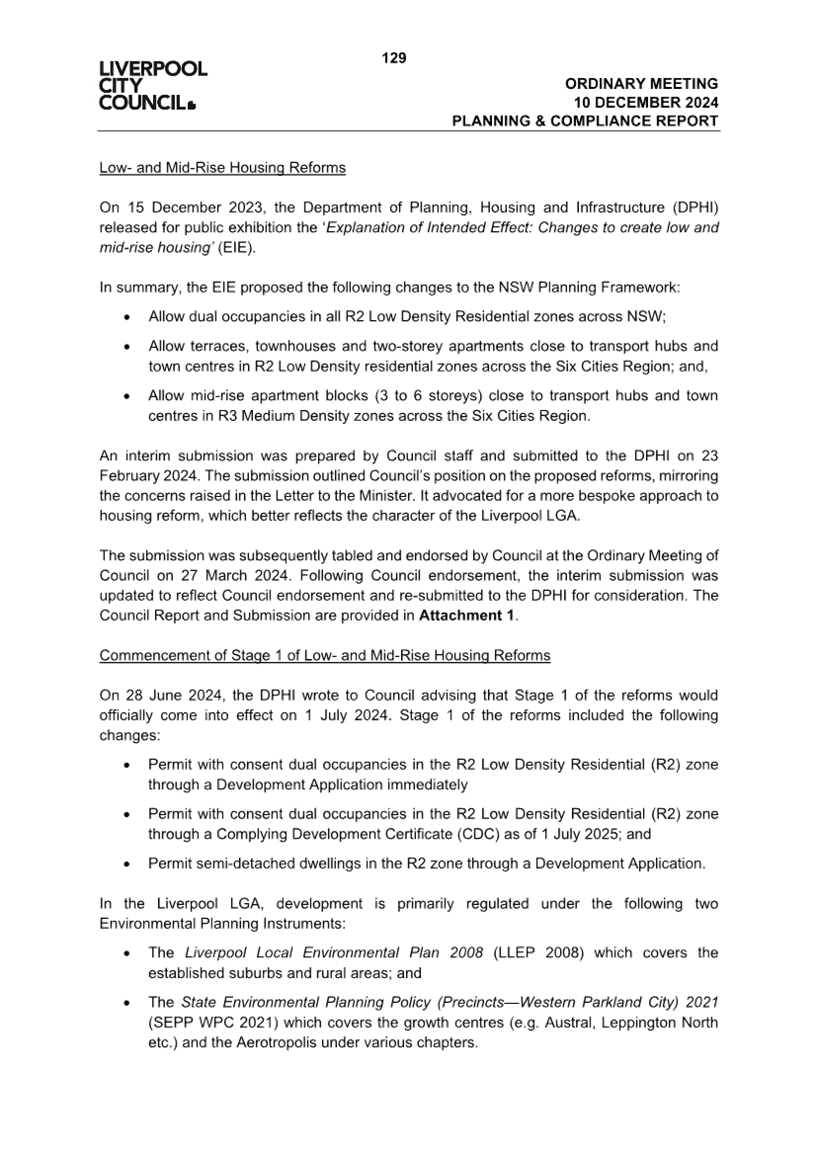
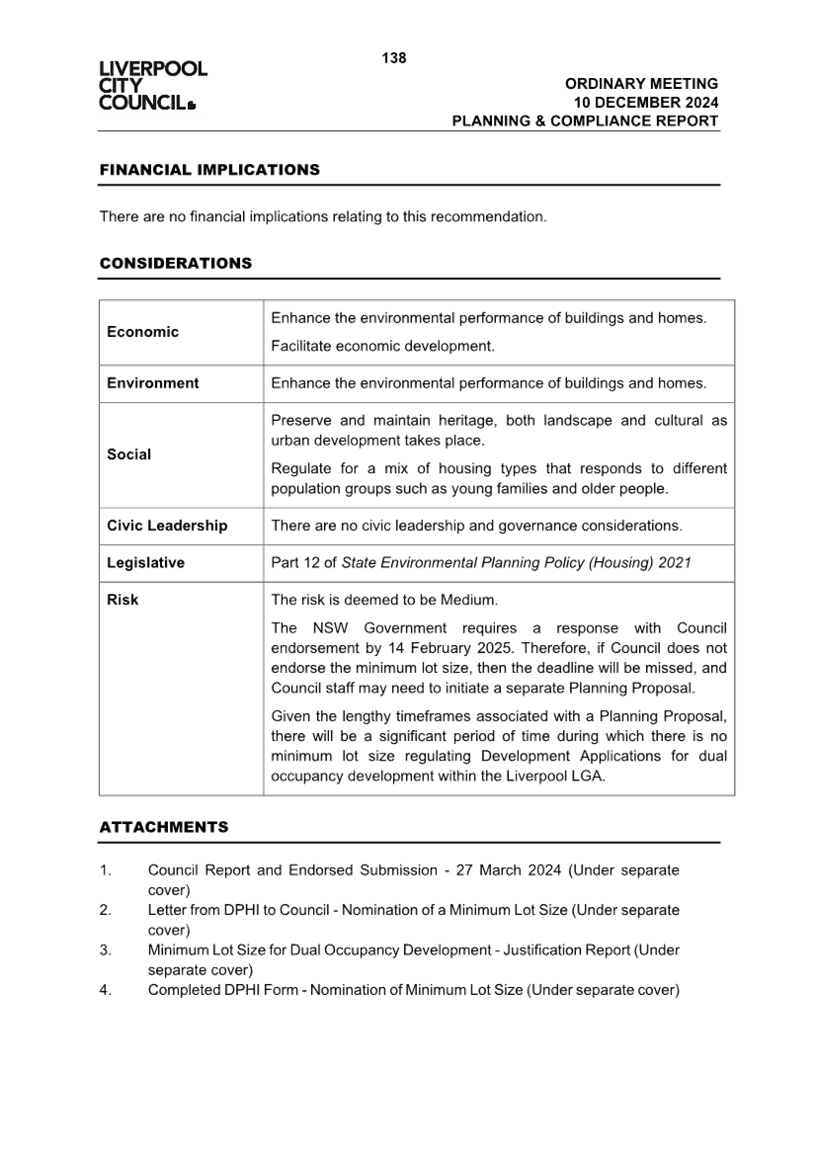
the Ordinary Meeting of Council on 10 December 2024, a Report (Attachment 1)
was tabled in response to the commencement of the NSW Low- and Mid-Rise Housing
Reforms, which permitted dual occupancies in the R2 zone of the Liverpool
Local Environmental Plan 2008. The Report recommended the implementation of
a minimum lot size of 600m² and minimum lot width of 15m for dual
occupancies in the R2 Low Density Residential zone.
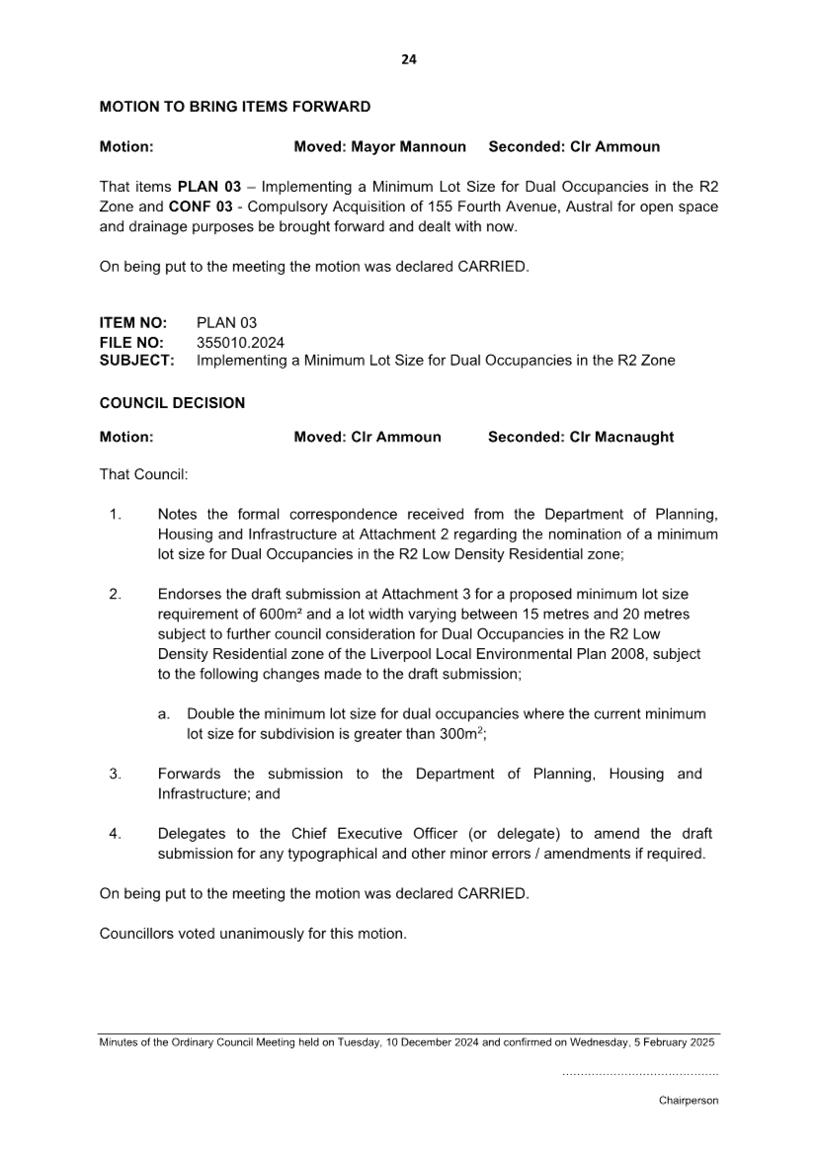
At
the Meeting, Council resolved to implement a minimum lot size of 600m2
for dual occupancies and to double the current minimum lot size where the lot
size for subdivision is greater than 300m2 currently.
Additionally,
Council resolved to further investigate a minimum lot width varying between 15m
and 20m in the R2 Low Density Residential (R2) zone. Accordingly, this Report provides Council with the
additional information regarding various lot widths and their impacts on the R2
zone.
As
a result of the Council Resolution, Council staff conducted a manual
investigation into lot various widths in the R2 zone. The investigation found
that in addition to having a minimum lot size of 600m²:
· Approximately 29% (or 9,198) lots have a minimum lot
width of 15m
· Approximately 21% (or 6,714) lots have a minimum lot
width of 18m
· Approximately 14% (or 4,388) lots have a minimum lot
width of 20m
Given Council resolved to apply a larger minimum lot
size than 600m² for dual occupancies within certain locations (e.g. R2
zoned land in Pleasure Point and Voyager Point, R2 zoned lots along Orange
Grove Road etc), it is noted some of the lots captured in the data above may
not meet the revised lot size requirements for these specific locations. This
is also likely to further lower (slightly) the above percentages.
It
is recommended that Council proceed with a minimum lot width of 15 metres in
the R2 zone. This width is also
consistent with the State Environmental Planning Policy (Exempt and
Complying Codes) 2008, which requires a minimum lot width of 15m for dual
occupancies in most development scenarios.
It
should be noted that Council staff met with representatives from the Department of Planning, Housing and Infrastructure
(DPHI) on 20 January 2025 to discuss the proposed minimum lot size and minimum
lot width options for the R2 zone. At the Meeting, the DPHI advised they would
be willing to consider the inclusion of a minimum lot width for the R2 zone,
subject to a merit assessment.
Accordingly,
Council staff have requested an extension to the submission on the minimum lot
size and minimum lot width in the R2 zone until 7 March 2025 to enable a final
response to be submitted following Council consideration of this Report.
That Council:
1. Receives
and notes this Report; and
2. Endorses a single minimum lot width of 15 metres for all
Dual Occupancies in the R2 Low Density Residential zone of the Liverpool
Local Environmental Plan 2008.
Background
On
1 July 2024, the NSW Government introduced Stage 1 of the Low- and Mid-Rise
Housing Reforms which made dual occupancies a permitted land use within all R2
Low Density Residential (R2) zones in NSW.
Prior
to this Reform, dual occupancies were prohibited in the R2 zone of the Liverpool
Local Environmental Plan 2008 (LLEP 2008). As a result, there is currently
no minimum lot size requirement applying to this type of development. Most
Councils, however, implement this control to ensure a lot can adequately
accommodate for landscaping, private open space, car parking and meet solar
access requirements.
As
a result of the Reforms, the DPHI wrote to Council on 25 September 2024 to
advise they would be willing to amend the LLEP 2008 to insert a minimum lot
size requirement.
The
nominated minimum lot size would apply to dual occupancy Development
Applications, as well as Complying Development Certificate (CDC) applications.
Accordingly,
at the Ordinary Meeting of Council on 10 December 2024, a Report (Attachment
1) was tabled for Council consideration regarding the implementation of a
minimum lot size of 600m² for dual occupancies in the R2 zone. In
addition, Council staff also proposed a minimum lot width requirement of 15m be
included in the LLEP 2008. At this Meeting, Council resolved the following:
That
Council:
1. Notes the formal correspondence received from the Department of Planning,
Housing and Infrastructure at Attachment 2 regarding the nomination of a
minimum lot size for Dual Occupancies in the R2 Low Density Residential
zone;
2. Endorses the draft submission at Attachment 3 for a proposed minimum lot
size requirement of 600m² and a minimum lot width varying between 15
metres and 20 metres subject to further council consideration for Dual
Occupancies in the R2 Low Density Residential zone of the Liverpool Local
Environmental Plan 2008 and also subject to the following changes made to the
draft submission:
a.
Double the minimum lot size for dual occupancies where the current minimum lot
size for subdivision is greater than 300m2;
3. Forwards the submission to the Department of Planning, Housing and
Infrastructure; and
4. Delegates to the Chief Executive Officer (or delegate) to amend the draft
submission for any typographical and other minor errors / amendments if
required.
In
accordance with Point 2 of the Council Resolution, this Report provides Council
with the additional information regarding various lot widths and their impacts
on the R2 zone.
Purpose
of Lot Width Control
The minimum lot width control is a useful tool to
define and establish the relationship of the development to the street. It is
particularly effective in the following ways:
· Managing the visual impacts of garages on the
streetscape by reducing its dominance;
· Providing flexibility to deliver favourable building
layouts, including suitably dimensioned living areas;
· Maximising doors and windows overlooking the street
for passive surveillance;
· Increasing opportunities for on-street parking (e.g.
in-between driveways); and
· Facilitating adequate space for deep soil planting
including trees in the front and rear setbacks, as well as required servicing.
The
inclusion of a minimum lot width specifically in the LLEP 2008 will ensure the
development standard is given more weight than if it were included in a Development
Control Plan. Under Clause 4.6 of the LLEP 2008, variations to the minimum lot
width can still occur if sufficiently justified.
Lot
Width Analysis for Dual Occupancies
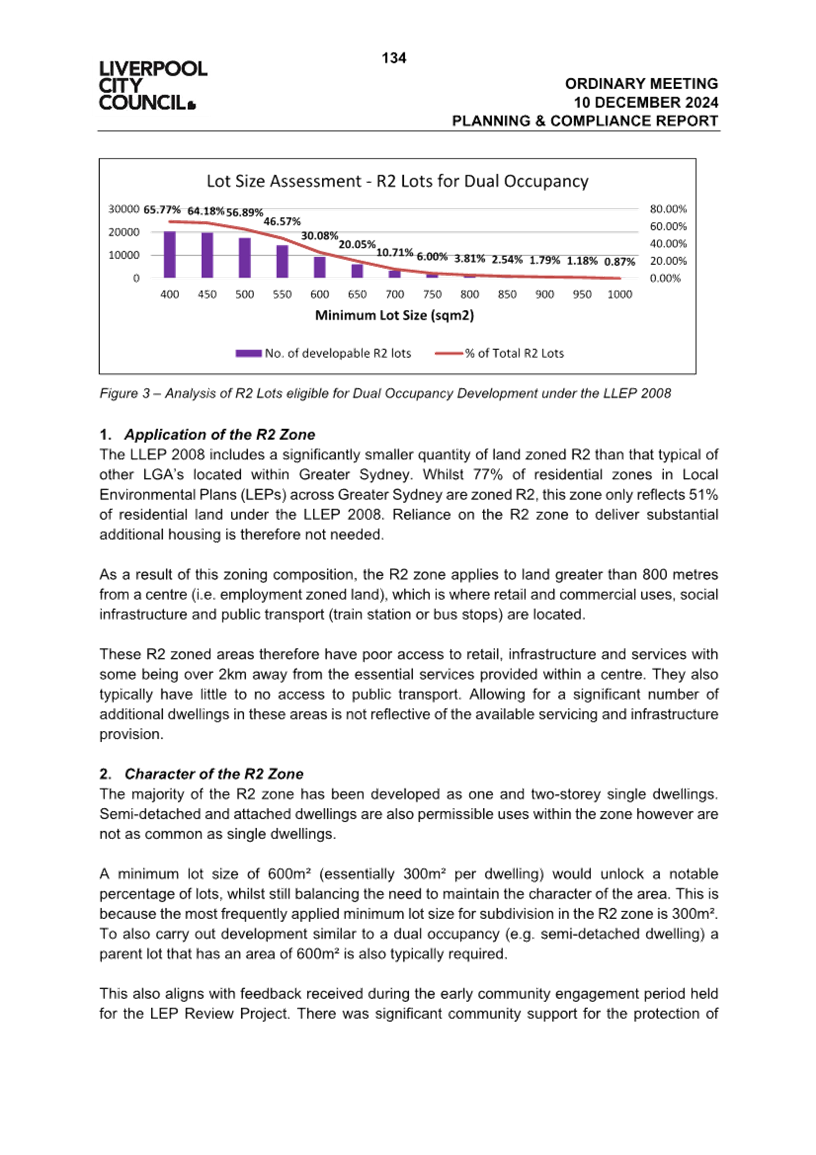
The Liverpool LGA currently comprises approximately
32,000 lots zoned R2 within land covered by the LLEP 2008. Furthermore, work
undertaken as part of the LEP Review Project found there to be approximately
9,301 R2 zoned lots with a lot size of 600m² or greater, and a
corresponding lot width of at least 15m.
As part of this exercise, further refinement of the
data was undertaken manually, to exclude duplicated data entries, sites marked
as schools or public reserves, and other lots considered undevelopable for the
purpose of a dual occupancy. This data was manually sourced from Councils GIS
system and rounded up/down to the nearest whole number. The findings of this
exercise are summarised in Table 1.
Table 1 – Lot width analysis of
R2 lots with a lot size greater than 600m2
|
Proposed Minimum Lot Width
|
Approximate Number of R2 Lots unlocked
|
|
15m
|
9,198 (29%)
|
|
16m
|
8,371 (26%)
|
|
17m
|
7,621 (24%)
|
|
18m
|
6,714 (21%)
|
|
19m
|
5,250 (16%)
|
|
20m
|
4,388 (14%)
|
As shown in Table 1, the analysis identified
that for properties within the R2 zone with a minimum lot size of 600m2,
application of a corresponding minimum lot width of 15 metres would limit dual
occupancy development introduced under the NSW Government’s Housing
Reforms to approximately 9,198 lots (or 29% of the total) where the LLEP 2008
applies.
At the other end of the scale, a corresponding minimum
lot width of 20 metres would unlock dual occupancy development introduced under
the NSW Government’s Housing Reforms for approximately 4,388 lots (or 14%
of the total) where the LLEP 2008 applies.
At the December Council meeting, Council resolved to
apply a larger minimum lot size than 600m² for dual occupancies proposed
within certain locations (e.g. R2 zoned land in Pleasure Point and Voyager
Point, R2 zoned lots along Orange Grove Road etc). In light of this, it is
noted some of the lots captured in the data above may not meet the revised lot
size requirements for these specific locations. This is also likely to further
lower (slightly) the above percentages.
Further Lot Width Considerations
1. Complying Development Certificate Applications
From 1 July 2025, Complying Development Certificate
(CDC) applications for dual occupancies in Liverpool will be allowed. The CDC will need to comply with the provisions of
the State Environmental Planning Policy (Exempt and Complying Codes) 2008 (Codes
SEPP), which requires a minimum lot width of 15 metres on most occasions.
If the car parking space for the parent lot however is
accessed only from a secondary road (i.e. a corner lot), parallel road or lane,
then the minimum lot width needed is reduced to 12m. This scenario will only
apply to a minority of lots however in the Liverpool LGA. Dual occupancies with
double garages will also dictate larger minimum lot widths to accommodate the
garage dimensions.
It is noted that if Council implements a minimum lot
size in the LLEP 2008, this figure will not
override the lot width controls contained in the Codes
SEPP. The application of a minimum lot width of 15m would therefore align with
the most common lot width scenario under the Codes SEPP and ensure general
consistency between applications approved by Council and private certifiers.
2. Consultation with DPHI Representatives on NSW
Government Housing Reforms
On
20 January 2025, Council staff met with representatives from the DPHI responsible for introducing the NSW Government
Housing Reforms. At the Meeting, the DPHI advised they would be willing to
consider the inclusion of a minimum lot width for the R2 zone, subject to a
merit assessment. DPHI representatives also noted that the policy direction of
the Housing Reforms is to aim for 50% of R2-zoned lots within an LGA to be dual
occupancy developable.
Accordingly,
Council staff have requested an extension to the submission on the minimum lot
size and minimum lot width in the R2 zone until 7 March 2025 to enable a final
response to be submitted following Council consideration of this Report.
3. LEP Review Project
Although the investigated widths will unlock no more
than a third of R2 zoned lots, it is noted that significant housing uplift is
already proposed under the LEP Review Project. The LEP Review Project, and resulting Principal
Planning Proposal, was endorsed by Council at the Ordinary Meeting of Council
on 29 May 2024 (Item PLAN 05). The Proposal is currently being assessed by the
DPHI for a Gateway determination.
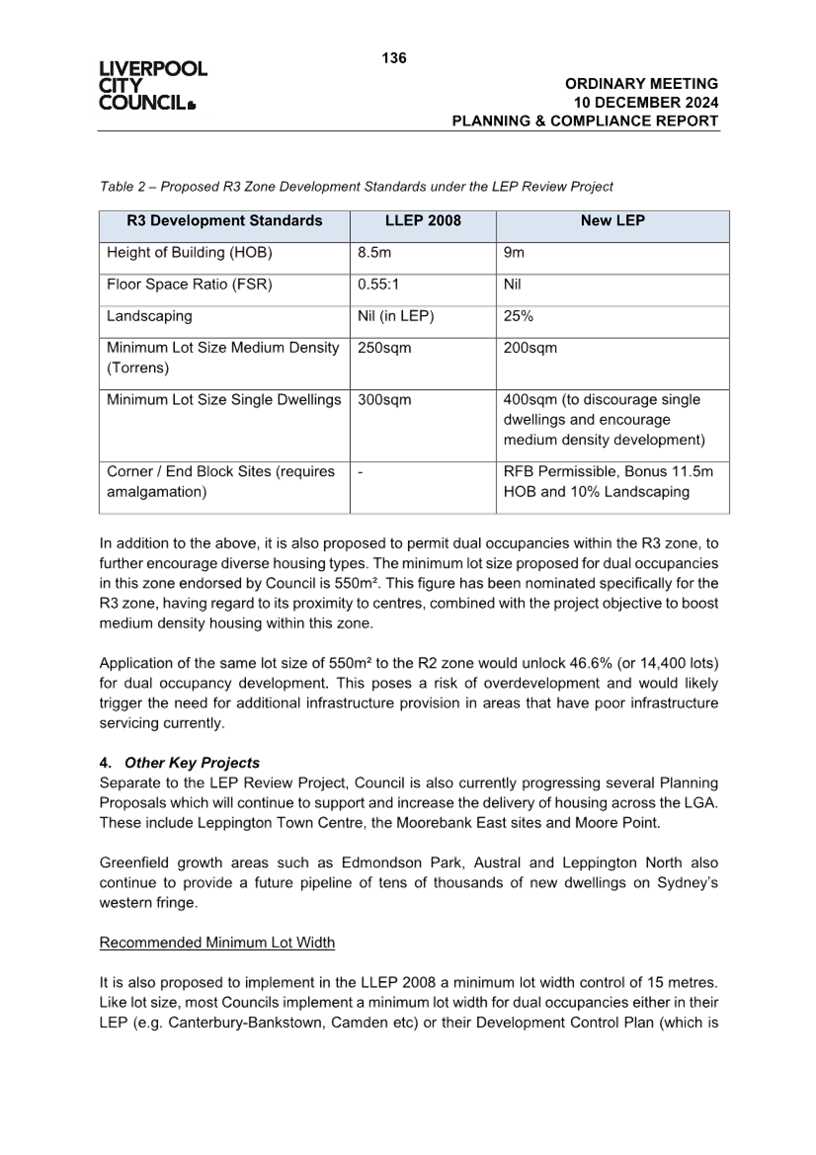
A key focus of this Project is to encourage the
delivery of medium density housing in appropriate locations, including the R3
Medium Density Residential zone. This is because this zone is widespread in its application and is land
located within 800 metres of a centre. Consequently, it is considered the most suitable location for more
density and significant changes have been proposed to the planning controls in
this zone, as summarised in Table 2 below.
Table 2 – Proposed R3 Zone Development Standards under the LEP
Review Project
|
R3 Development Standards
|
LLEP 2008
|
New LEP
|
|
Height of Building (HOB)
|
8.5m
|
9m
|
|
Floor Space Ratio (FSR)
|
0.55:1
|
Nil
|
|
Landscaping
|
Nil (in LEP)
|
25%
|
|
Minimum Lot Size Medium Density (Torrens)
|
250sqm
|
200sqm
|
|
Minimum Lot Size Single Dwellings
|
300sqm
|
400sqm (to discourage single dwellings and encourage
medium density development)
|
|
Corner / End Block Sites (requires amalgamation)
|
-
|
RFB Permissible, Bonus 11.5m HOB and 10% Landscaping
|
Recommendation
It is recommended that Council proceed with a minimum
lot width of 15m, which aligns with the most commonly used lot width in the
Codes SEPP for dual occupancies. This will ensure general consistency between applications approved by Council and
private certifiers. In addition to this, a minimum lot width of 15m is more
likely to be implemented by the DPHI than a larger lot width, given the policy direction of the Housing Reforms.
There
are no financial implications relating to this recommendation.
|
Economic
|
Enhance
the environmental performance of buildings and homes.
Facilitate
economic development.
|
|
Environment
|
Enhance
the environmental performance of buildings and homes.
|
Social
|
Preserve
and maintain heritage, both landscape and cultural as urban development takes
place.
Regulate
for a mix of housing types that responds to different population groups such
as young families and older people.
|
Civic Leadership
|
There are no civic leadership and governance considerations.
|
|
Legislative
|
Part 12 of State Environmental Planning Policy (Housing) 2021
|
|
Risk
|
The risk is deemed to be Low.
If Council does not endorse a minimum lot width/s at
this stage, it may not be able to be included within DPHI’s amendment
to the LLEP 2008 (subject to their assessment).
|
1. Council
Report - 10 December 2024
2. Minutes
of Council Meeting - 10 December 2024
|
1
|
|
ITEM
01
|
Inclusion
of a Minimum Lot Width for Dual Occupancies in the Liverpool Local
Environmental Plan 2008
|
|
Attachment
1
|
Council
Report - 10 December 2024
|
|
1
|
|
ITEM
01
|
Inclusion
of a Minimum Lot Width for Dual Occupancies in the Liverpool Local
Environmental Plan 2008
|
|
Attachment
2
|
Minutes
of Council Meeting - 10 December 2024
|
Governance Committee Meeting
18 February 2025
Infrastructure and Planning Committee Report
|
ITEM 02
|
School Access and Safety
|
|
Strategic
Objective
|
Healthy,
Inclusive, Engaging
Support
active and healthy lifestyles by improving footpaths, cycleways and walkways
and other infrastructure that promotes and supports active transport
|
|
File Ref
|
403616.2024
|
|
Report By
|
Daniel Riley
- Manager Development Engineering
|
|
Approved
By
|
Lina Kakish
- Director Planning & Compliance
|
The
purpose of this report is to respond to the 14 December 2022 Council notice of
motion on parking arrangements around schools in the LGA, resolved as follows:
1. A further report be presented to a future Council meeting containing professional
advice on how on-street parking concerns during drop off and pick up times
around schools in the LGA are being addressed by Council staff including the
possibility of a rostered ranger compliance check for parking issues at all
schools within the LGA during drop off and pick up times starting with reported
problem schools;
2. Hold a number of individual consultation meetings with
the community and all schools within the Liverpool LGA where there are reported
traffic problems regarding the drop off and pick up of students to investigate
ways of addressing issues on our public roads; and
3. Write to the NSW Department of Planning the
State Minister for Education, and Transport NSW, after the 2023 State Election,
urging co-operation and collaboration to deliver possible changes through
Planning instruments and Legislation in order to provide safer access to school
drop off and pick up zones that are contained inside the school property
boundaries and not on public roads and or public footpaths.
That the Governance Committee
note the issues and
activities by Council around schools in the LGA to maintain safe and efficient
traffic movements, encourage safe driver behaviour, encourage parking turning
over and minimise illegal parking, and what we are working toward for better
school site planning, transport services to schools and travel behaviour change
incentives.
Context
The Liverpool LGA currently has 75 public
and private primary and secondary schools. The Department of Education through
School Infrastructure NSW (SINSW), manages construction of public schools on
behalf of the State Government. Private schools are constructed by various
religious and non-denominational organisations.
Issues
Safety
Drop-off and pick-up at schools causes
safety issues for everyone. The issues are driven by a range of factors
including, but not limited to road design, traffic volume, access points to
schools, driver behaviour, pedestrian behaviour, time management and changing
student populations. Influencing these factors is not always within the control
of Council and making significant improvement in behavioural change takes time
and requires consistent and coordinated effort between Council and State
Government.
Congestion
A high percentage of students are driven to
and from school resulting in congested streets around the school, particularly
in the afternoon when drivers converge at the same time (in the morning drop
off tends to be more staggered).
Limited on-site parking
Most of the existing schools in the LGA
have limited on-site parking, even for staff, and rely on kerbside parking
along neighbourhood streets near schools. For new school developments, SINSW
has adopted an approach of providing limited on-site parking to discourage
driving and minimise safety risks within school grounds.
Illegal parking
People often ignore the parking
restrictions and choose to park illegally resulting in greater safety risks and
worsening congestion.
Lack of options
Most new school developments in the LGA
have set public transport mode share targets of 50% or higher in their
operational green travel plans. However, these ambitious vehicle trip reduction
targets are not supported by the necessary services and incentives to encourage
behaviour change. People drive students to school partly for lack of public
transport options and lack of safe routes to walk and ride to school.
Activities by Council
On-street parking management
Council installs timed No Parking restrictions to
facilitate efficient pick-up and drop-off around the schools. Council is not responsible for providing parking
to schools. Our role is to manage the availability of on-street spaces and work
with the schools to ensure efficient use.
Rostered patrols
Council’s Compliance Team conducts rostered patrols across all
schools in the LGA to encourage safe
driver behaviour and minimise illegal parking. While it is not possible to have a presence at every
school every day, the team strives to ensure a regular presence to encourage
safe driving behaviour and remind drivers that existing traffic regulatory
signs and line marking are enforced regularly.
Observations in school zones indicate that
when everyone follows the rules the system works well. Feedback from the
community is that when Rangers or Police are in attendance both the traffic
flow and driver behaviour improve. This means that the existing road
environment is not always the problem, and driver compliance affects its
operational efficiency and safety.
Crossings and Traffic calming treatments
Council installs pedestrian
facilities and traffic calming devices, where appropriate, to improve safety.
These treatments may include:
· pedestrian priority crossing on a raised threshold to
slow vehicle speed
· a children’s crossing only active during school
hours
· median refuge to enable pedestrians to cross one
direction of traffic and wait in the middle of the road to cross the other
direction of traffic
· road linemarking
School Road Safety Education
Council’s Road Safety Officer is responsible for
the strategic development of a local road safety program with key stakeholders
in the community. The road safety program identifies local road safety issues
and risks to vulnerable people and develops and implements road safety
behavioural programs that integrate a combination of education, engineering and enforcement to address the issues and
support vulnerable people.
Our Road Safety Officer works directly with school
communities to encourage safe behaviour. They meet with
school principals, school communities and residents to discuss and address
safety and school access issues including on-street drop-off and pick-up, as
well as parking.
Recent initiatives include:
· Shared responsibility campaign - The initiative
included distribution of letters and corflute signs with road safety and no
parking messages, and follow-up emails reminding schools to display the
corflutes, and digital images to promote road safety around to all schools
within the LGA.
· No Stopping campaign - Every school with an
appropriate No Stopping zone received several corflutes to place along their
school fence next to the No Stopping zone. These corflutes explain the rule for
No Stopping and the associated safety hazard for non-compliance.
· Digital Road Safety Education materials –
Council regularly supplies every school in the LGA with a suite of digital road
safety educational materials. The schools can use these across all of their
social media platforms, newsletters and emails to their school community. These
online materials also complement the messages on the corflutes from other
programs. The distribution of this educational material is also complemented by
the regular roster of visits by Council’s Rangers to School to support in
the promoting of road safety and enforce as required.
NSW Police support
The Liverpool Local Traffic Committee
supports implementing solutions to maintain safe traffic conditions around
schools in the LGA. This includes raising issues with NSW Police regarding road
safety around schools. The NSW police support all our school programs and
provide support and enforcement when resourcing allows.
Advocacy
We wrote to the NSW Department of Planning, the State
Minister for Education, and Transport NSW urging co-operation and collaboration
to deliver possible changes through Planning instruments and Legislation to
provide safer access to school drop off and pick up zones that are contained
inside the school property boundaries and not on public roads and or public
footpaths. We are waiting for
responses.
What Council is working toward
Council continues to work to influence better outcomes at
schools.
Improvements at existing schools
We are working to improve and increase communication
and support from within schools regarding road safety (i.e. Department of Education, Catholic Education Office, Australian Independent
Schools Association). This includes advocating for:
· Review of access points for schools, i.e. can more be
provided to redistribute the students on arrival and departure
· Increased provision when student numbers increase,
i.e. staff parking, additional crossings and/or
upgrade
· Staggered arrival and departure times for schools with
large student populations. An example of this working was during covid with
students were released at staggered times
· Ensuring arrival and departure times are different for
schools near each other
· System to manage senior students who drive to school
Enforcement
More collaboration is needed between Council and NSW Police to ensure adequate resources
are provided for consistent and increased patrols at schools. We advocate for
TfNSW to provide traffic management in addition to school crossing supervisors
for locations that experience elevated levels of congestion, including high
schools. The management of traffic at some crossing locations would improve
safety in these areas.
New school planning and development
As new schools are now larger developments
they are often put through as State Significant Development (SSD). This means
Council is only commenting on the development and its effect on the surrounding
area.
However, School Infrastructure NSW convenes a monthly Transport Working Group with
Council, Transport for NSW and area bus operators to discuss school projects in
advance of student demand and to meet student travel demand safely, efficiently
and sustainably.
We use this forum to advocate for more
onsite parking at schools to better accommodate school staff, onsite provisions
for students with additional mobility access needs
(disabled parking) and better street design adjacent to
schools. For example, Council raised issues with NSW School Infrastructure in
the development of the new Edmondson High School resulting in the agency
agreeing to widen the surrounding streets to provide additional
on-street parking in-lieu of parking on-site.
School bus service
We advocate for school bus service
expansion prior to the start of a new school or increase of student numbers,
including proper provision and priority for bus zones.
The current School Student Transport Scheme
(SSTS) prevents most students who attend their local school from qualifying for
free public transport services to school. However, students living within
walking distance often are forced to cross unsafe large high-speed roads.
Allowing more students to travel by bus would significantly decrease the number
of single vehicle trips made to and from schools.
Kiss and drop
Kiss and drop zones are not always the
solution. Existing kiss and drop provisions, both on-street and on-site, create
queueing. In the AM peaks they work well as the drop off to school is always
more staggered. In the PM peaks we see vehicles arriving too early for the
expected use of these areas. Replacing them in PM peak with unrestricted
parking may prevent misuse.
We advocate for greater consideration to
how many vehicles can be accommodated, how to reduce the queueing on local
roads and traffic management support to properly monitor and improve school
access and circulation.
Encourage other ways to travel to school
School Green Travel Plans have commendable
mode shift targets, but greater State investment in transport services,
infrastructure and incentives is needed to enable and encourage other ways of
travel to school. Schools are best placed to analyse school travel data and
communicate with the students and carers using existing communication channels.
Better coordination is needed between TfNSW
and NSW Schools to ensure safe routes to walk and cycle to school and encourage
greater use of public transport.
There
are no financial implications relating to this recommendation.
|
Economic
|
Deliver and maintain a range of transport related infrastructure such
as footpaths, bus shelters and bikeways.
Deliver a high quality local road system including provision and
maintenance of infrastructure and management of traffic issues.
|
|
Environment
|
Promote an integrated and user friendly public transport service.
Support the delivery of a range of transport options.
|
Social
|
There are no social and cultural considerations.
|
Civic
Leadership
|
There are no civic leadership and governance
considerations.
|
|
Legislative
|
Roads Act 1993.
|
|
Risk
|
There is no risk associated with this
report.
|
Nil
Governance
Committee Meeting
18 February 2025
|
ITEM 03
|
Budget FY 2025/26 Information: Council
Activity Report
|
|
Strategic
Objective
|
Visionary,
Leading, Responsible
Ensure
Council is accountable and financially sustainable through the strategic management
of assets and resources
|
|
File Ref
|
043108.2025
|
|
Report By
|
Vishwa Nadan
- Chief Financial Officer
|
|
Approved
By
|
Farooq
Portelli - Director Corporate Support
|
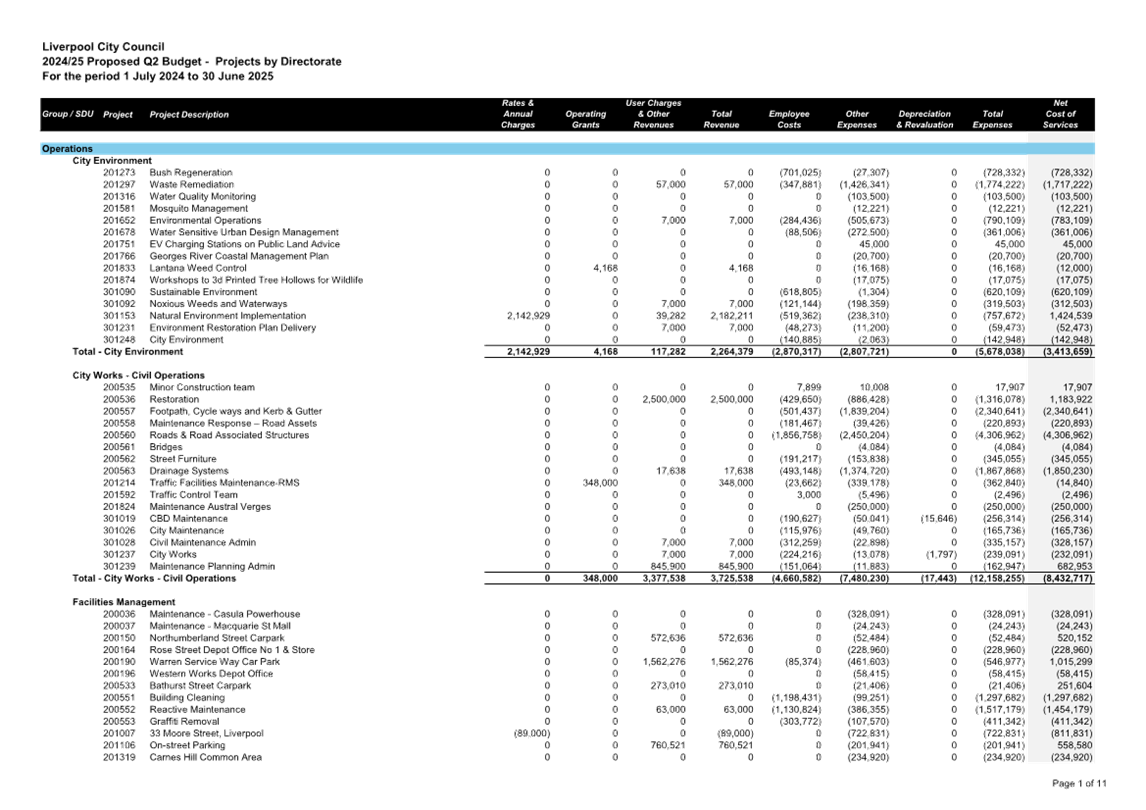
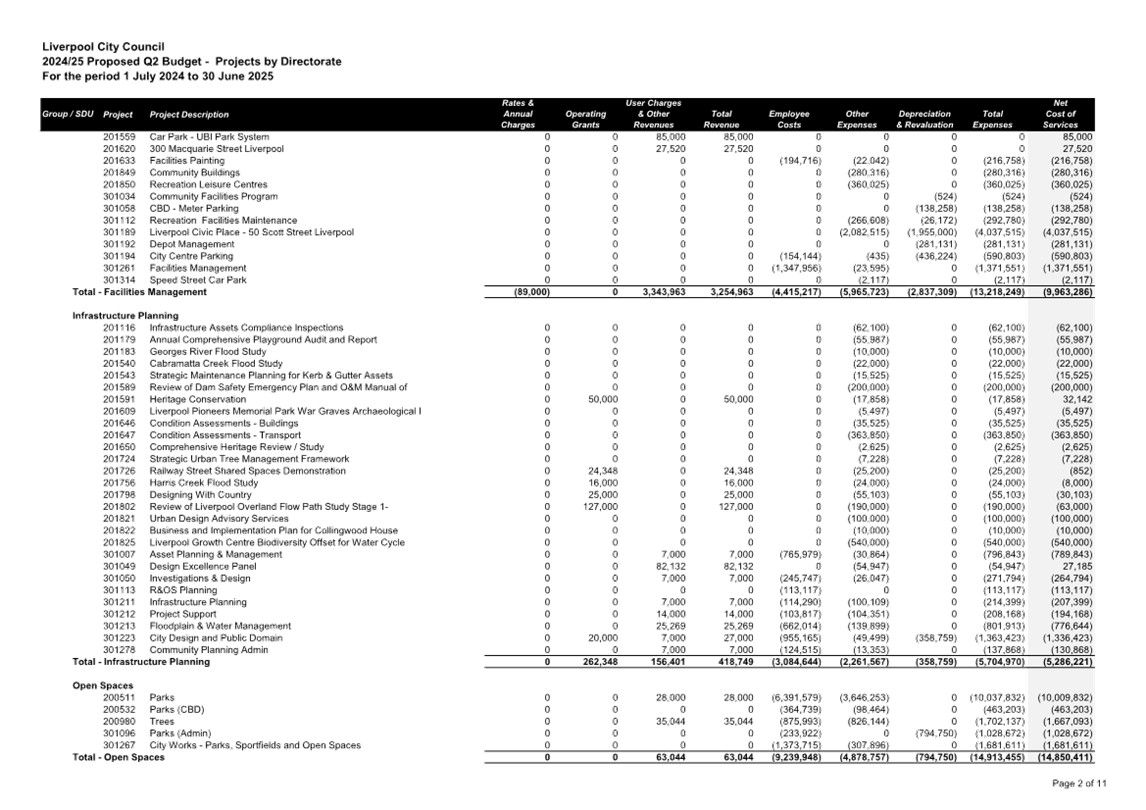
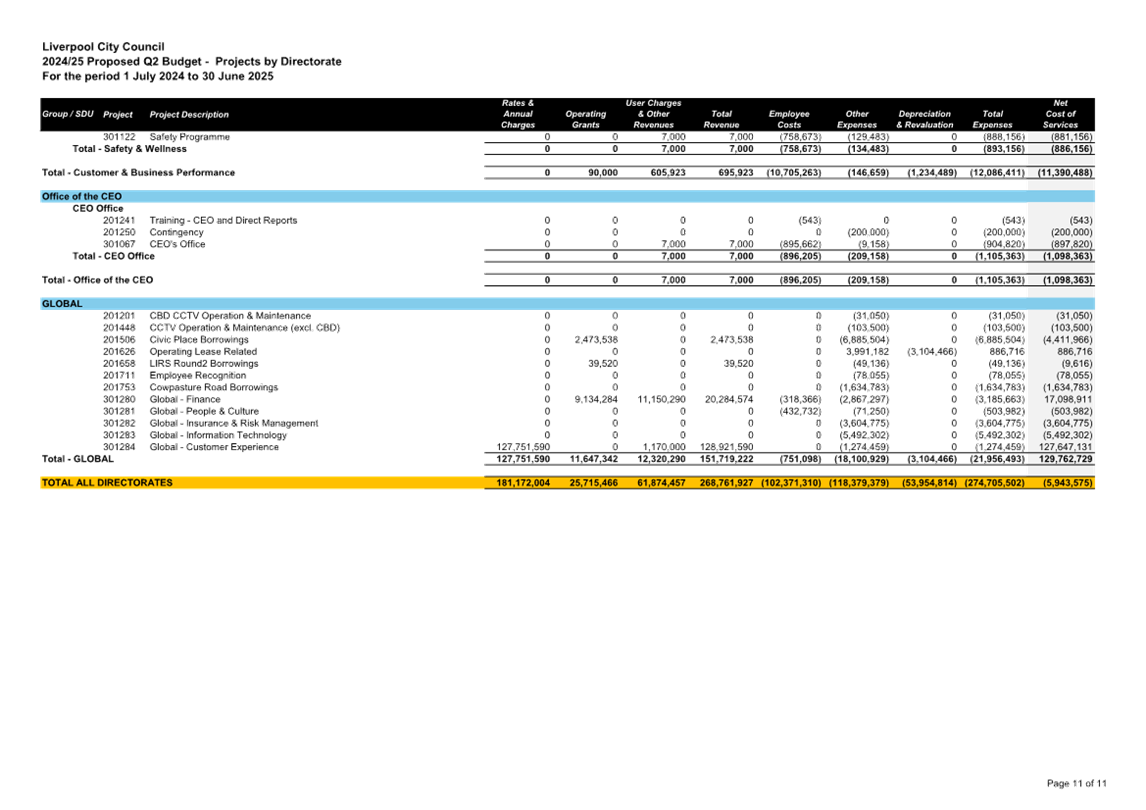
This
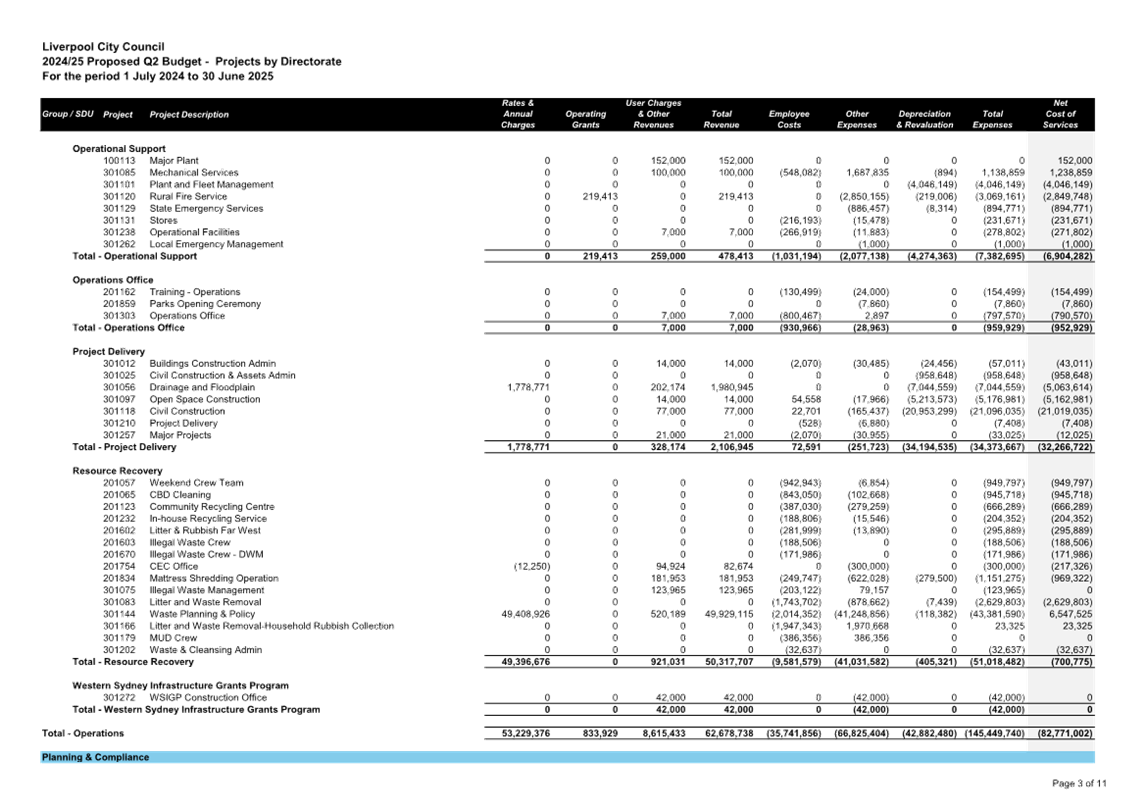
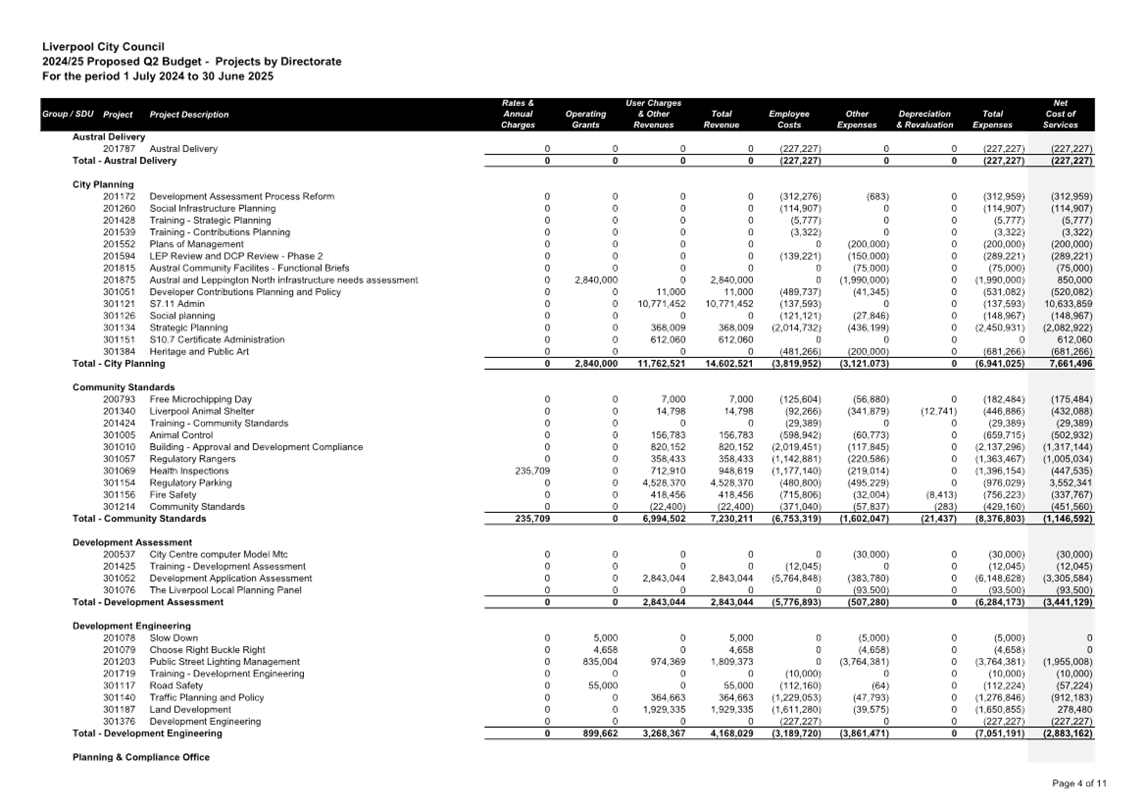
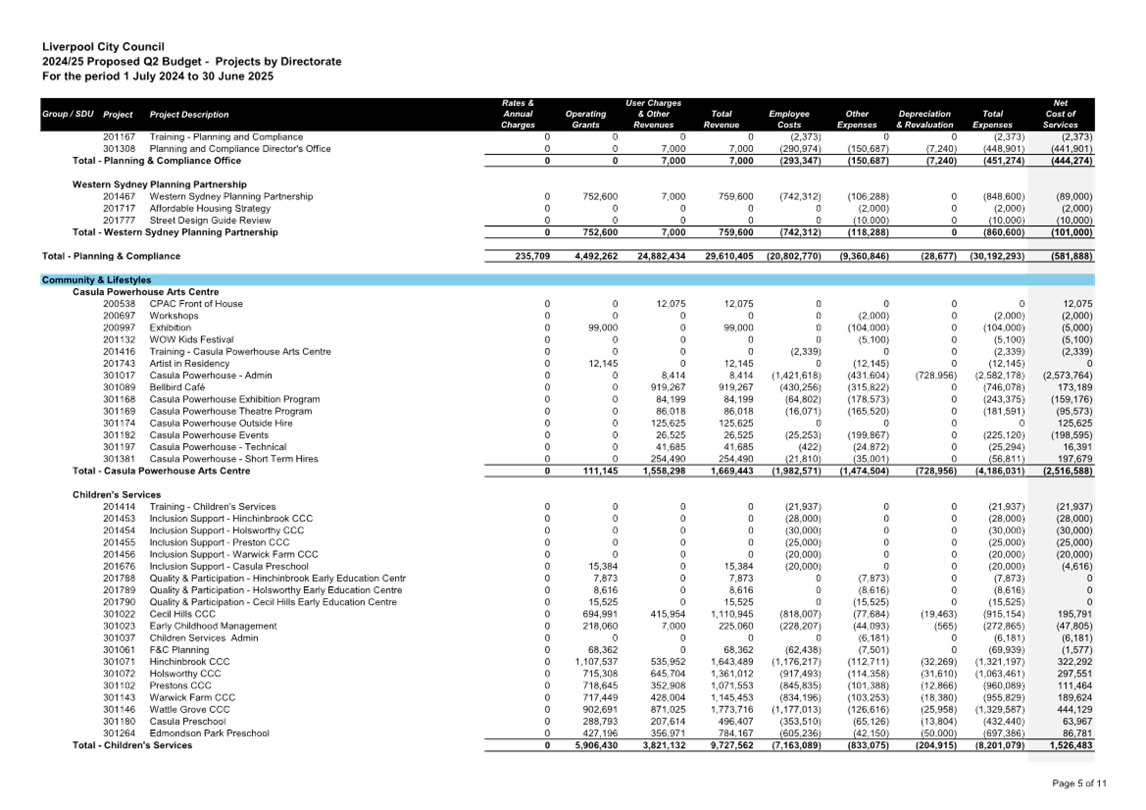
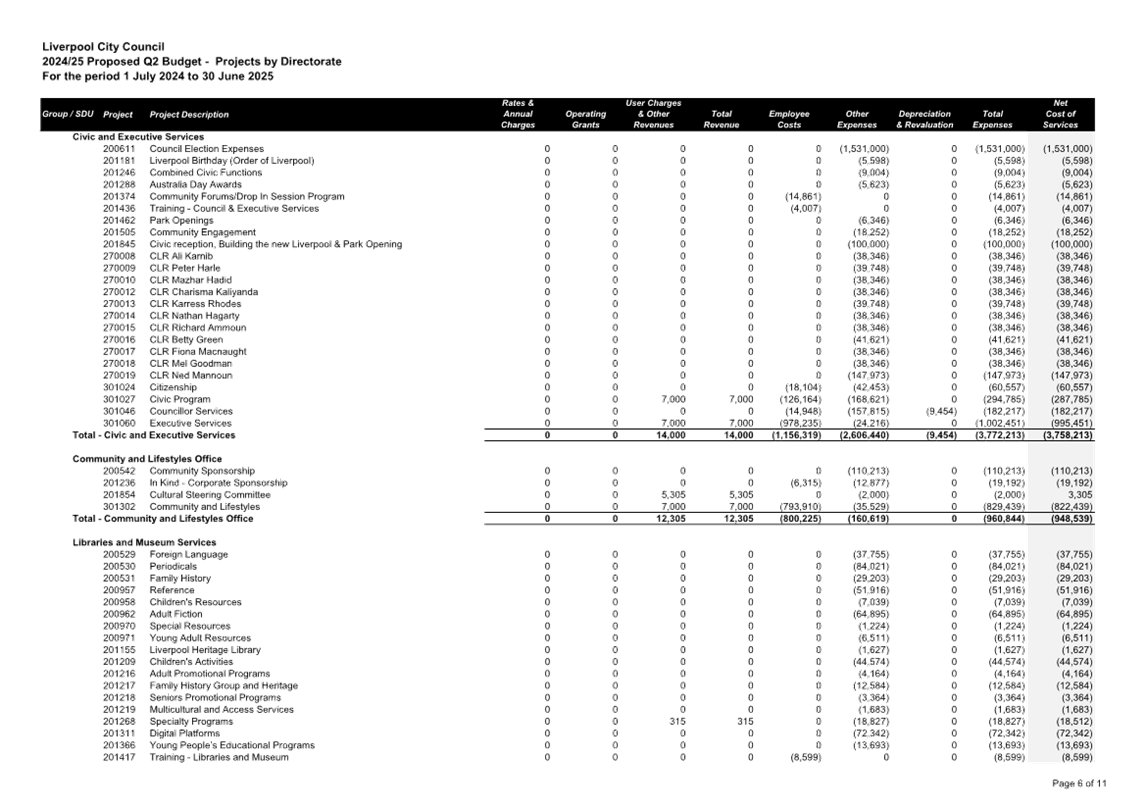
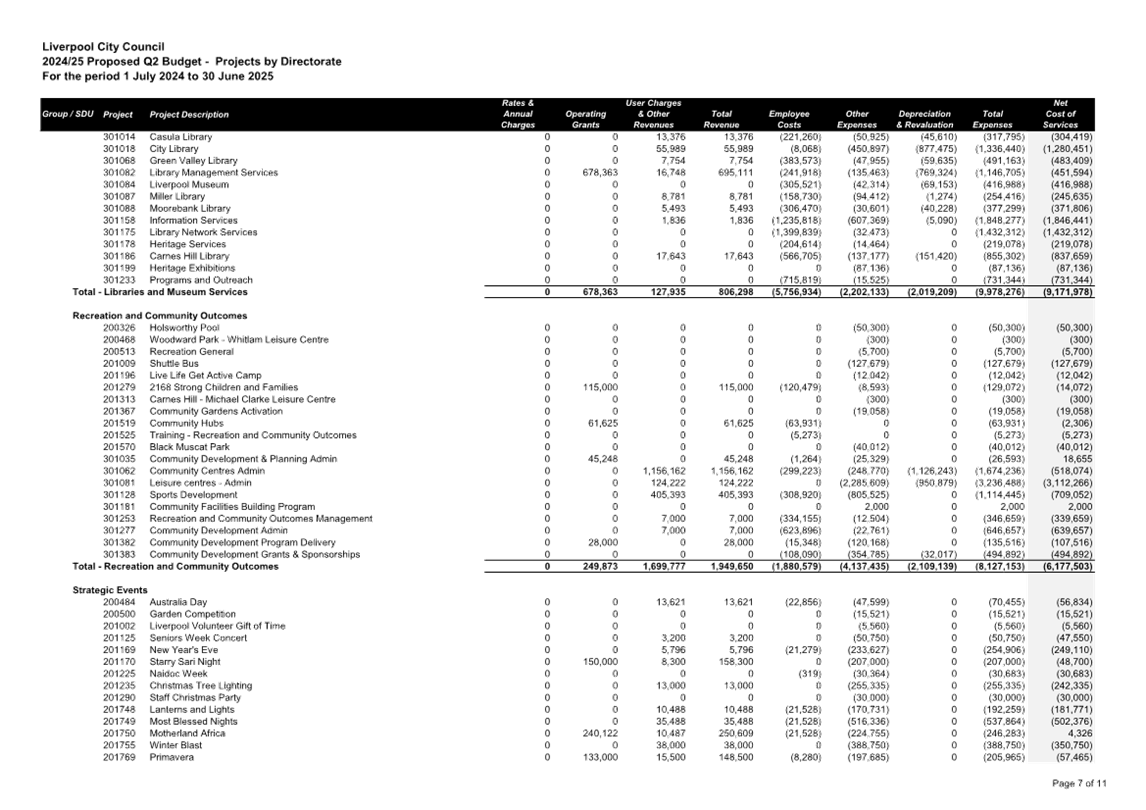
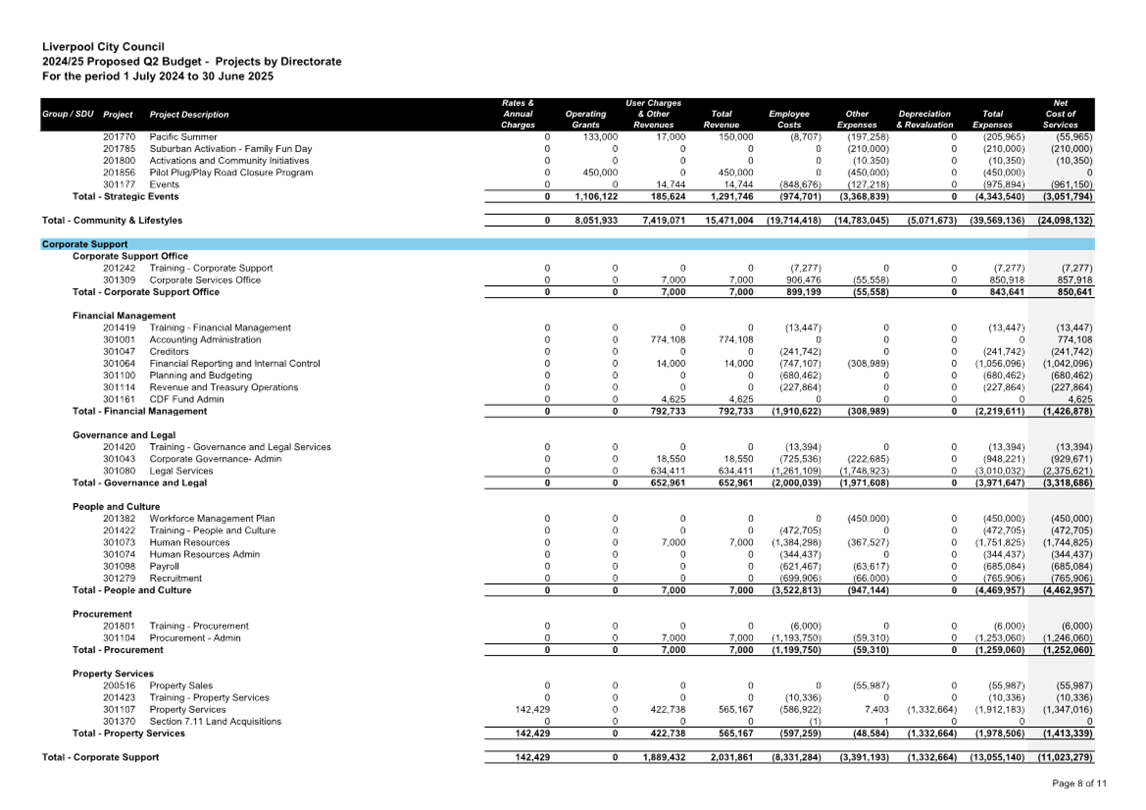
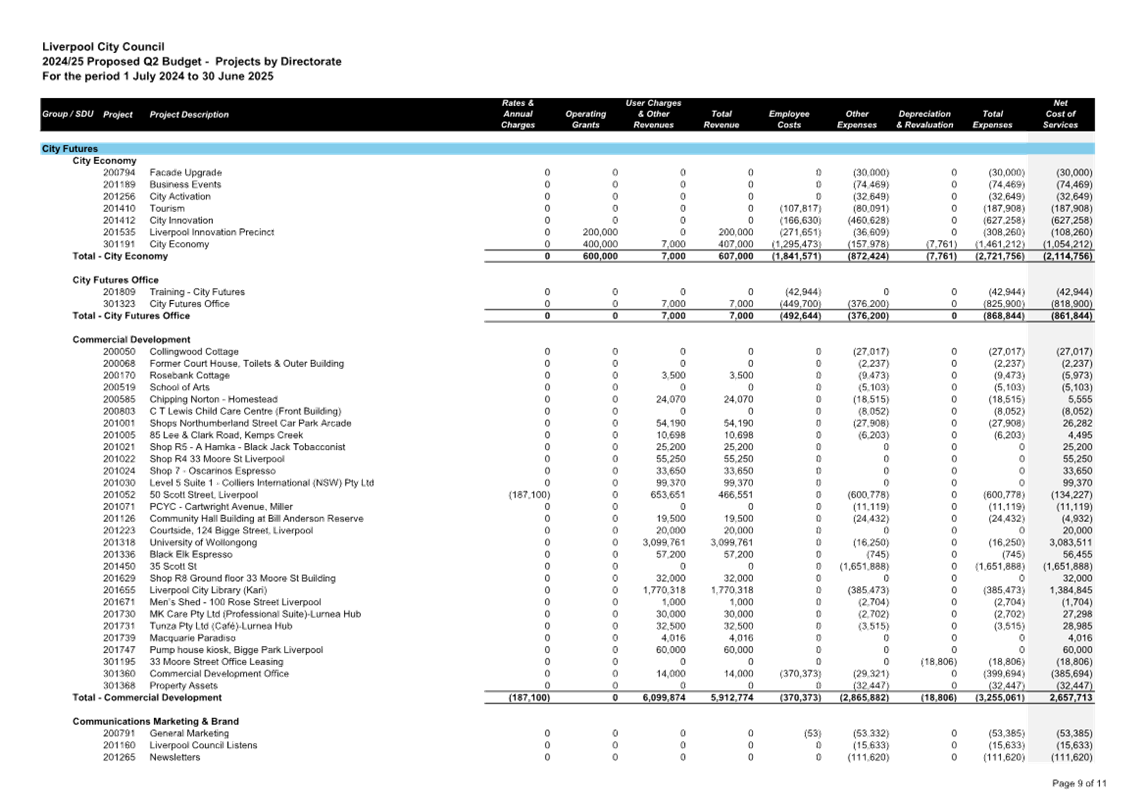
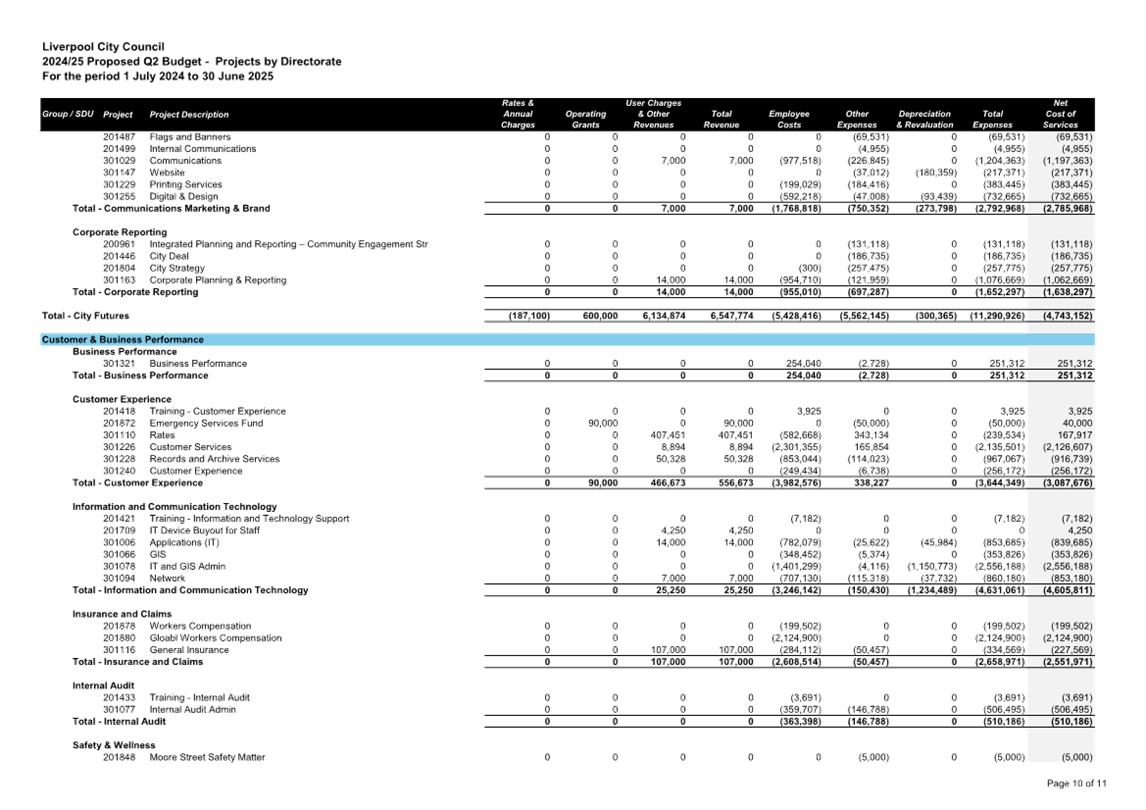
report provides list of Council activities/ projects under each Directorate.
The
income and expenditure included in the report is based on 2024/25 December (Q2)
revised budget and provided as an indication of how Councils financial
resources are allocated.
That the Governance
Committee:
1. Receives and notes the report.
2. Considers for the purpose of identifying priority
allocation, where investment in activities/projects should be considered in
preparing the 2025/26 budget and Long Term Financial Plan (LTFP).
Councillors need information on council investment in
its various activities and projects to help them better understand the
operations of Council, the impact on the budget and to make informed decisions
regarding allocation of financial resources.
The attached report provides Council activities/
projects under each directorate. The income and expenditure included in the
report is based on 2024/25 December (Q2) revised budget and provided as an indication of how Councils
financial resources are allocated.
The
allocations for 2025/26 and future years should be in line with Council’s
planning and strategic documents including the Strategic plan, Delivery plan
and various resource plans.
In preparation for 2025/26 budget and Long-term
financial plan, Councillors will be separately provided base assumptions that
will be that used to populate projected income and expenditure.
Similar reports, amended by decisions of Council, will
be provided to Councillors using draft 2025/26 budget income and expenditure in
future budget meetings/ workshops.
1. Council
Activity Report
|
1
|
|
ITEM
03
|
Budget
FY 2025/26 Information: Council Activity Report
|
|
Attachment
1
|
Council
Activity Report
|
Governance
Committee Meeting
18 February 2025
Strategic Priorities Committee Report
|
ITEM 04
|
Grants Donations and Sponsorship
Program
|
|
Strategic
Objective
|
Healthy, Inclusive,
Engaging
Promote a
harmonious community that celebrates its diversity
|
|
File Ref
|
035210.2025
|
|
Report By
|
Javeria Hoda
- Acting Coordinator Community Development
|
|
Approved
By
|
Tina Bono -
Director Community & Lifestyle
|
Council is committed to building strong and resilient
communities in the Liverpool Local Government Area (LGA) and maximising social
wellbeing. Council’s
Grants Donations and Community Sponsorship program helps achieve these goals by
providing financial support to local community groups and not for profit
organisations to develop leadership
skills, increase participation in community activities and address identified
social issues with financial
contributions to deliver projects that benefit residents, build, or enhance the
reputation of Liverpool City Council and support delivery of local priorities
as outlined in Council’s Community Strategic Plan.
This
report recommends the changes to the Grants Donations and Sponsorship Program
and the Policy to include an assessment on financial capacity as a key
component of the assessment criteria. It is proposed that organisations
with the financial capacity to fund proposed events, based on an assessment of
annual turnover, operating surpluses and net asset value, would be ineligible
for funding under the policy changes.
That Council:
1. Notes the Grants Donations and Community
Sponsorship Program, Policy, and the Grant management process;
2. Provides feedback on the inclusion of
additional eligibility criteria in an amendment to the Community Grants,
Donations and Sponsorship Policy :
- Applicants must have an annual financial
turnover of less than $3,000,000 as indicated in the previous years audited
financial statements; and
- Applicants must an annual operating surplus
no greater than $150,000 as indicated in the previous years audited financial
statements.
Background
Council’s Community Grants programs
provide a coordinated and integrated approach to growing Liverpool socially,
culturally, economically, and environmentally.
The purpose of the program is to provide
financial support to local community organisations and other entities seeking
to deliver important community services, programs and activities to the
Liverpool Community. The program has been successful in targeting the
delivery of these programs by small locally based groups supporting vulnerable
community groups and persons access programs and deliver activities not offered
by the Council or corporate markets.
In 2023/24, Council’s community
grants program provided financial support through 82 approved applications,
delivering $460,834 in financial support towards community program, events and
activities. Council estimates that 80,000 residents have benefited
through Council’s community grants program.
In 2024/25 Council Officers indicated that,
given the significant growth in popularity of the program, that the budgeted
spend of $477,000 will be exhausted by March 2025.
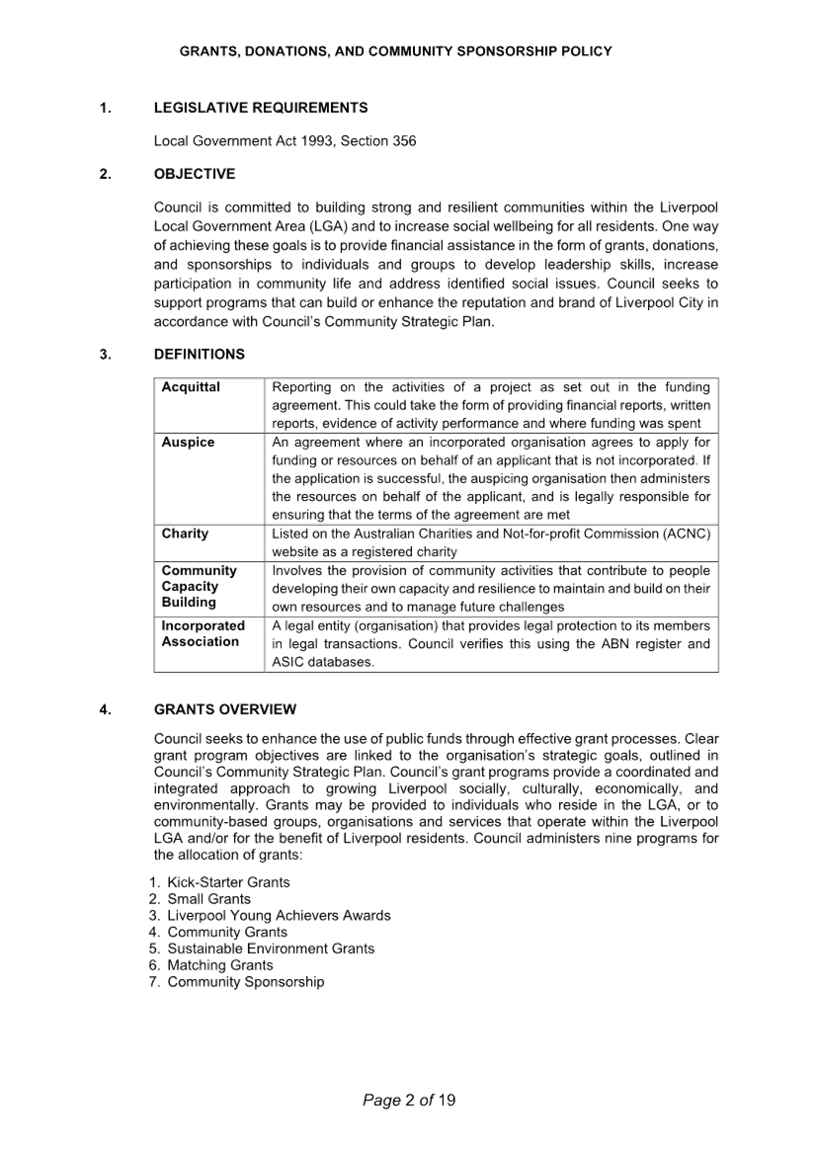
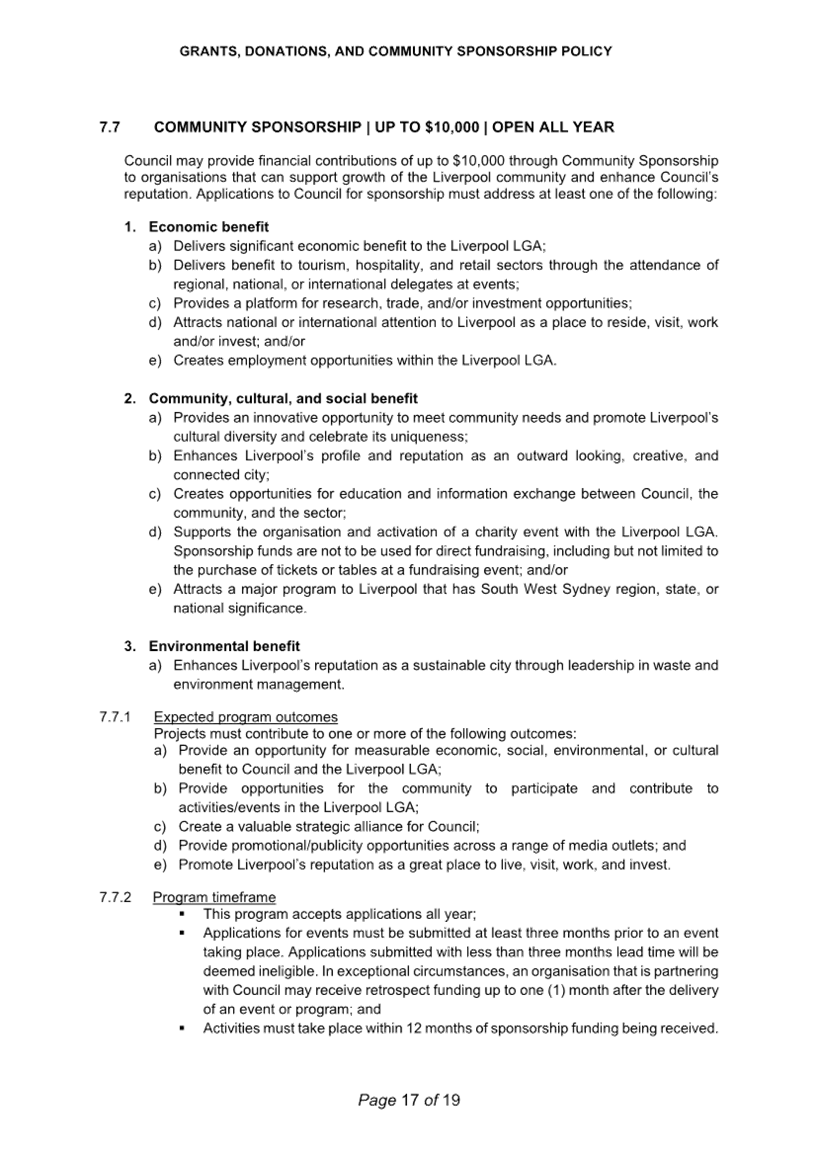
Current Eligibility Criteria
Council’s Grants, Donations and
Community Sponsorship Policy (the Policy) provides the framework for the
implementation and management of the grants program. The Policy defies
eligibility criteria that includes:
· Applicants must incorporated or auspice by
an incorporated organisation;
· Applicants must be a non-profit community
service organisation or group located in the LGA and/or principally providing
services to the residents of Liverpool;
· Applicants must supply a copy of their most
recent financial statements and public liability documents; and
· Applicants must have acquitted all previous
Council grants and have no outstanding debts to Council.
In its current form, the eligibility
criteria contained within the Policy only considers financial capability of the
applicant to the extent that it acts to demonstrate the applicant’s
financial capacity to delivery on the project or activity.
At the 10 December 2024 Council meeting,
Council resolved:
“That the Grants Donations and
Community Sponsorship Policy come to a Governance Committee meeting for review
and discussion in 2025.”
Proposed Eligibility Criteria
Consistent with this resolution, Council
Officers have reviewed the Policy and included additional eligibility criteria
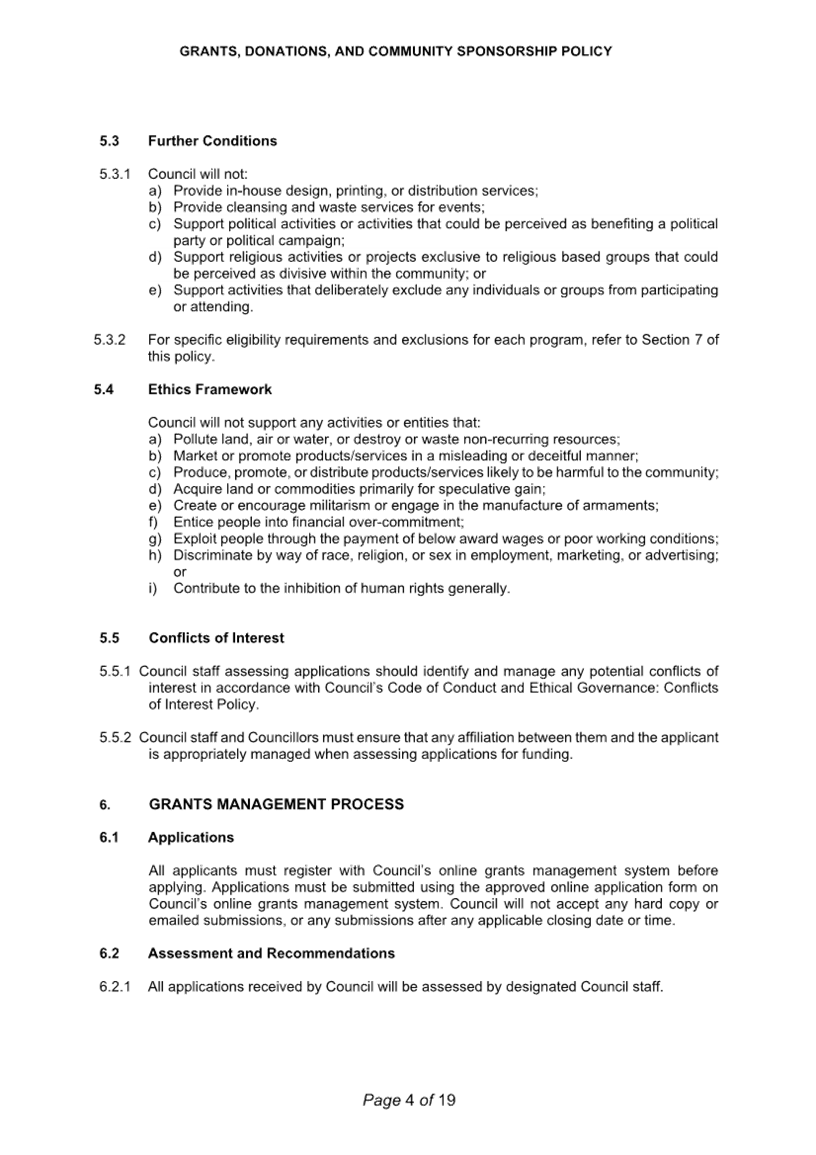
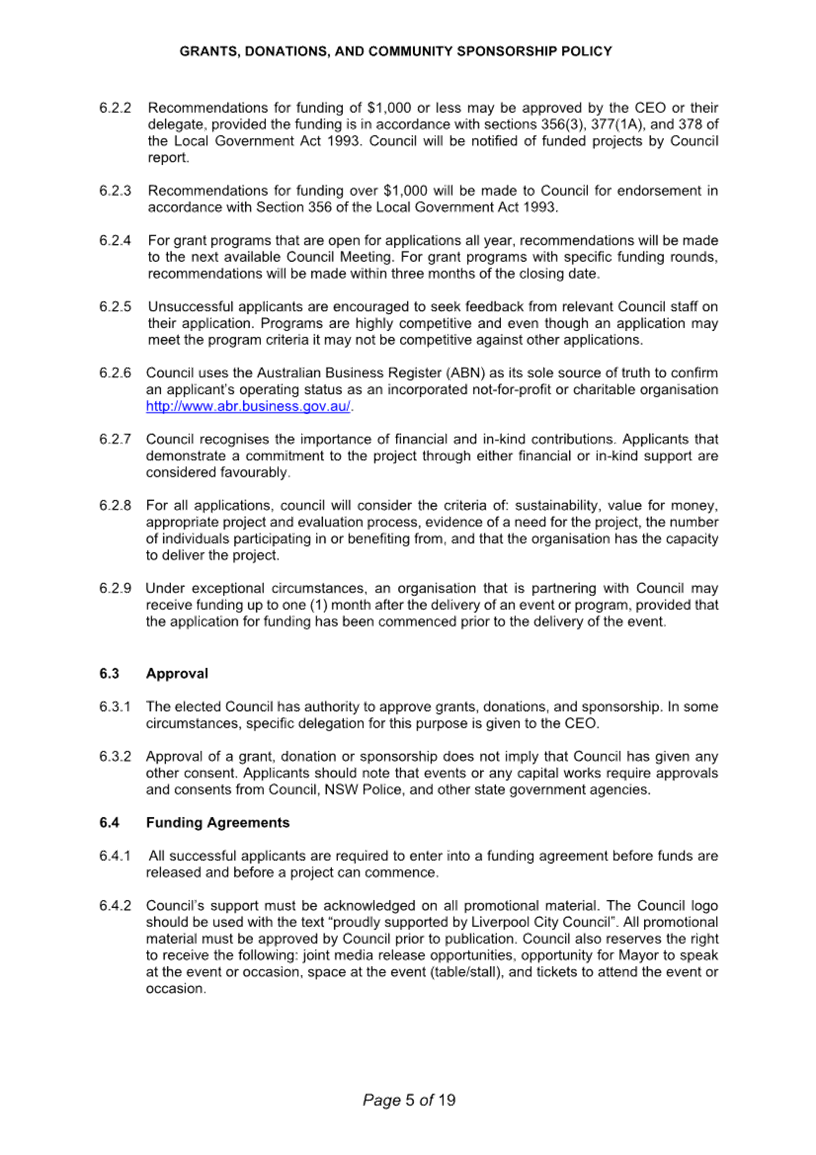
to the Policy that considers an applicant’s financial
capacity. The inclusion of this criteria is intended to ensure that
beneficiaries of financial support through its Community Grants program is
limited to organisations that have limited financial capacity. An
organisation that has high financial turnover, profitability or net Aset value
are exempt from financial support through Councils Grants program.
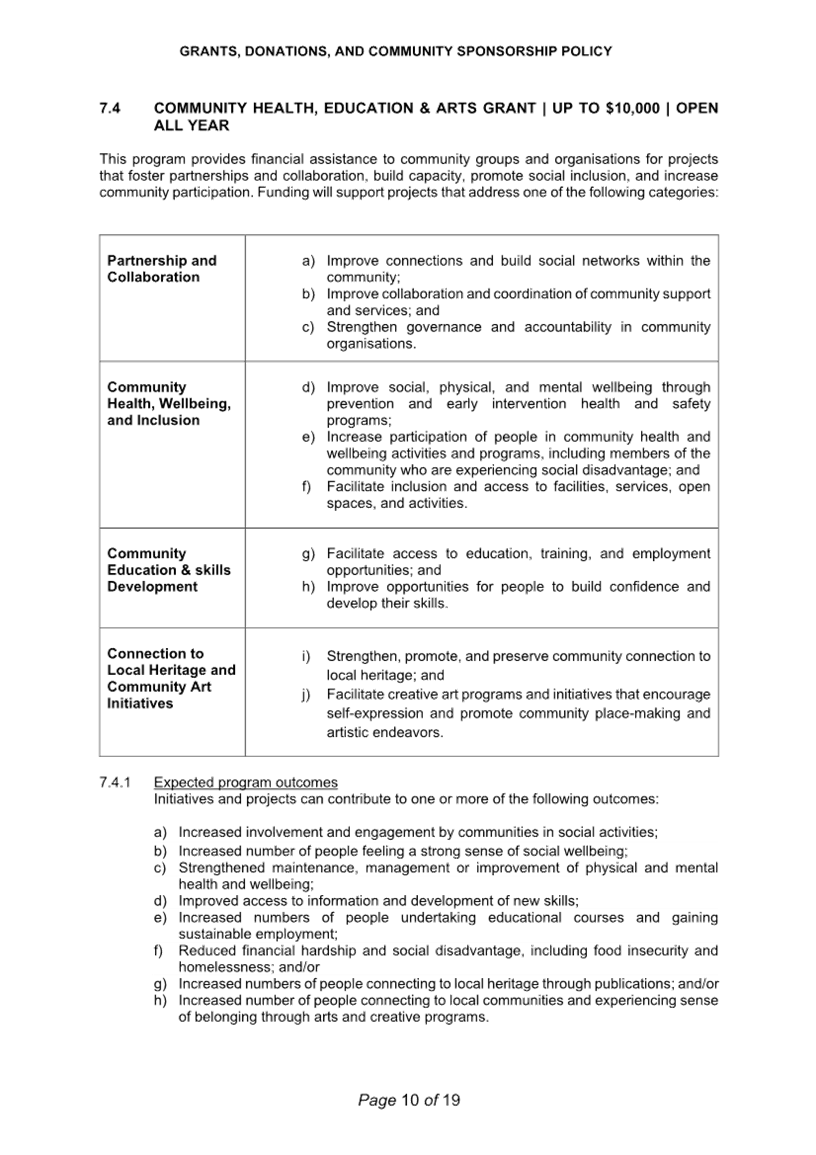
It is proposed that Council’s Grants
Donations and Community Sponsorship Policy be amended to include the following
eligibility criteria:
Organisations
must:
a) Be an organisation that is based in Liverpool and/or
providing services activities and/or programs within the local government area;
b) Incorporated and not-for-profit or under auspice of an
incorporated organisation and not for profit organisation;
c) A non-funded community group or a registered charity
providing services, including programs, activities, or outcomes to marginalised
or vulnerable members of the community;
d) Not afforded any other Council subsidies, by way of
Grants, Donations or other financial support for the use of community or
sporting facilities to deliver the defined programs;
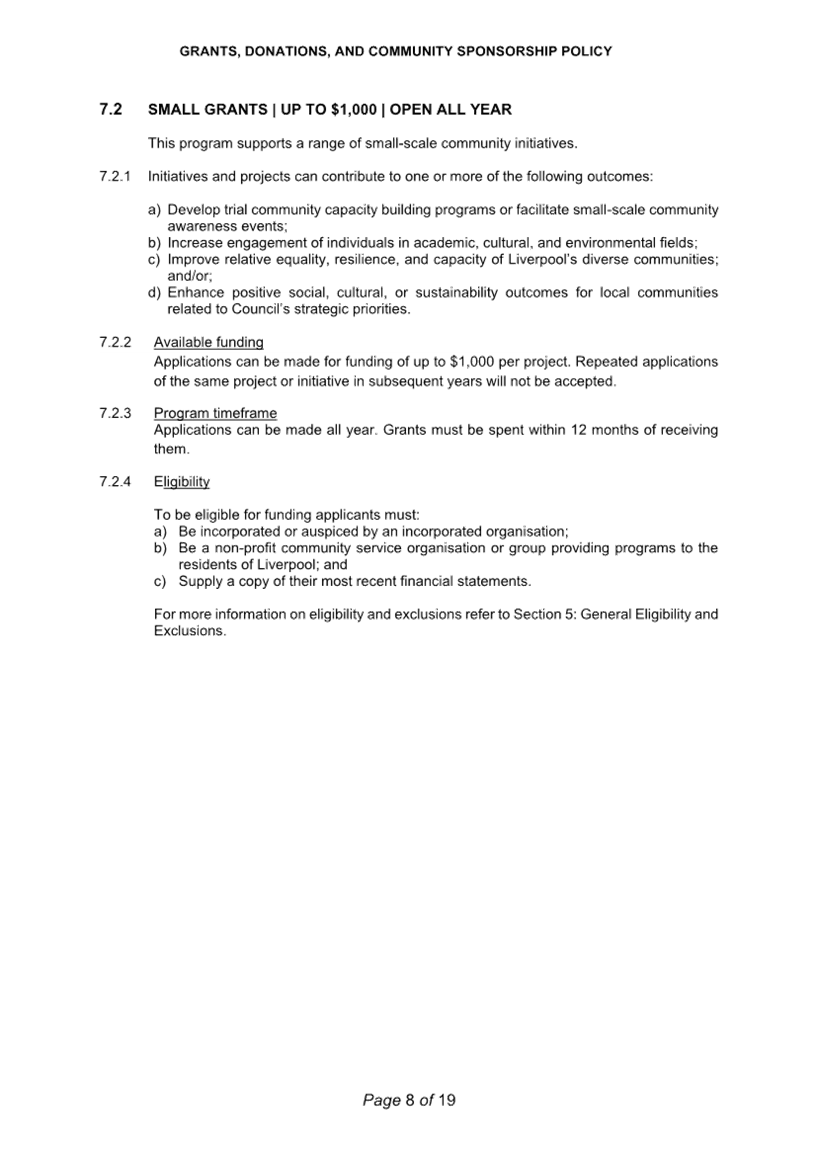
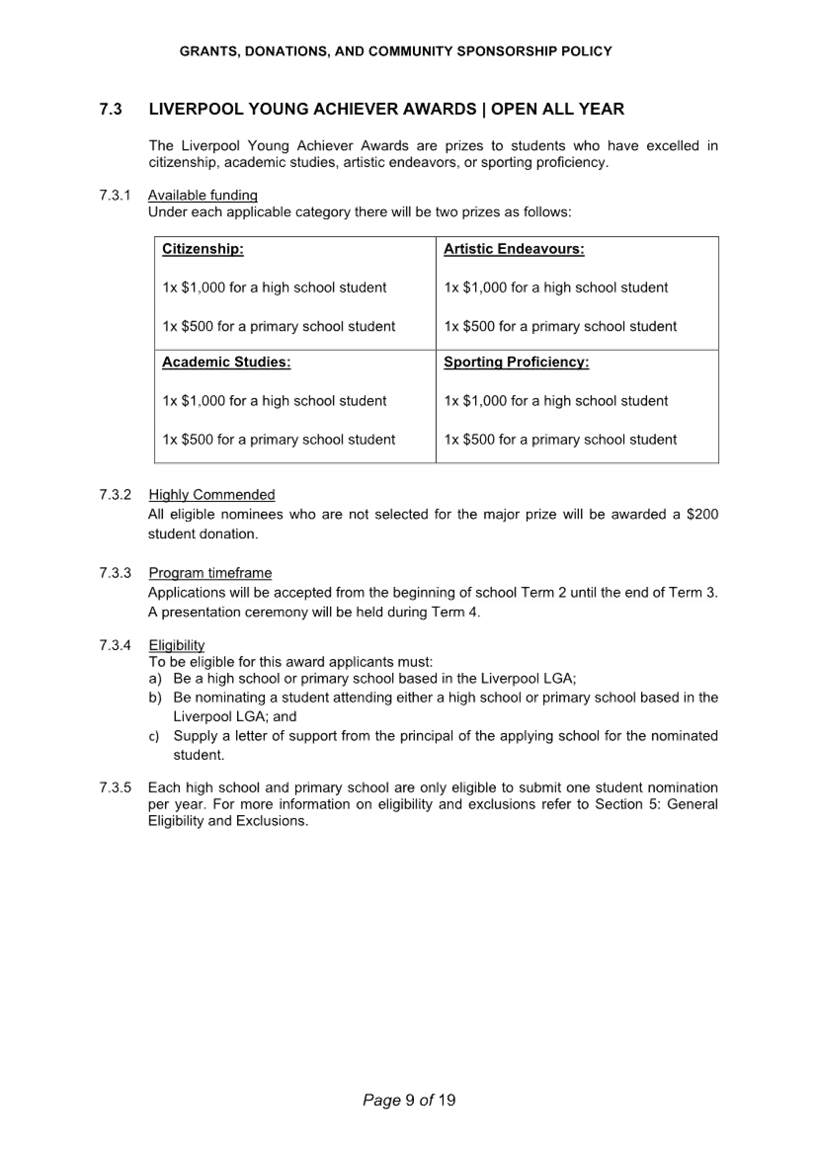
e) Have an annual financial turnover of less than
$3,000,000;
f) Have an annual operating
surplus (based on the audited financial statements of the previous financial
year) of greater than $150,000;and
Council Officers have given due
consideration to including Net Asset (less than $500,000) as an additional
criteria, however an analysis of that criteria would have substantial impact on
past recipients that have deliver quality community facing programs such as
PCYC, Western Sydney Community Forum and Western Sydney university.
Based on the above criteria, any
organisation that has an annual financial turnover of more than $3,000,000, an
annual operation surplus of more than $150,000 will be deemed ineligible for
Councils Grants Donations and Sponsorship Program.
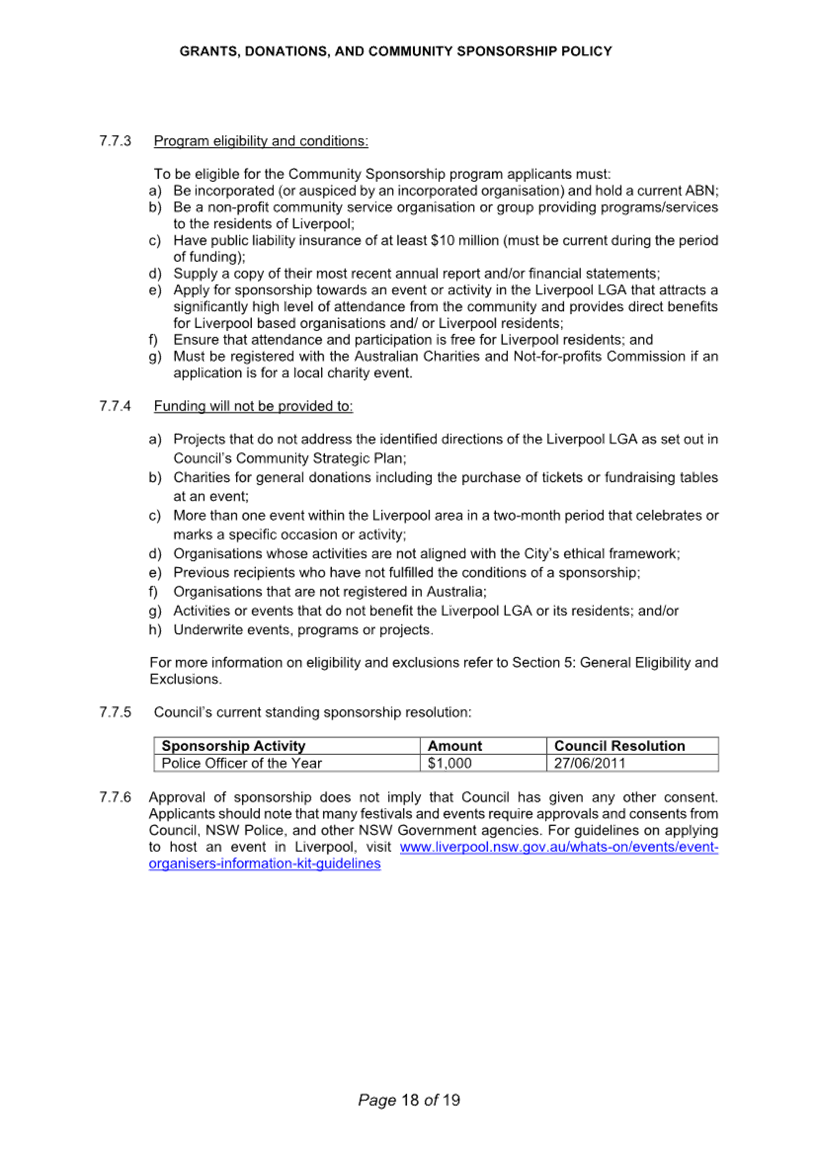
Council should also note that the Grants,
Donations and Community Sponsorship Policy also defines the following projects
that are deemed ineligible for funding. There are no proposed changes to
ineligible projects.
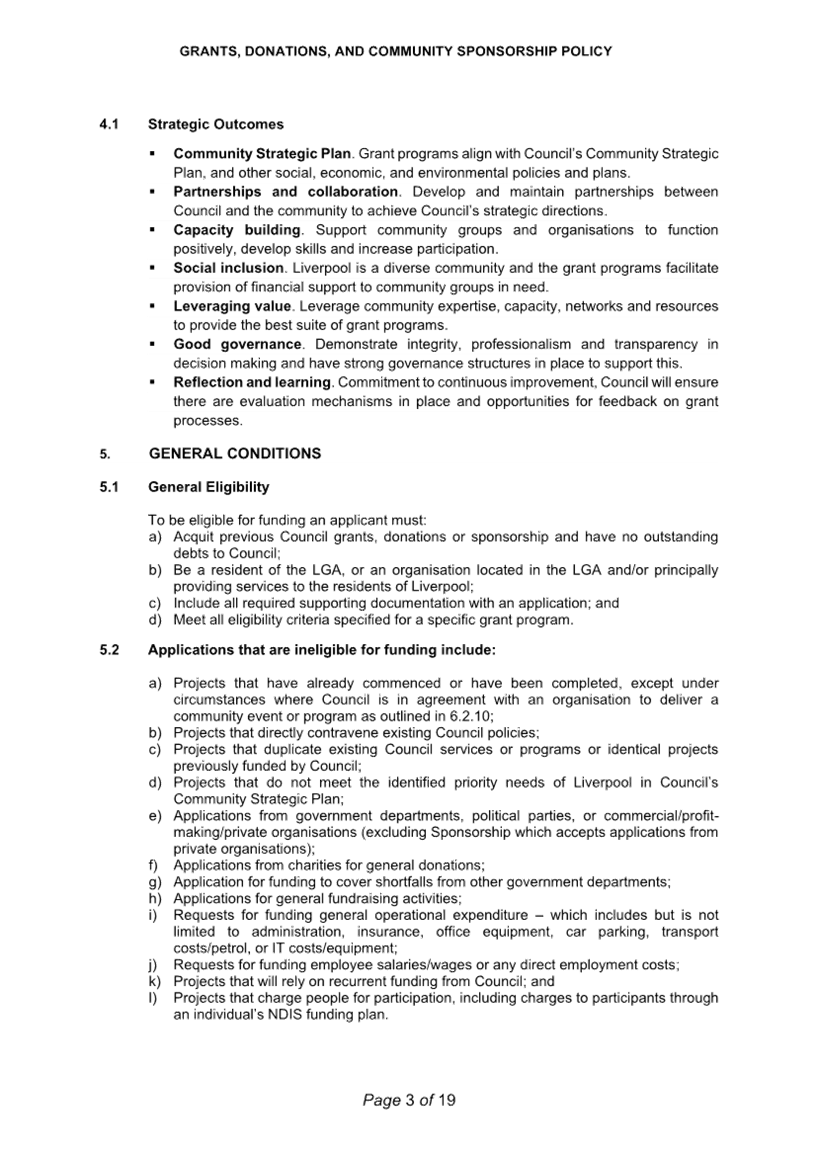
Applications that are ineligible for
funding include:
a. Projects that have already commenced or
have been completed;
b. Projects that directly contravene existing
Council policies;
c. Projects that duplicate existing Council
services or programs or identical projects
d. previously funded by Council;
e. Projects that do not meet the identified
priority needs of Liverpool in Council’s Community Strategic Plan;
f. Applications from government departments,
political parties, or commercial/profit making/private organisations (excluding
Sponsorship which accepts applications from private organisations);
g. Applications from charities for general
donations;
h. Application for funding to cover shortfalls
from other government departments;
i. Applications for general fundraising
activities;
j. Requests for funding general operational
expenditure – which includes but is not
k. limited to administration, insurance,
office equipment, car parking, transport costs/petrol, or IT costs/equipment;
l. Requests for funding employee
salaries/wages or any direct employment costs;
m. Projects that will rely on recurrent
funding from Council; and
n. Projects that charge people for
participation, including charges to participants through an individual’s
NDIS funding plan.
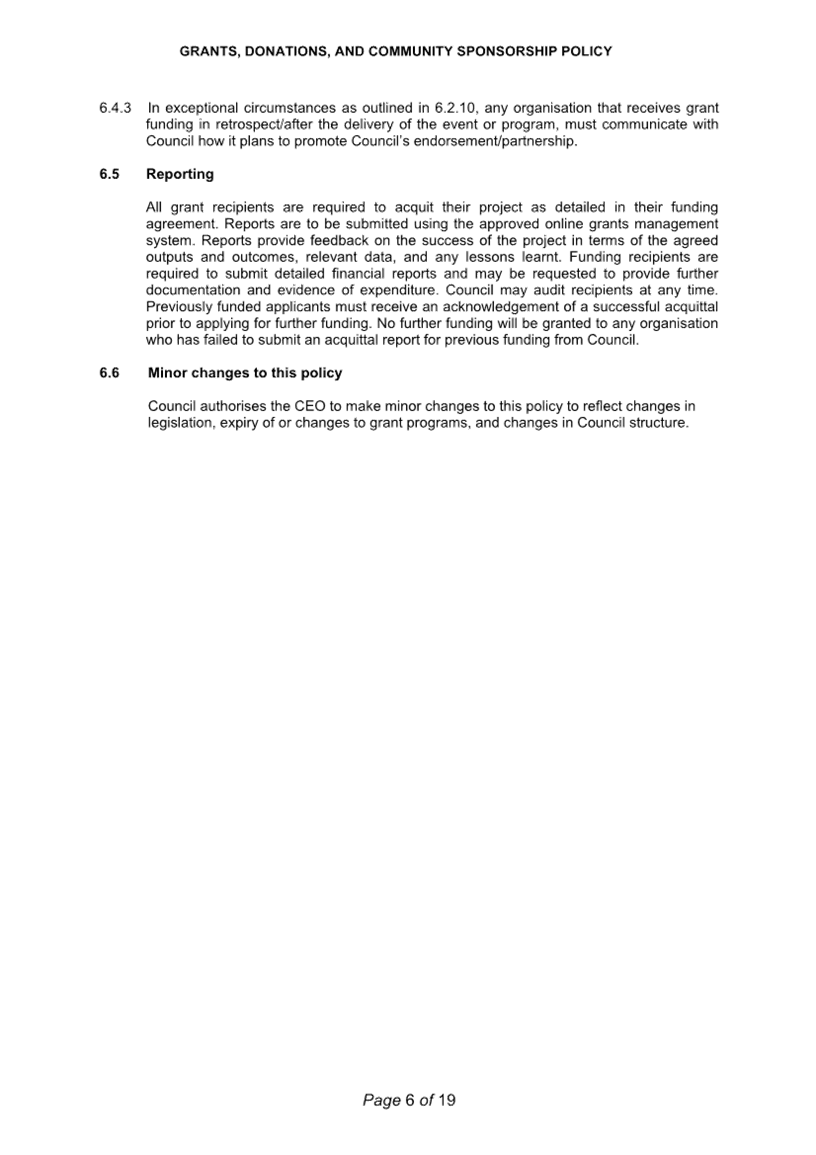
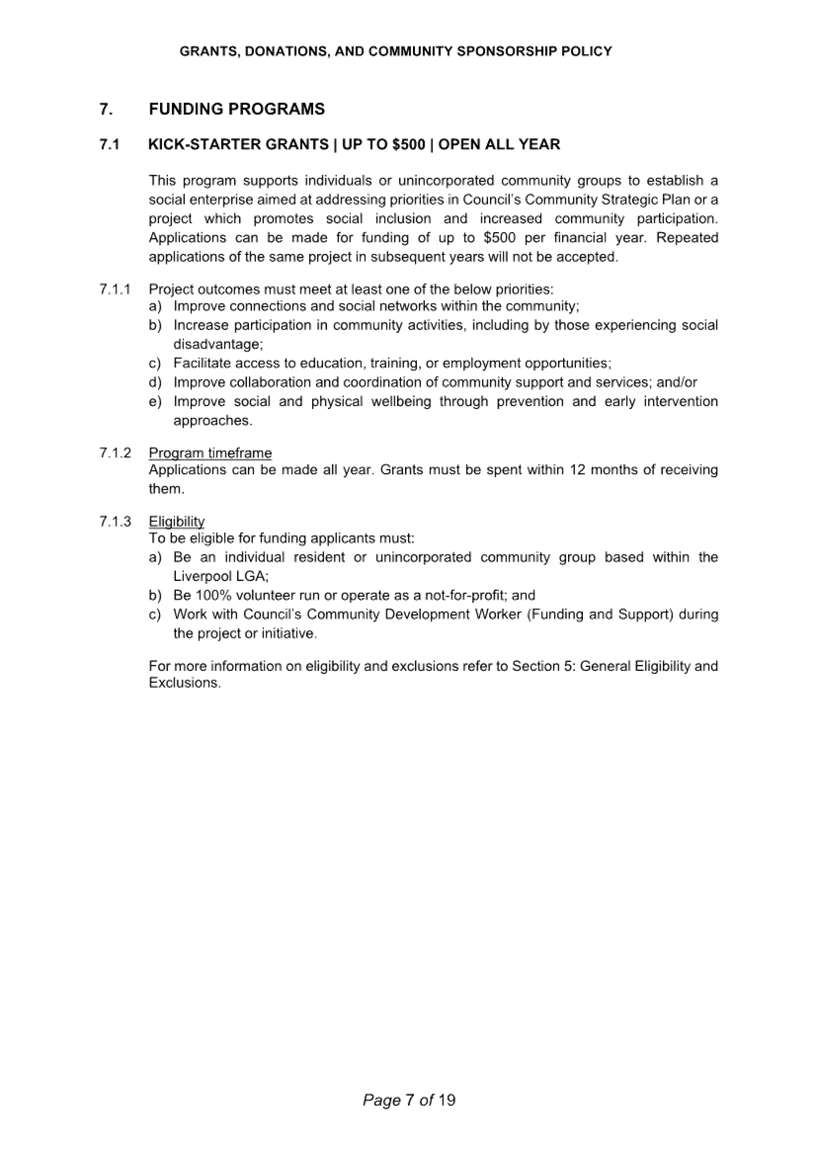
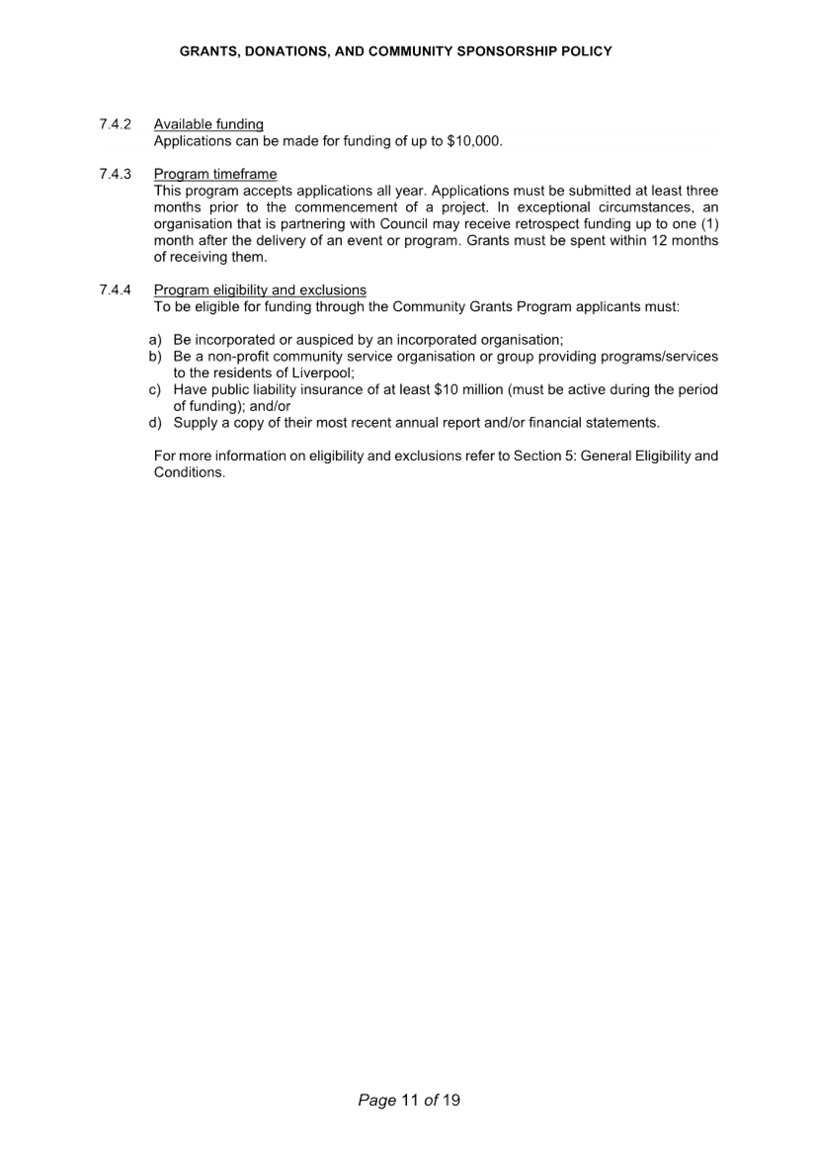
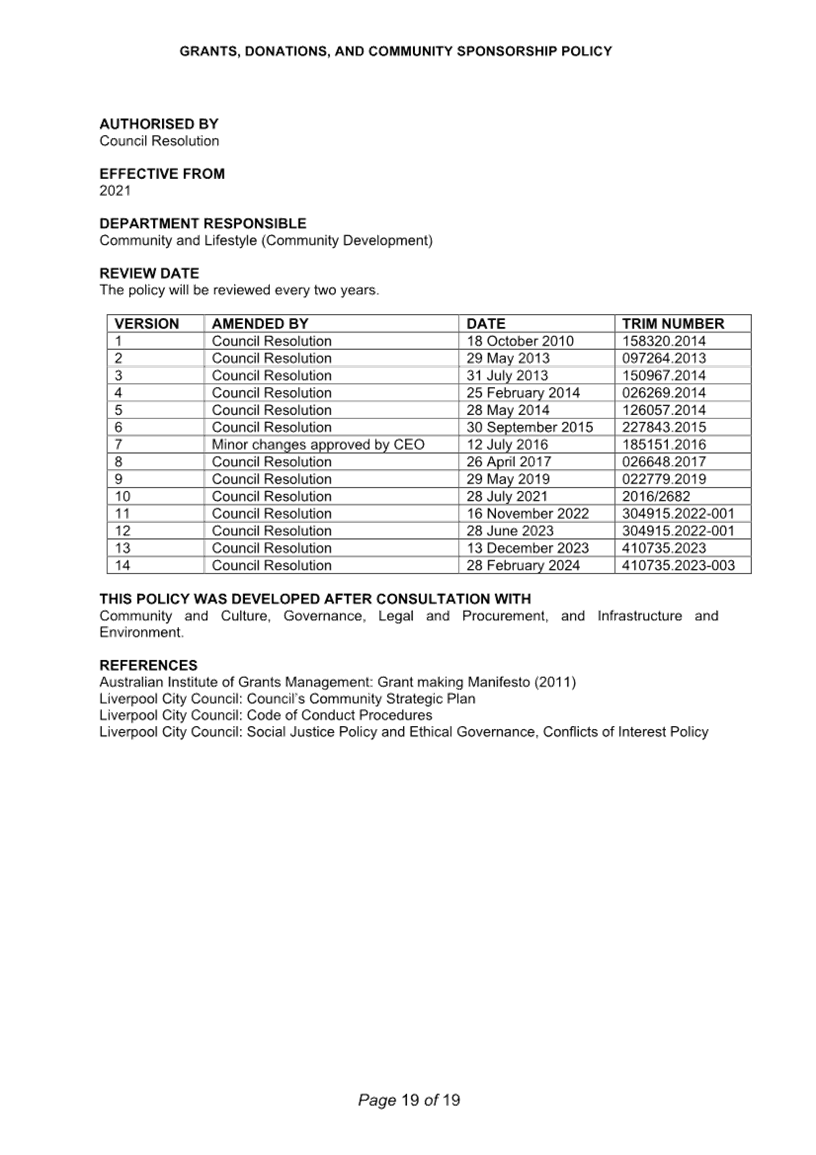
A copy of the Grants, Donations and Community
Sponsorship Policy is attached to this Report.
FINANCIAL IMPLICATIONS
Costs
associated with this recommendation have been included in Council’s
budget for the current year and long-term financial plan.
|
Economic
|
All costs associated with the delivery of the Grants
Donations and Community Sponsorship program are contained within the annual
operating budget
|
|
Environment
|
There are no environmental and sustainability
considerations.
|
Social
|
Promote community harmony and address discrimination.
|
Civic
Leadership
|
Encourage the community to engage in Council initiatives and actions.
Operate a well-developed governance system that demonstrates
accountability, transparency, and ethical conduct.
|
|
Legislative
|
There are no legislative considerations relating to
this report.
|
|
Risk
|
There is no risk associated with this
report.
|
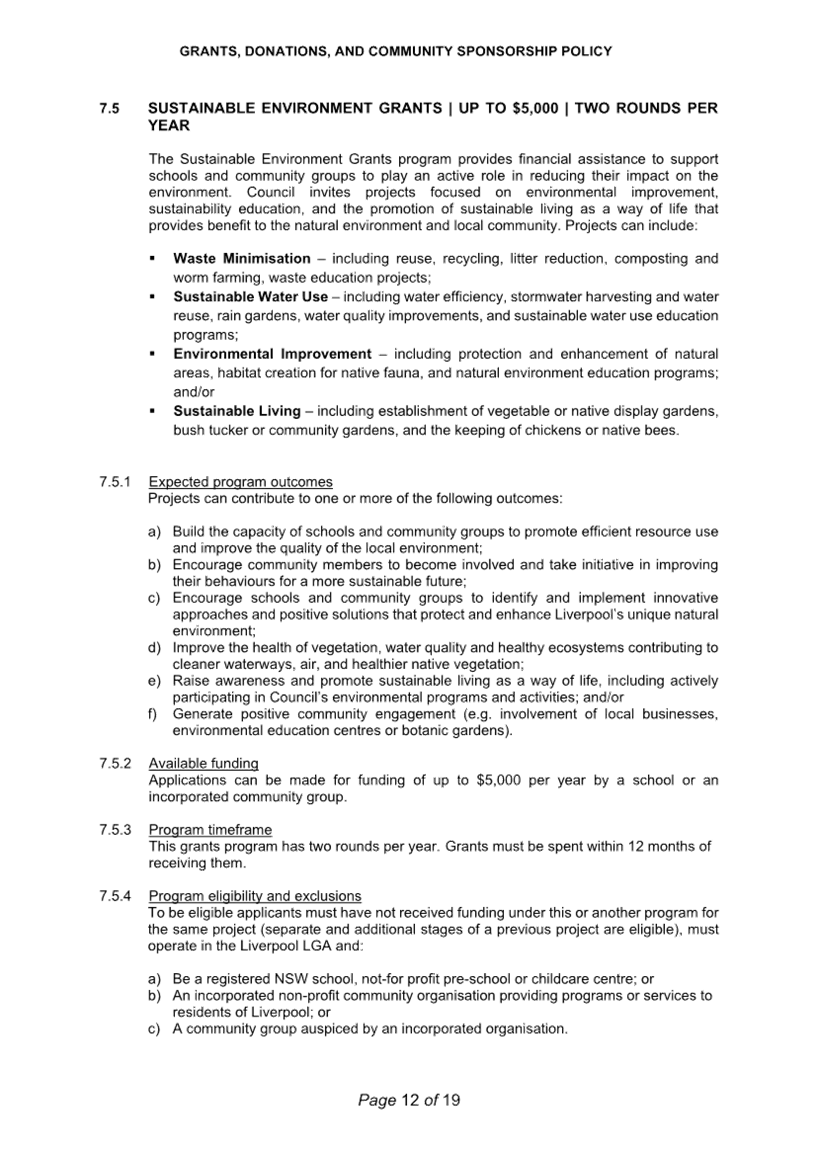
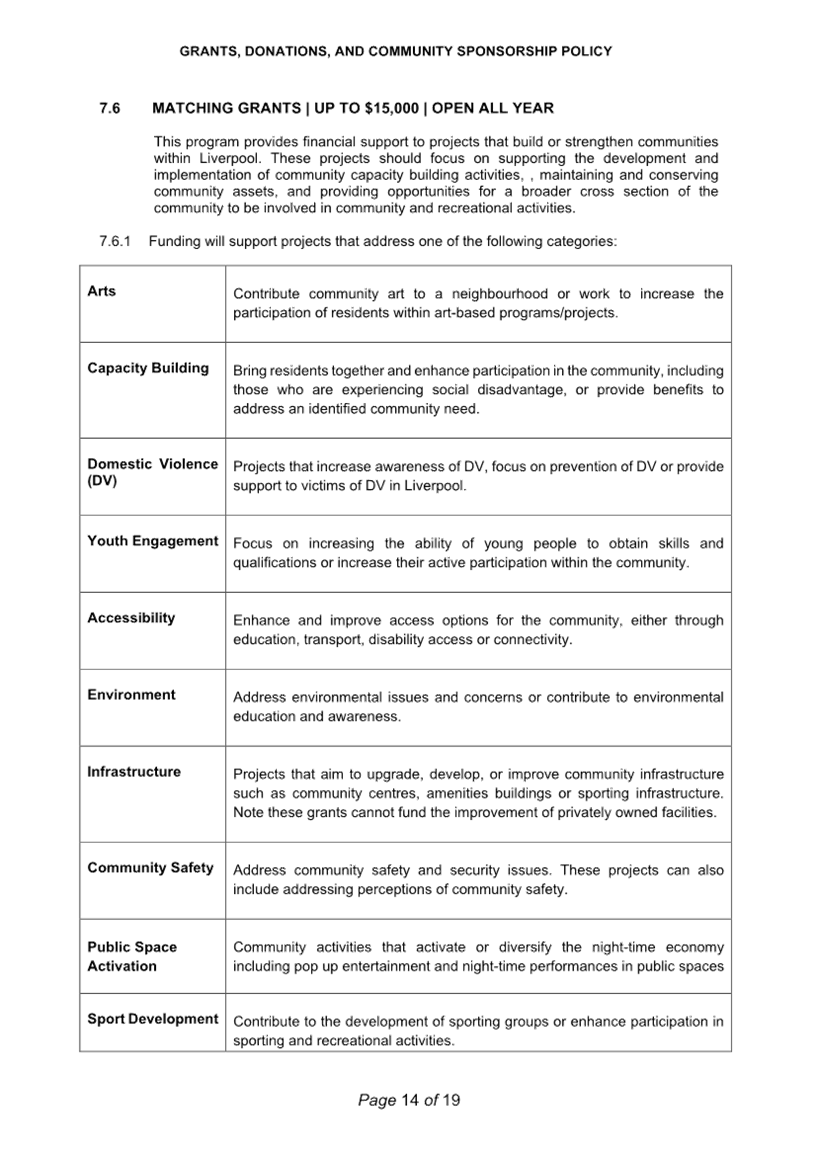
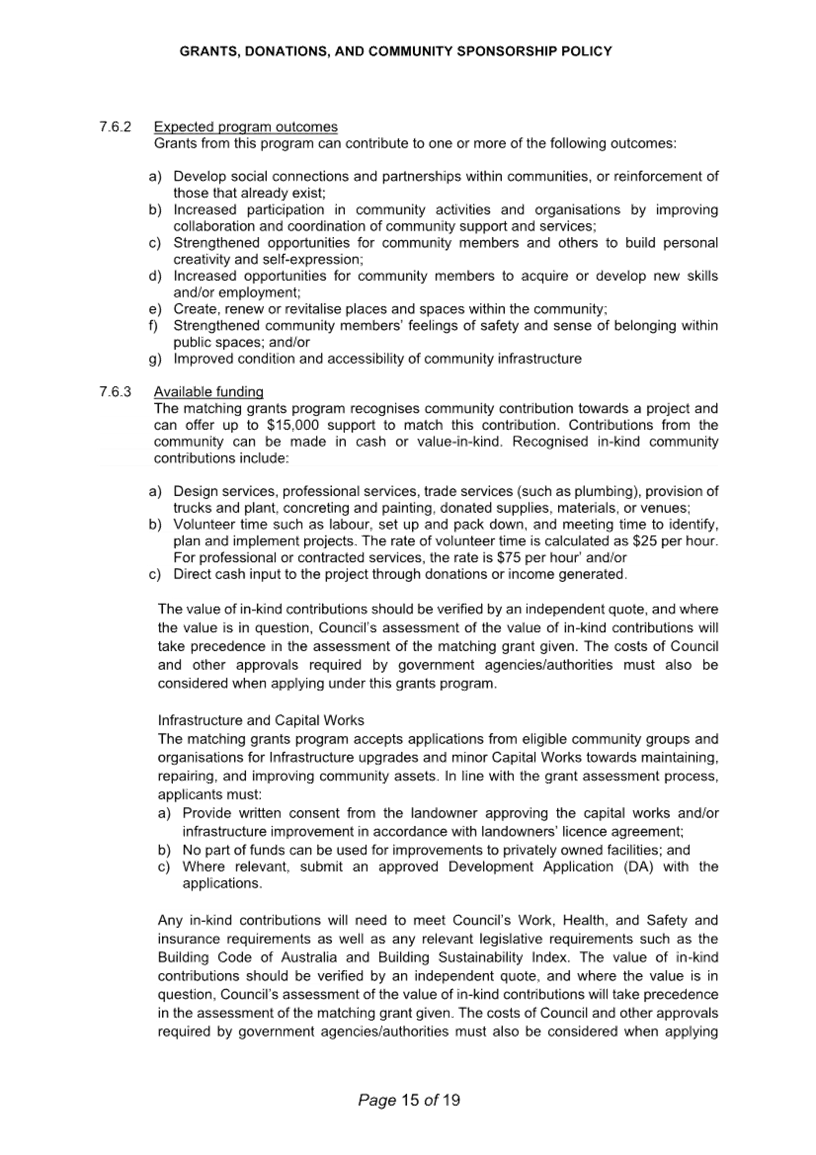
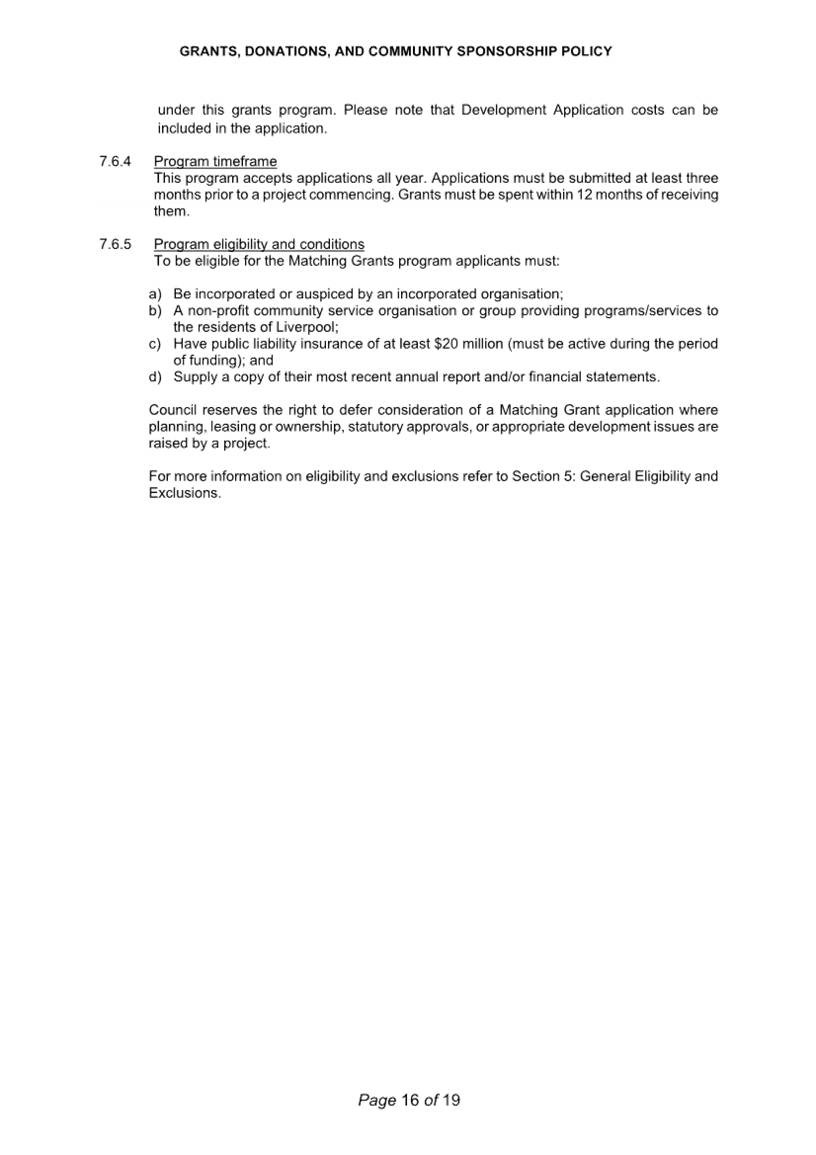
1. Grants
Donations & Sponsorship Policy 2024
|
1
|
|
ITEM
04
|
Grants
Donations and Sponsorship Program
|
|
Attachment
1
|
Grants
Donations & Sponsorship Policy 2024
|

Governance
Committee Meeting
18 February 2025
Strategic Performance Committee Report
|
ITEM 05
|
Review of the Code of Conduct and Code
of Conduct Procedures
|
|
Strategic
Objective
|
Visionary,
Leading, Responsible
Demonstrate
a high standard of transparency and accountability through a comprehensive
governance framework
|
|
File Ref
|
009689.2025
|
|
Report By
|
David Day -
Head of Governance
|
|
Approved
By
|
Farooq
Portelli - Director Corporate Support
|
Council’s current Code of
Conduct and Code of Conduct Procedures were adopted by resolution of the
Council on 31 August 2022. The Local Government Act 1993 provides that:
· councils must adopt a code of conduct that
incorporates the provisions of the Model Code of Conduct (or is consistent with
the Model Code of Conduct),
· councils must, within 12 months of each ordinary
election, review its adopted Code of Conduct and make such adjustments as it
considers appropriate (section 440(7)).
· the adopted Code of Conduct may include
provisions that supplement the Model Code, but they must not be inconsistent
with them (section 440AAA).
· councils must adopt Code of Conduct Procedures
for the administration of the Code of Conduct that incorporates the provisions
of the Model Code of Conduct Procedures (section 440AA). The Code of Conduct
Procedures may include provisions that supplement the Model Code of Conduct
Procedures but must not be inconsistent with them.
That the
Governance Committee recommends to Council that the Draft Code of Conduct and
Draft Code of Conduct Procedures be reported to the Council meeting of the 26
March 2025 for consideration and adoption.
On 5 September
2024, the Office of Local Government (OLG) advised that it was reviewing the
Councillor Conduct Framework and released The Councillor conduct and meeting
practices – a discussion paper. OLG proposes changes, which include
removing the current two-step process for investigating alleged breaches of the
Code of Conduct and a better definition and response to alleged Councillor
misbehavior.
Submissions on the OLG discussion
paper closed on 15 November 2024 and no further updates have been provided by
the OLG at the time of this report. Given there is no certainty that the
discussion paper will result in any changes within 12 months of the previous
general election, it is proposed to continue with the current review to comply
with section 440(7) of the Local Government Act 1993.
Council’s Code of Conduct
and Code of Conduct Procedures have been reviewed against the existing Model
Codes. Council’s documents are not exactly the same as the Model Codes,
but they are consistent and compliant.
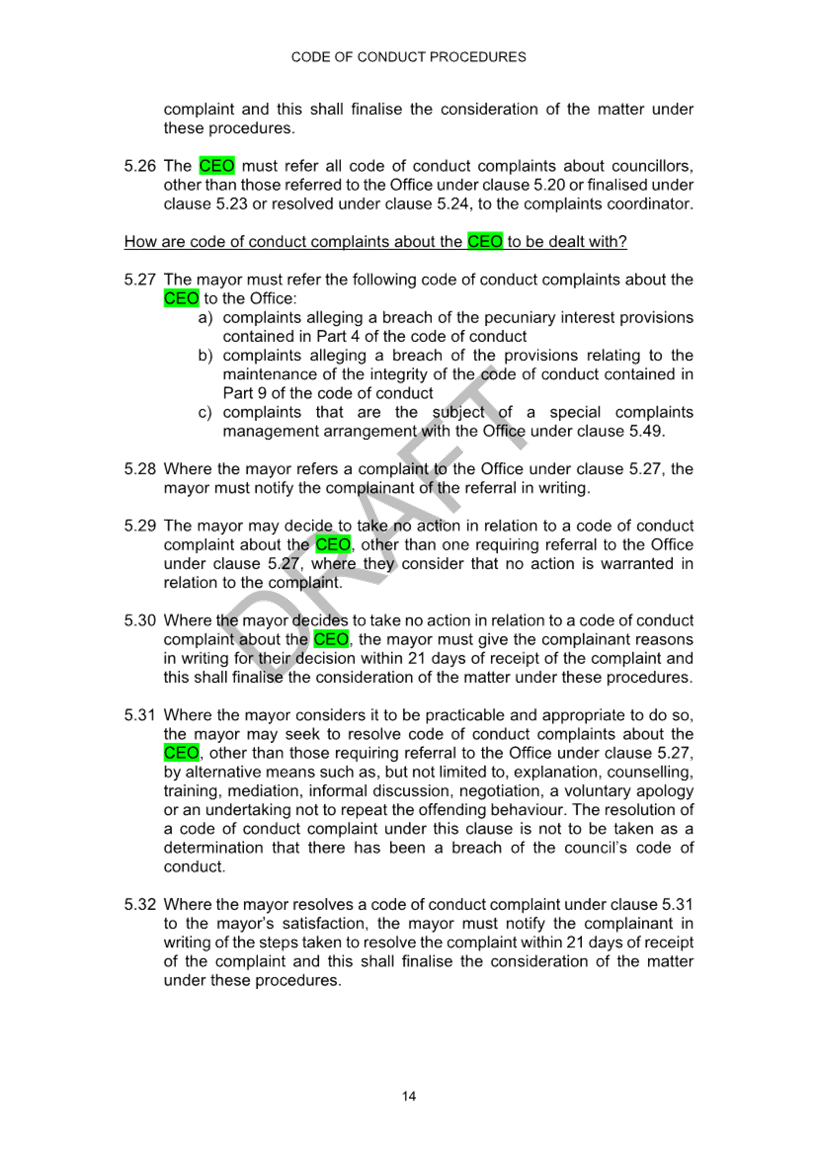
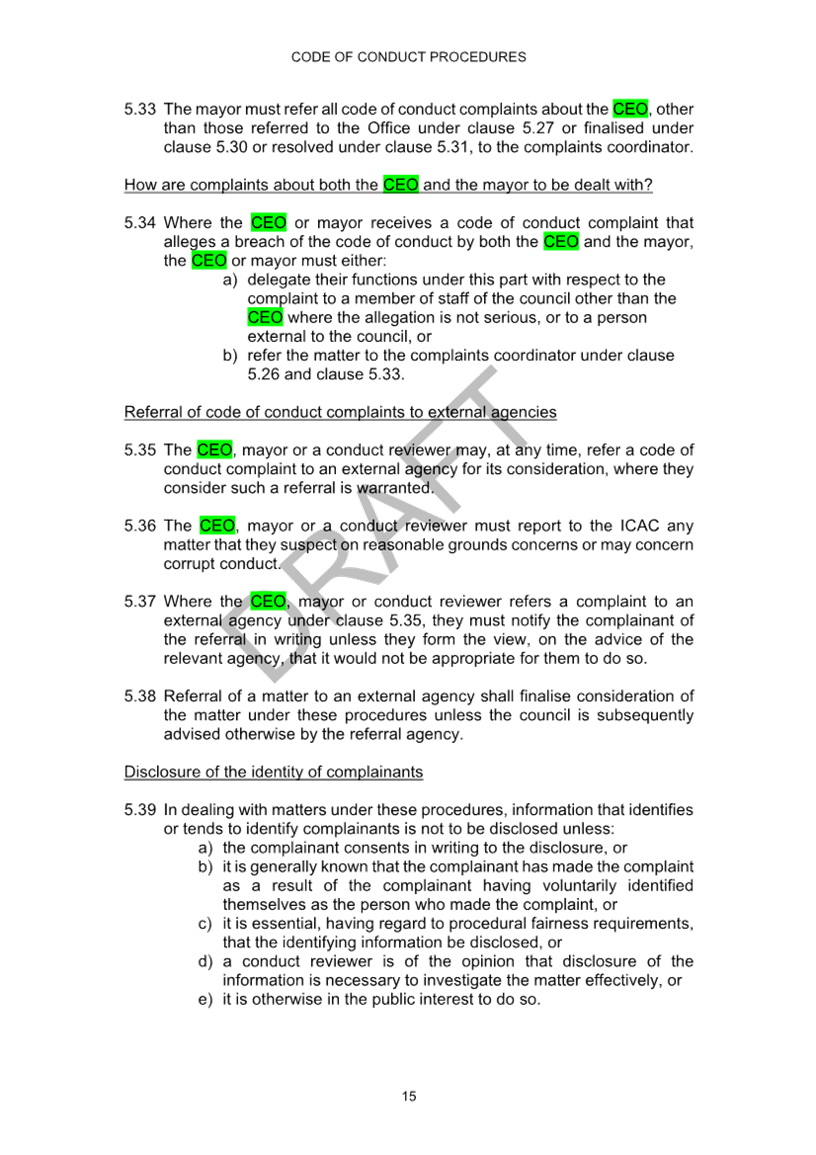
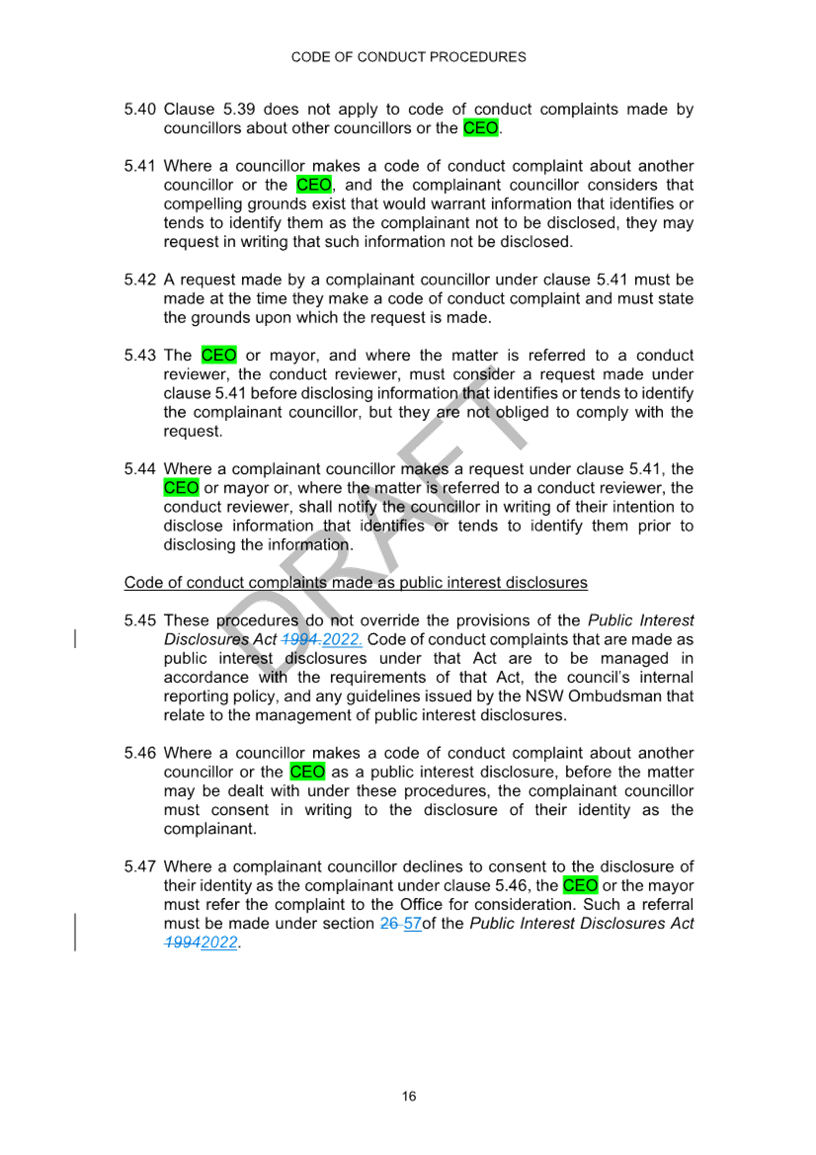
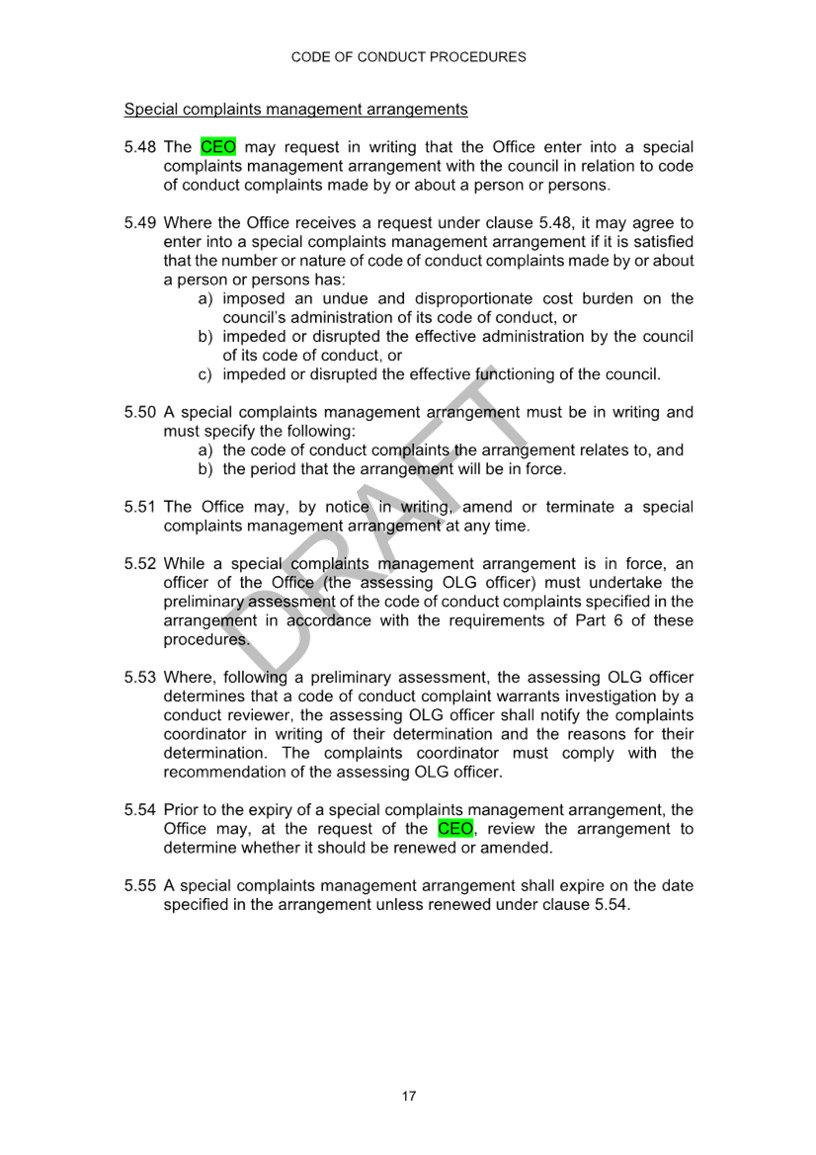
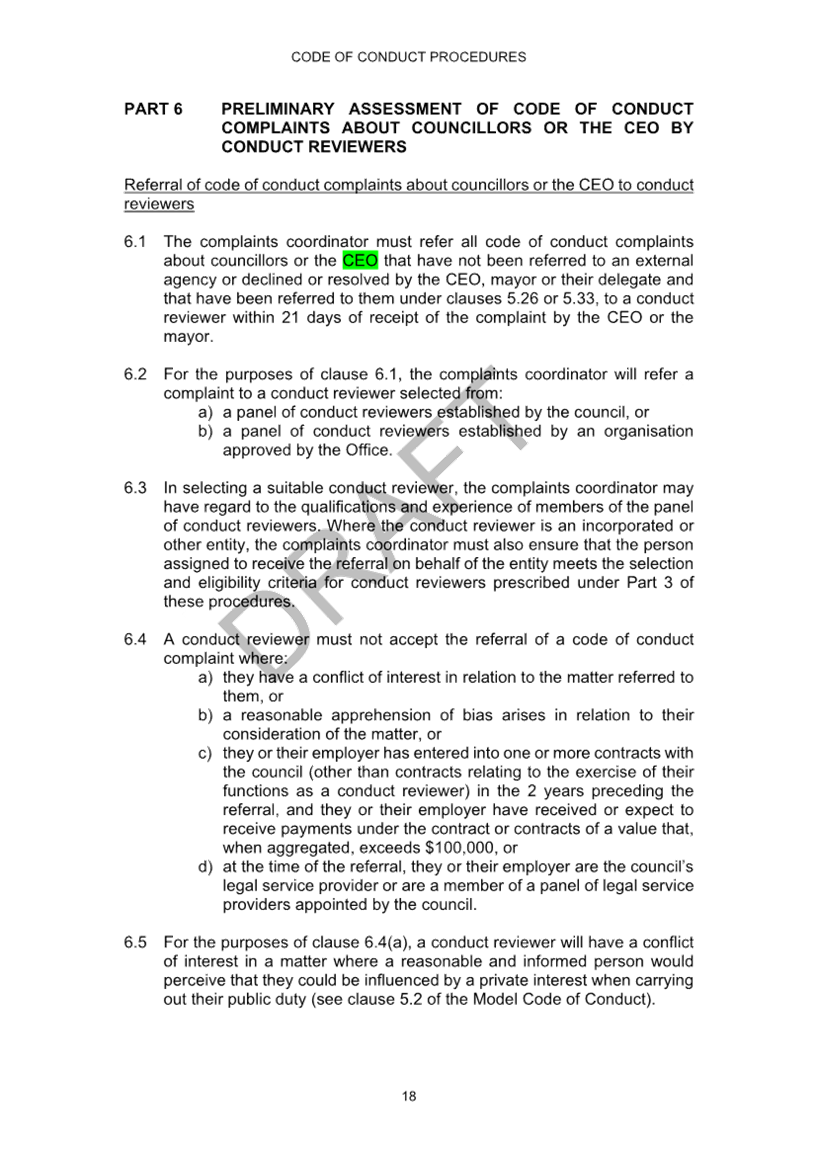
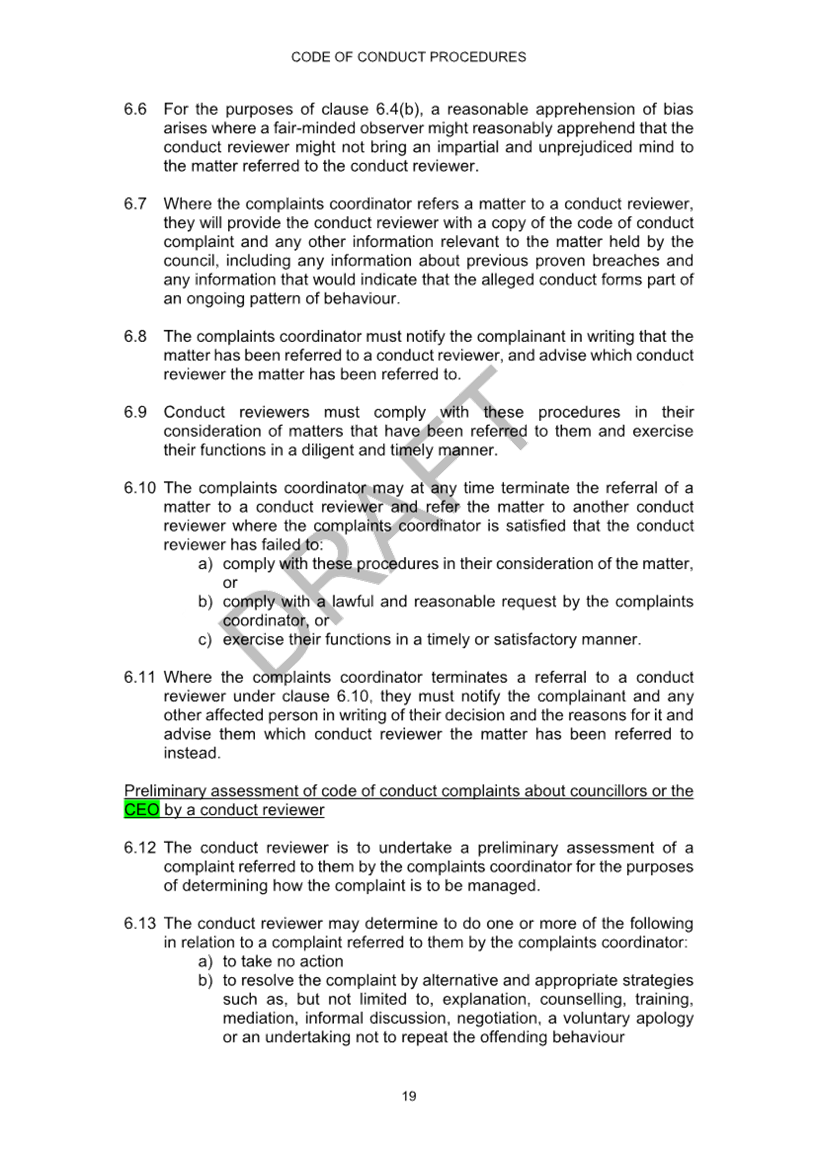
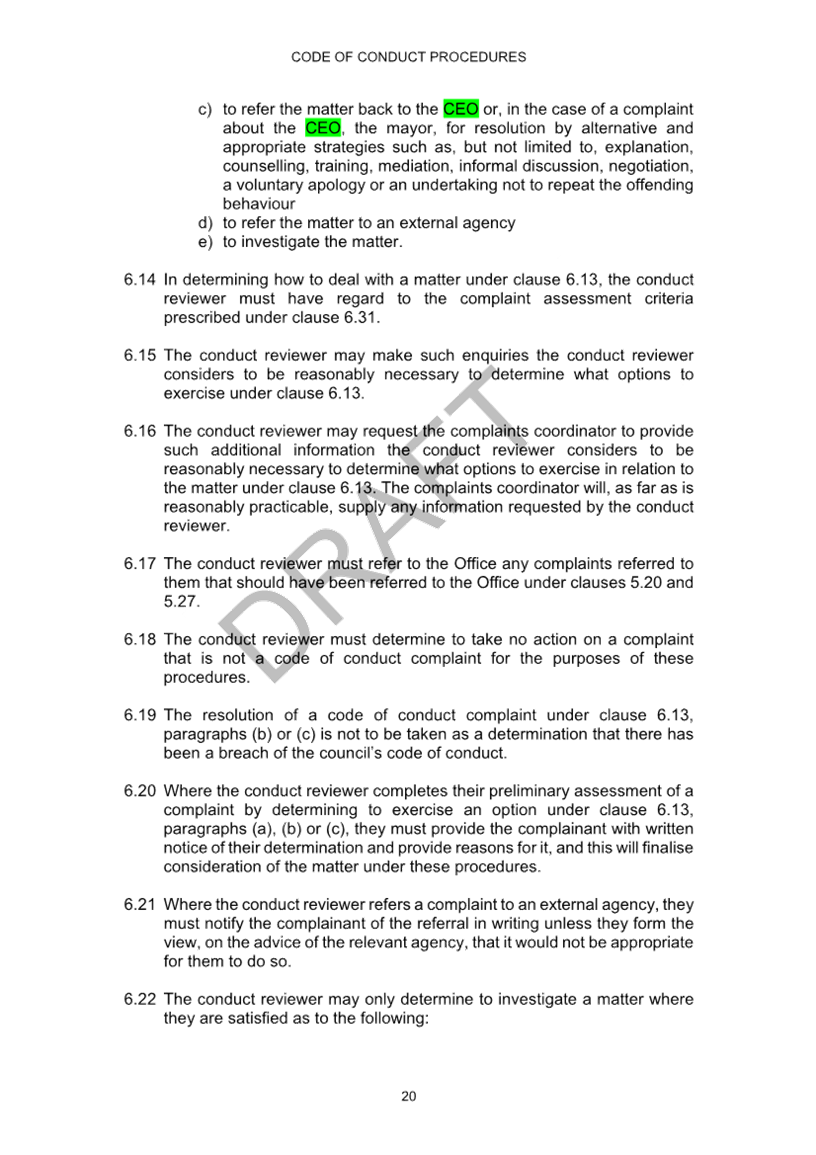
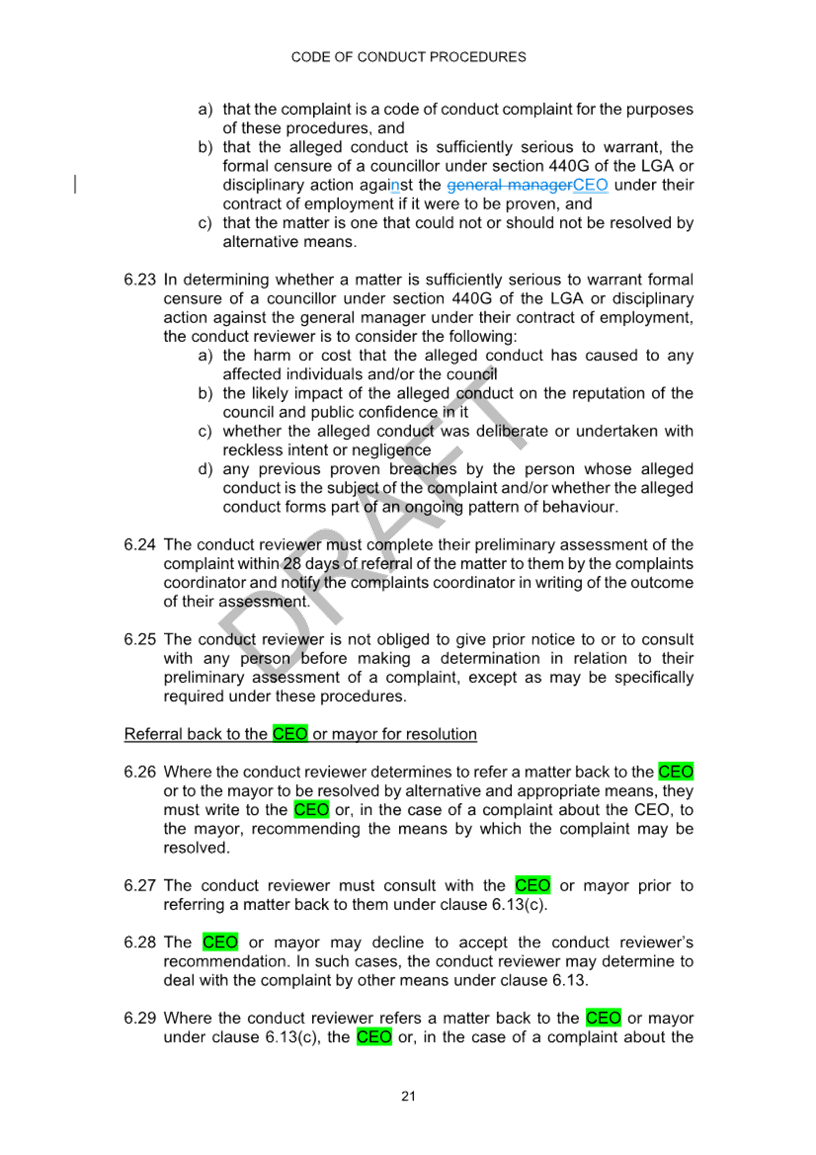
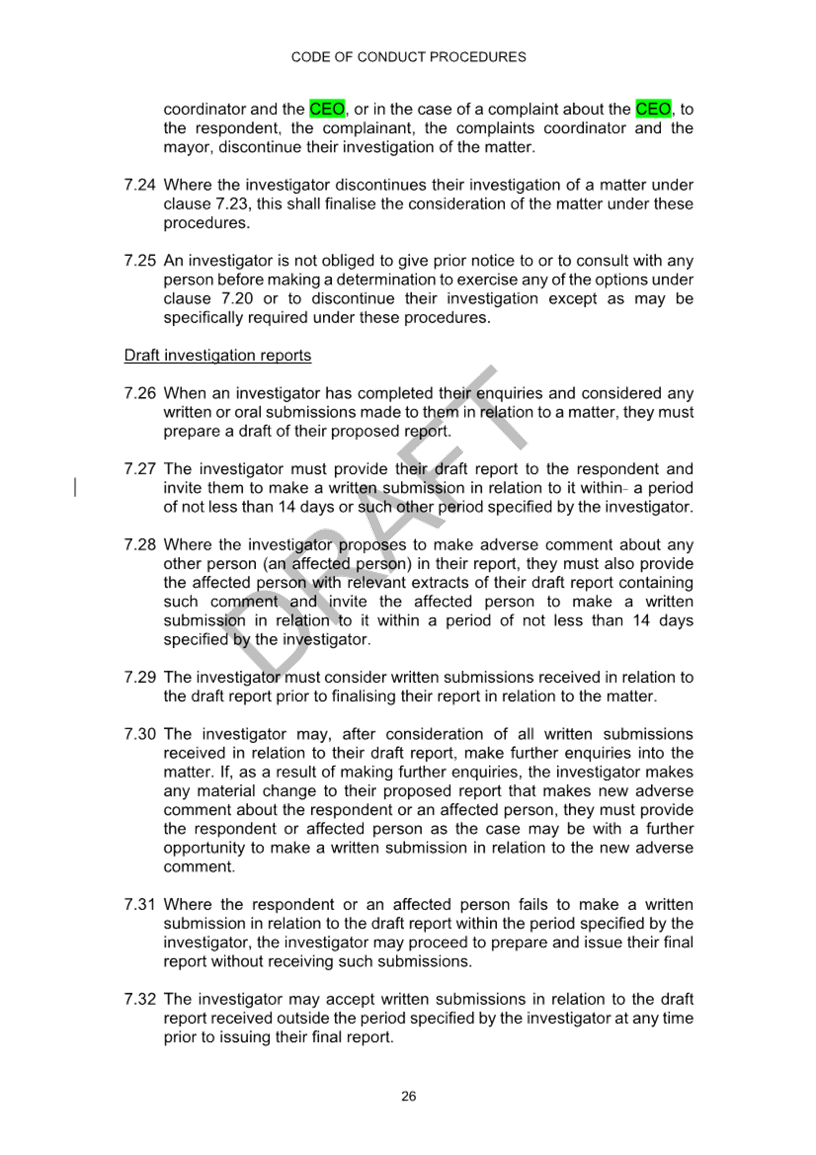
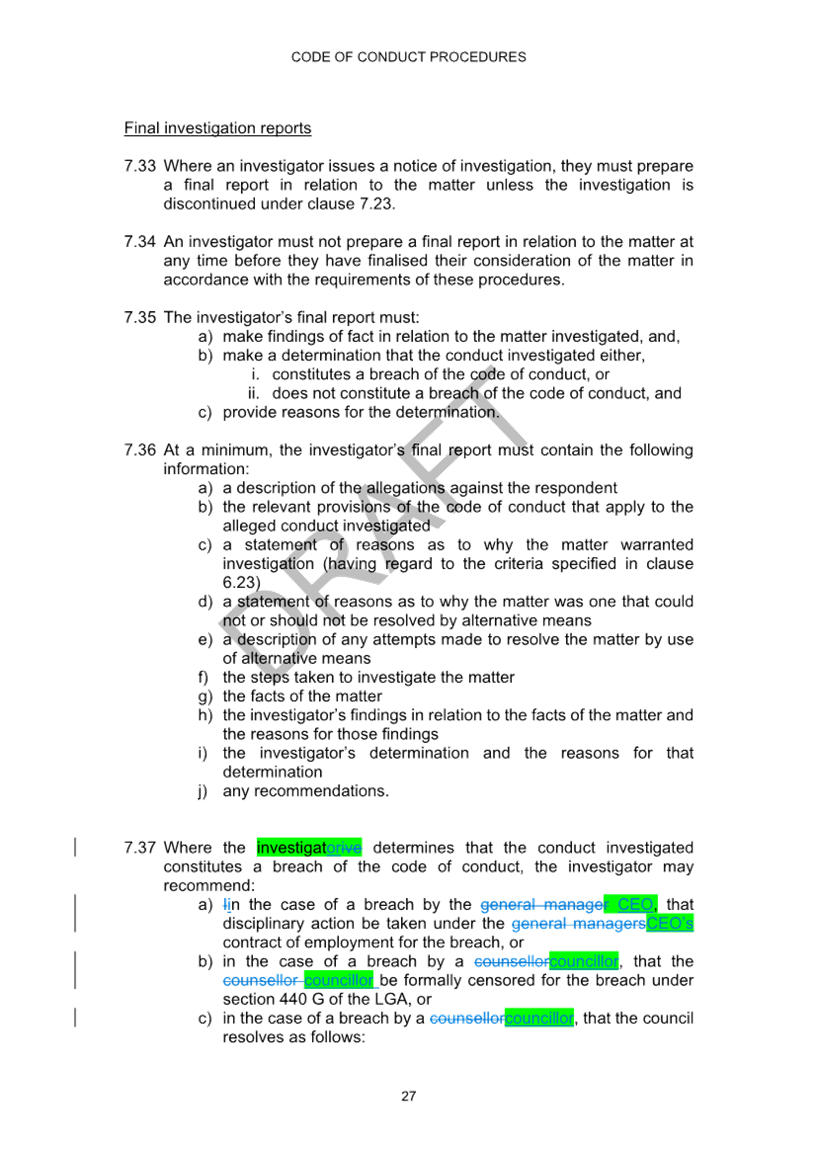
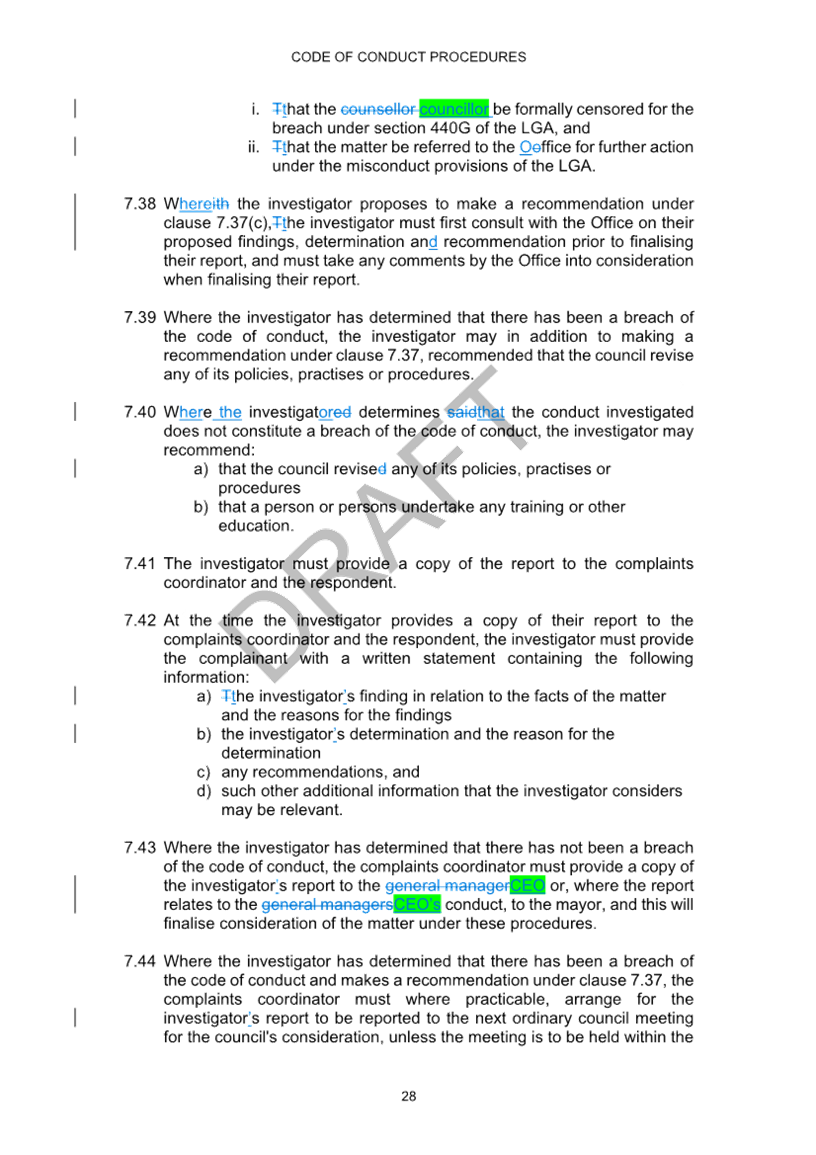
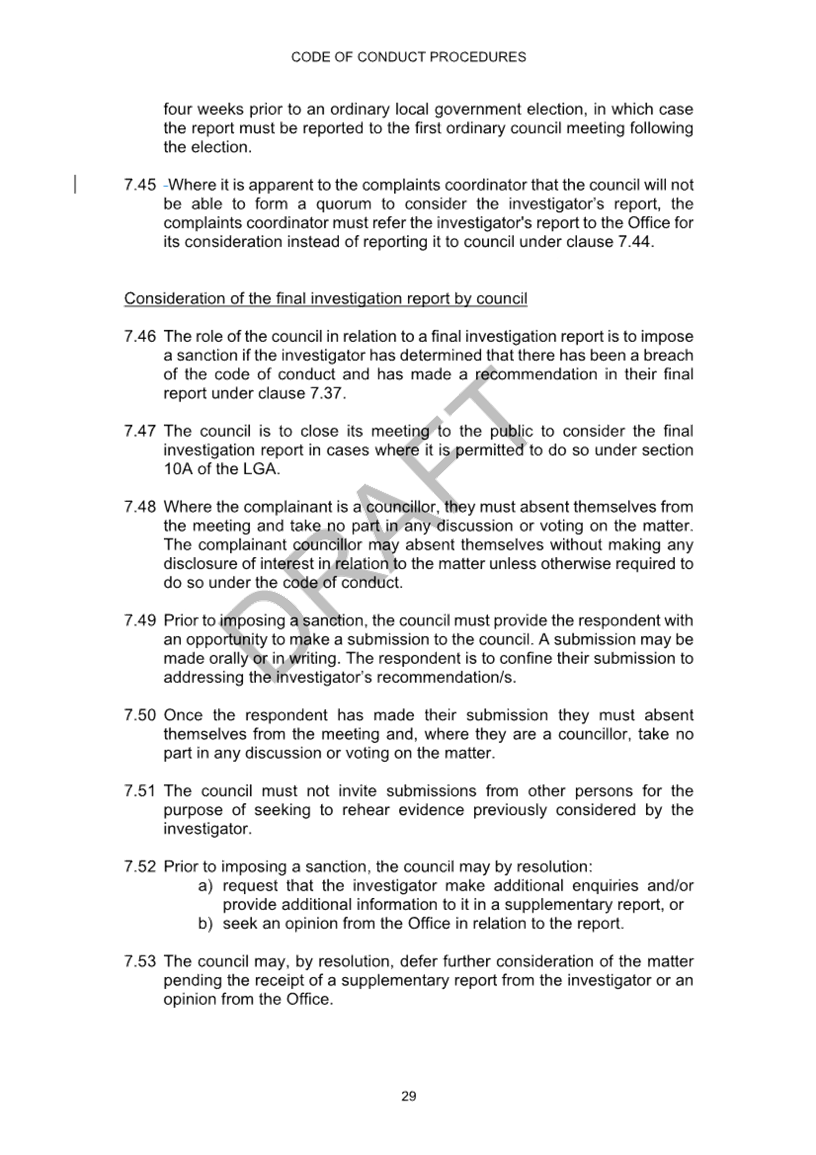
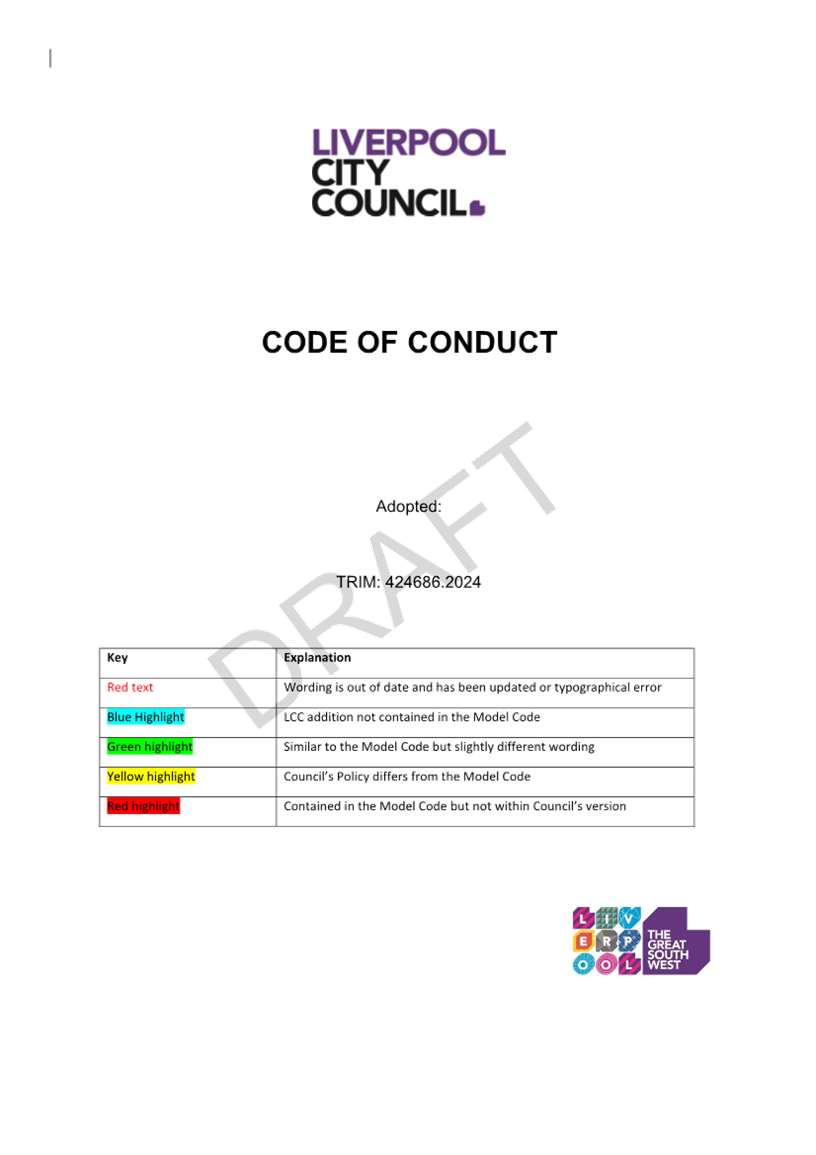
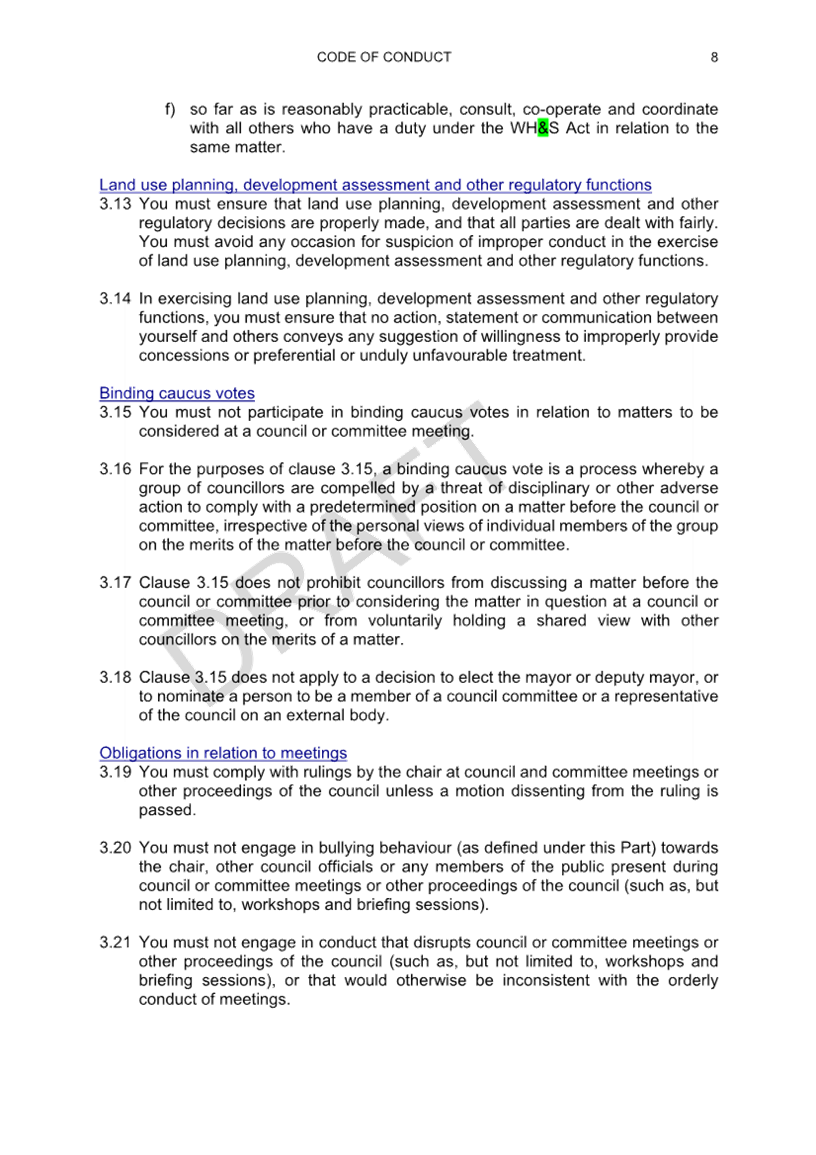
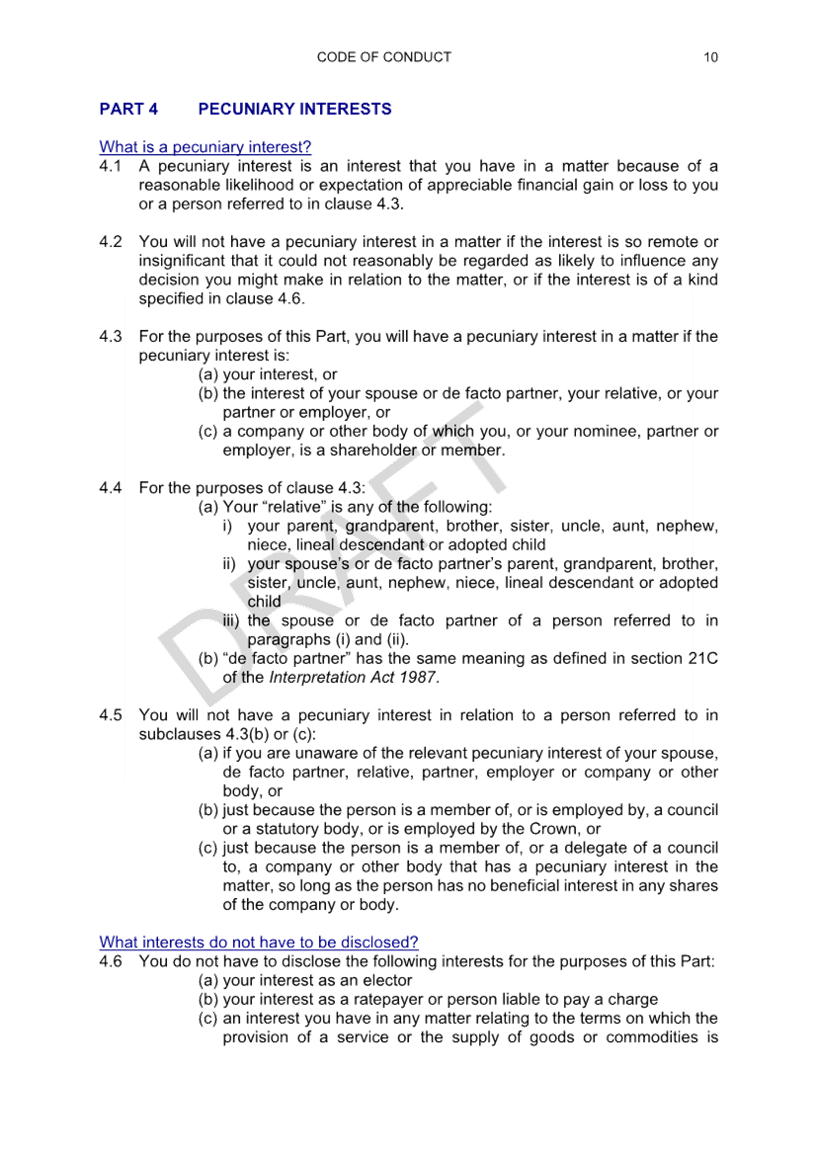
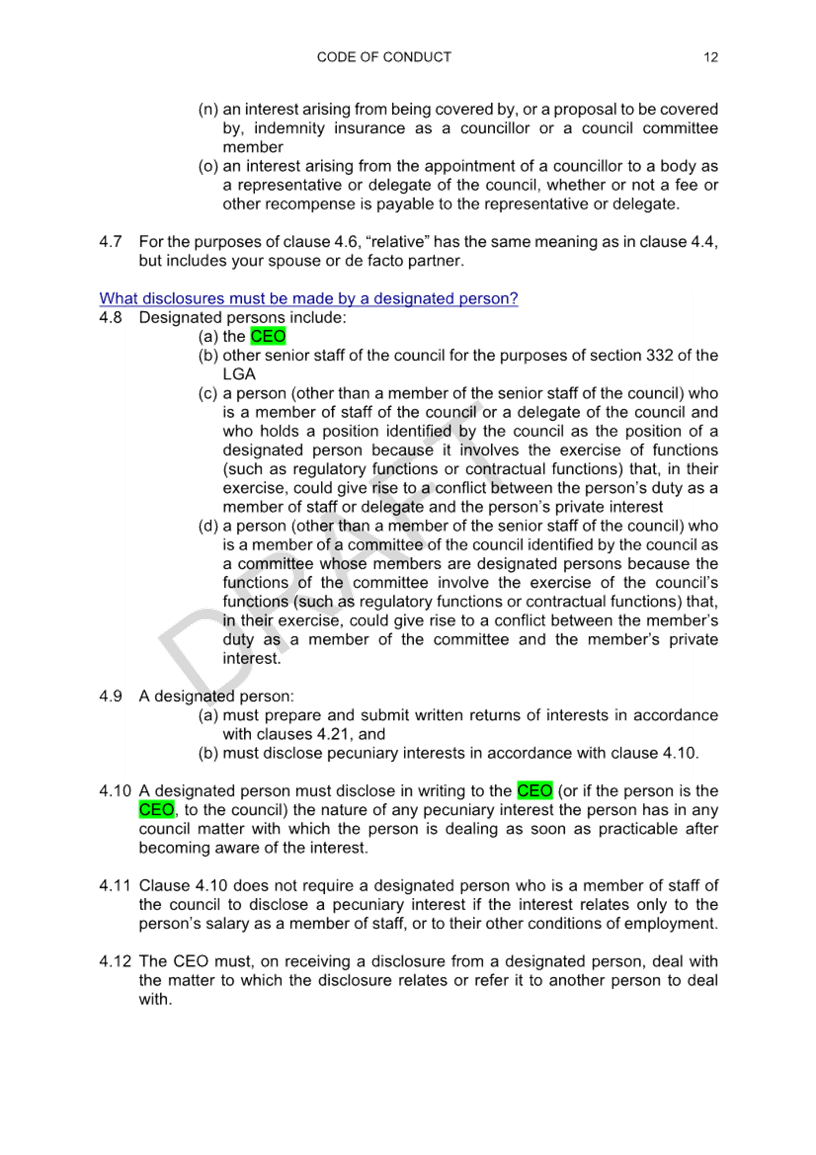
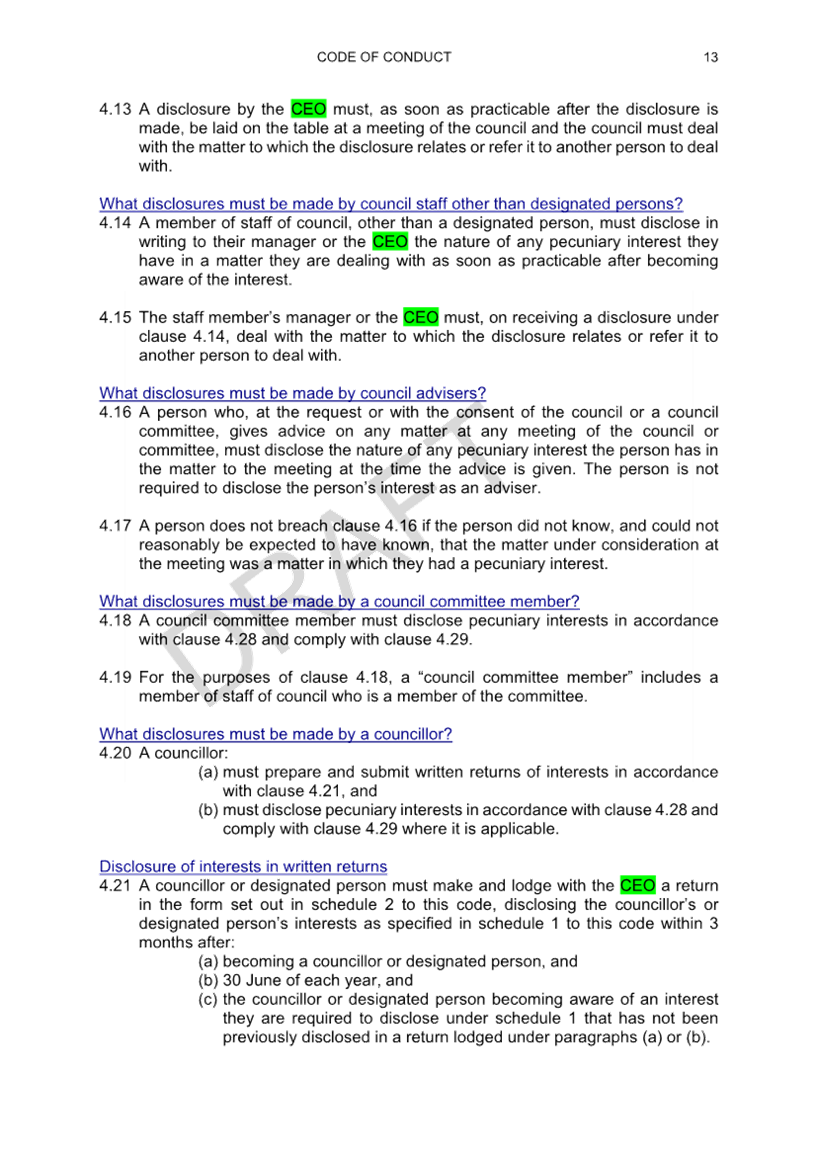
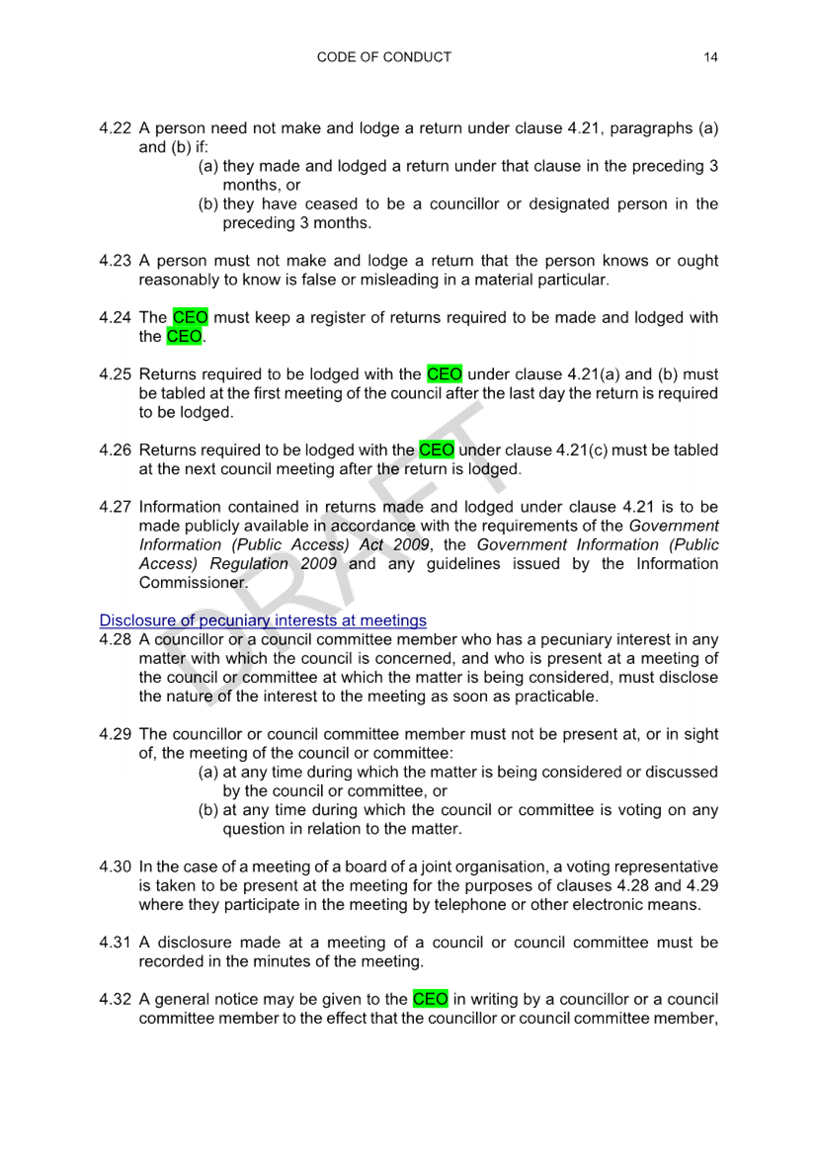
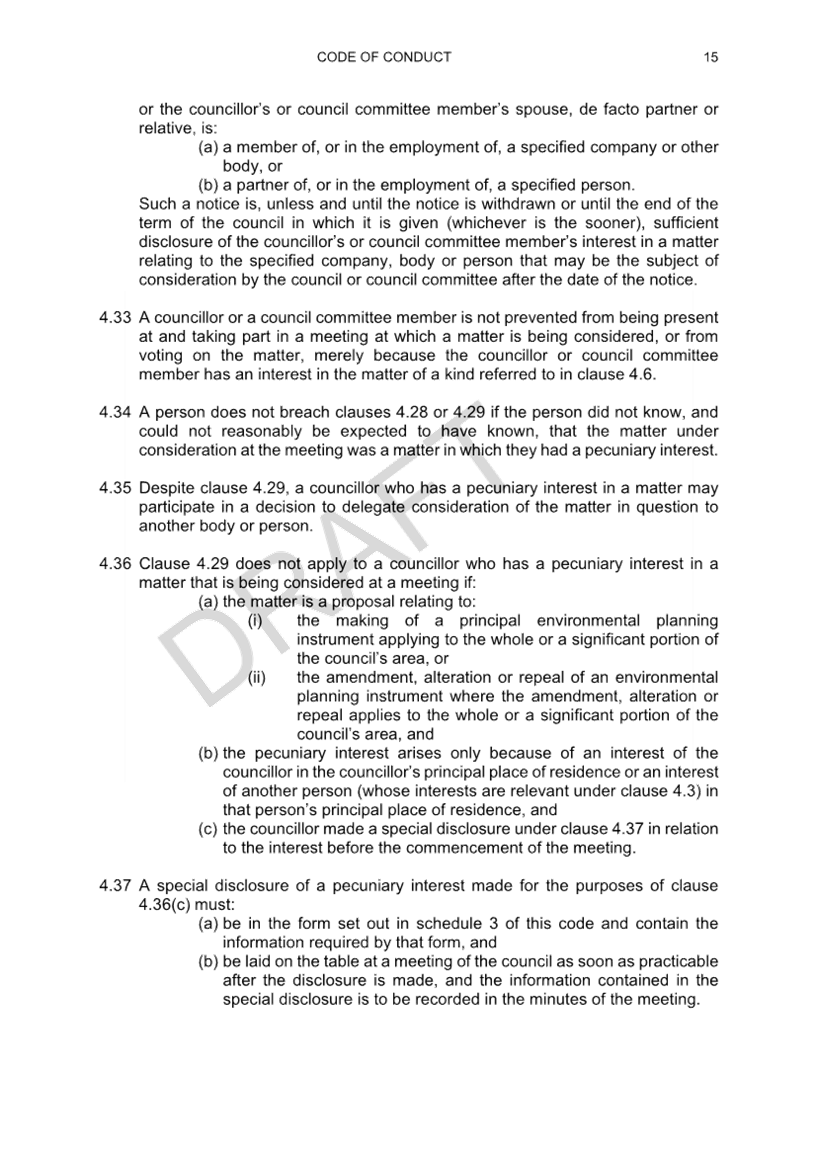
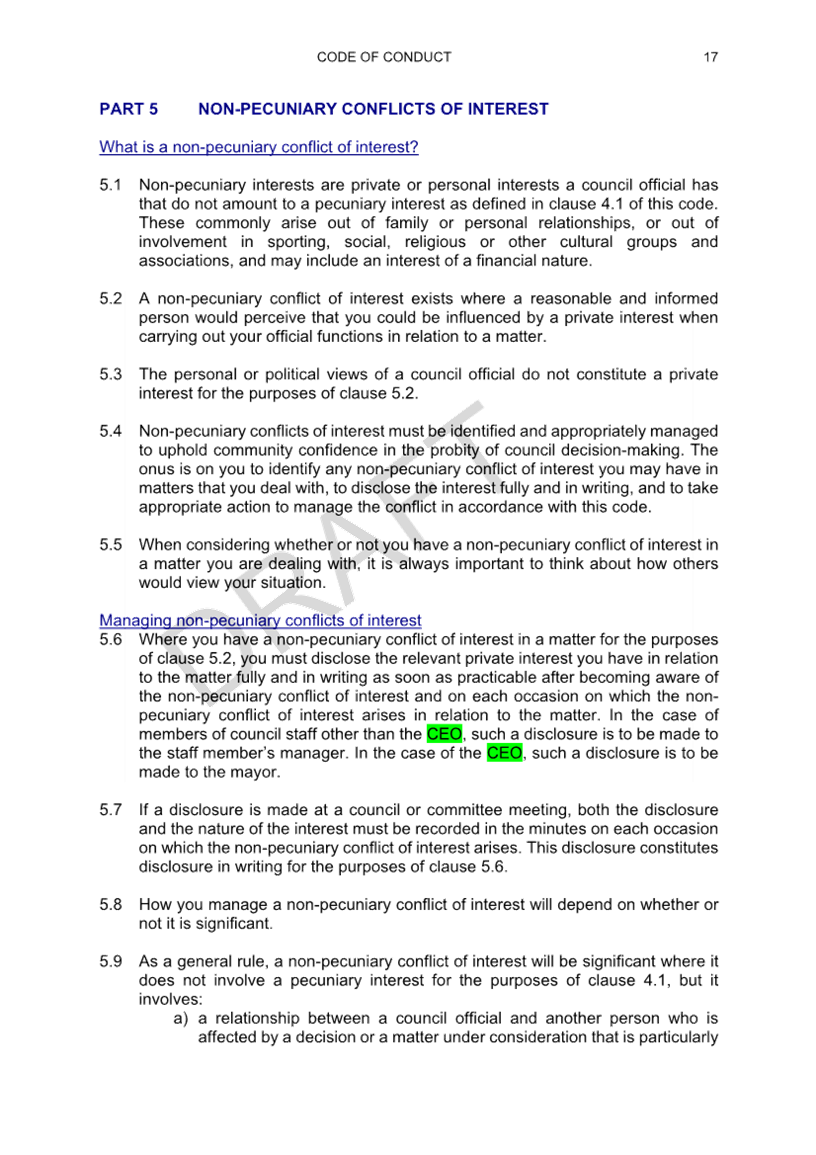
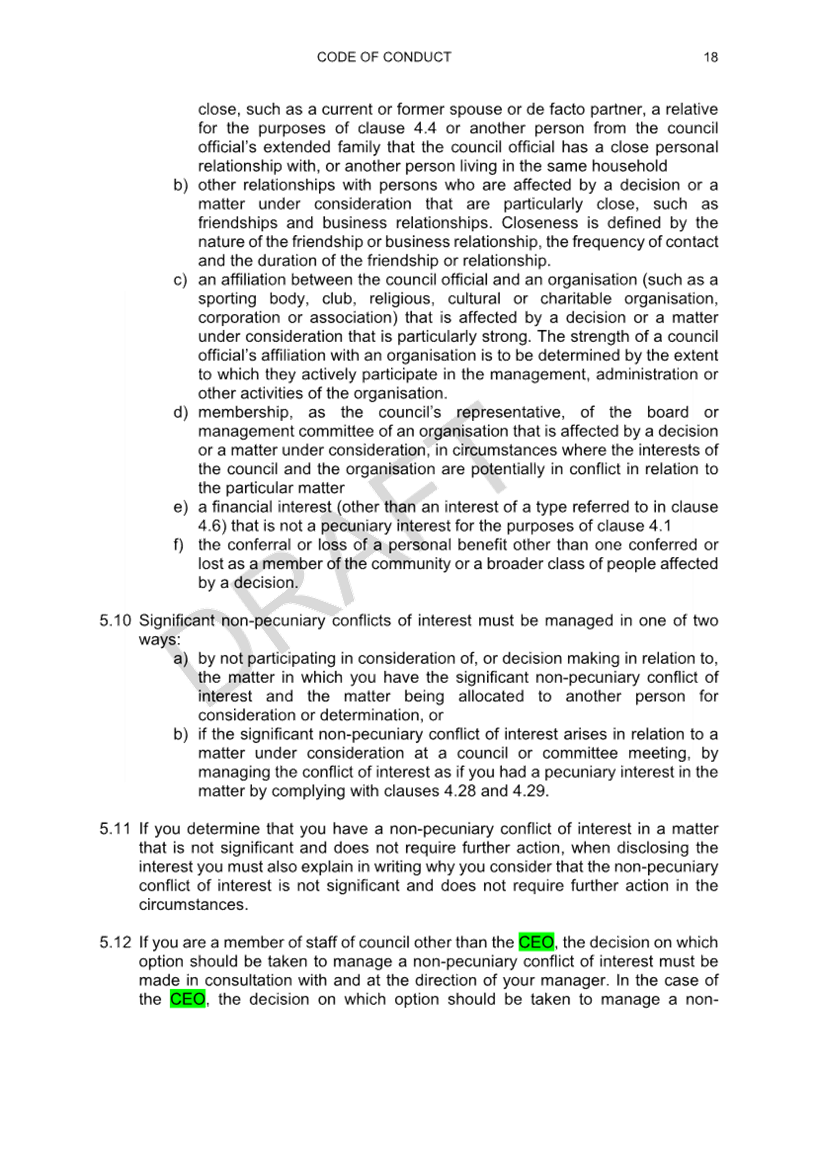
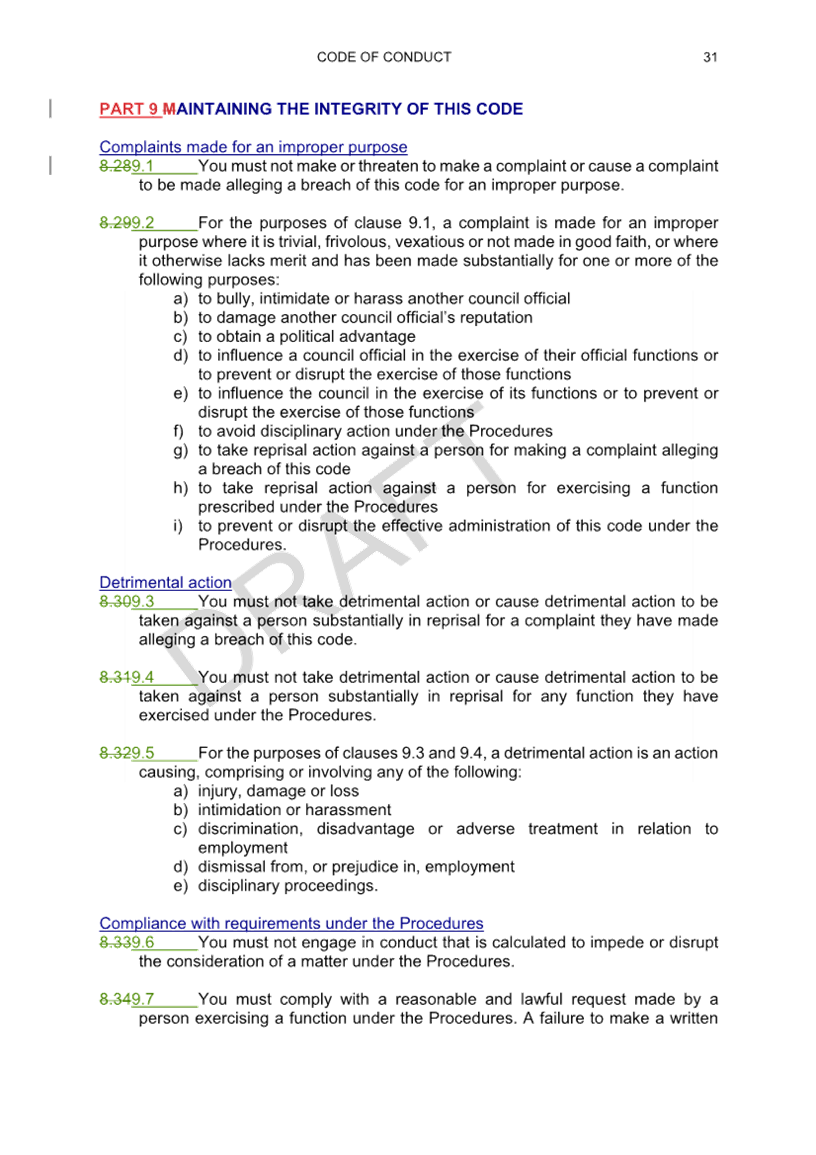
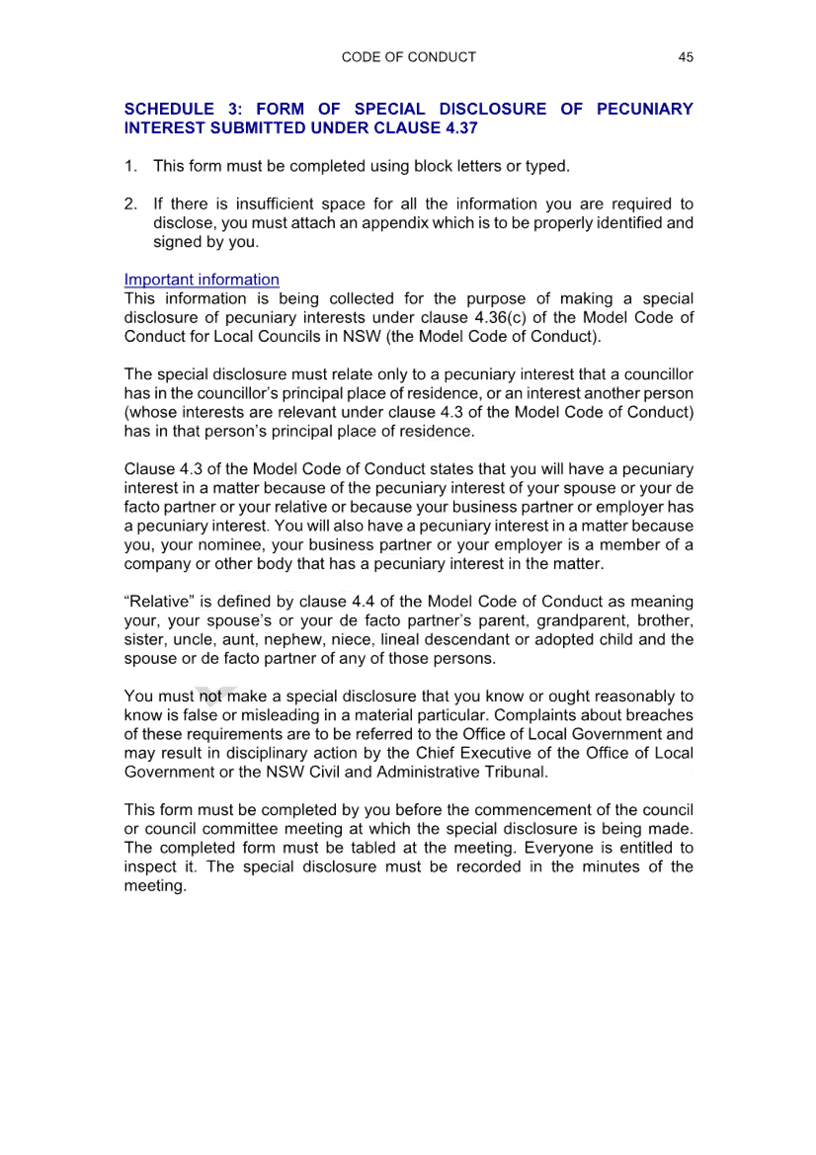
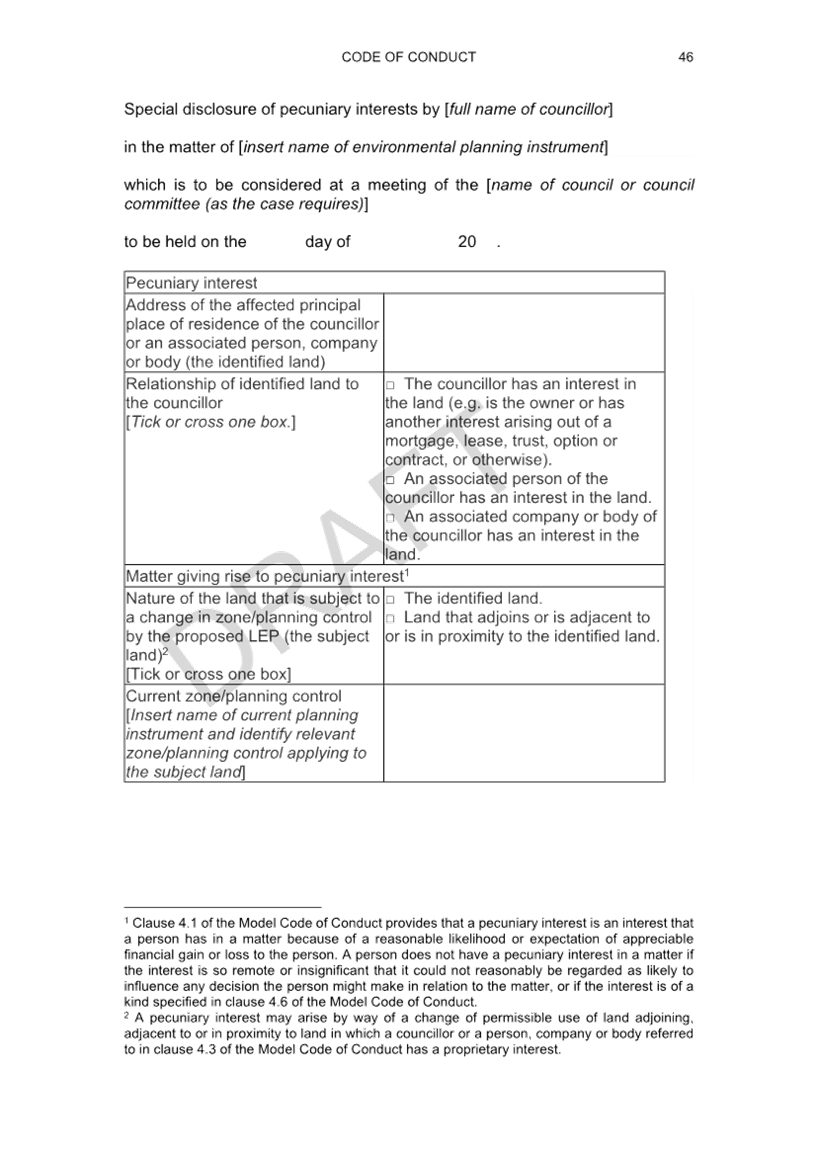
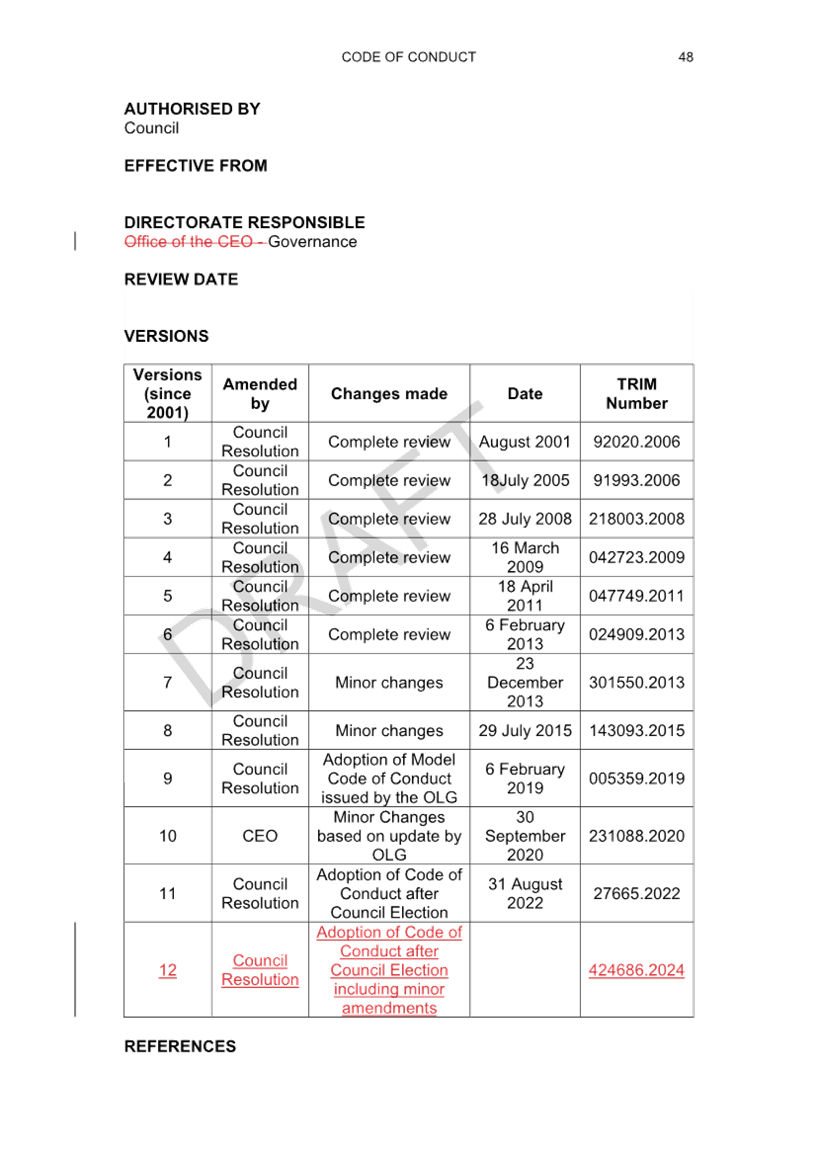
For ease of reference, marked
up versions of the Code of Conduct and Code of Conduct Procedures have been
prepared using the following legend:
|
Key
|
Explanation
|
|
Red text
|
Wording is out of date and has been
updated or typographical error
|
|
Blue Highlight
|
LCC addition not contained in the Model
Code
|
|
Green highlight
|
Similar to the Model Code but slightly
different wording
|
|
Yellow highlight
|
Council’s
Policy differs from the Model Code
|
|
Red highlight
|
Contained
in the Model Code but not within Council’s version
|
Changes have been tracked to
Council’s Code of Conduct to correct errors and out of date text.
Attention is drawn to the following proposed changes and differences identified
between Council’s Code of Conduct and the Model Code of Conduct:
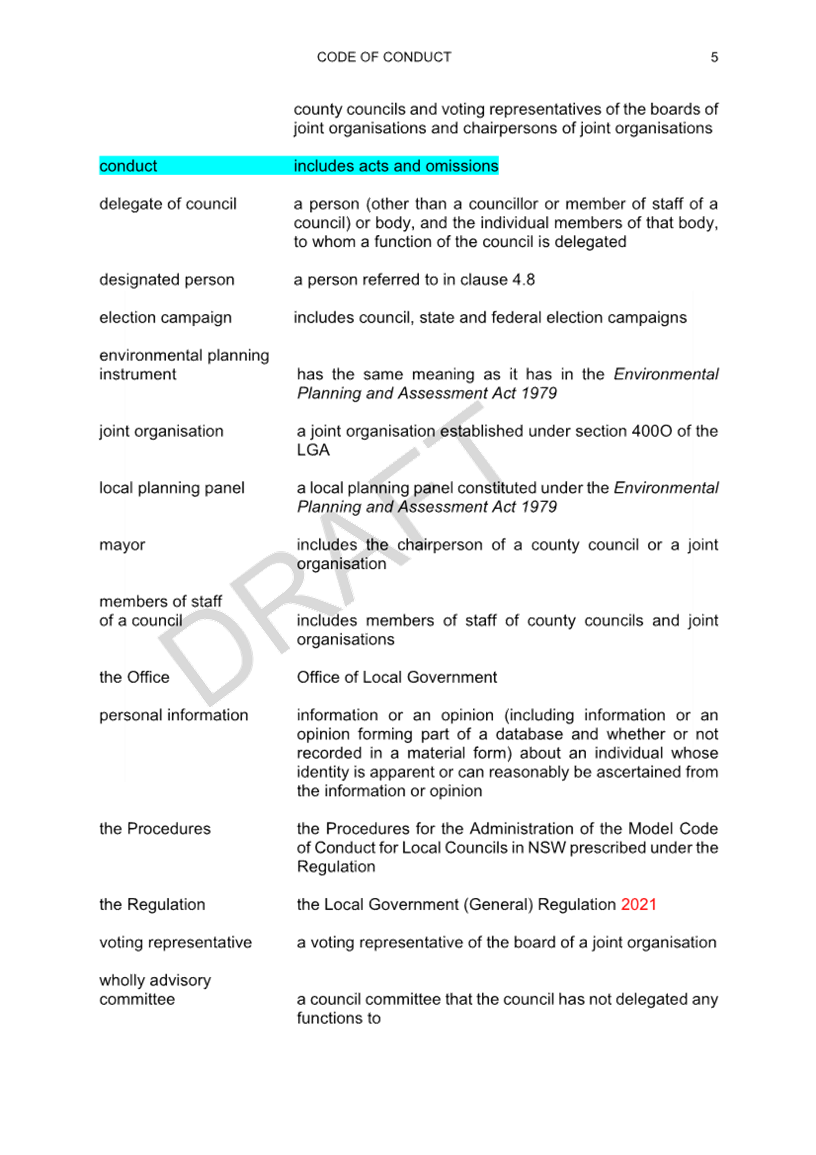
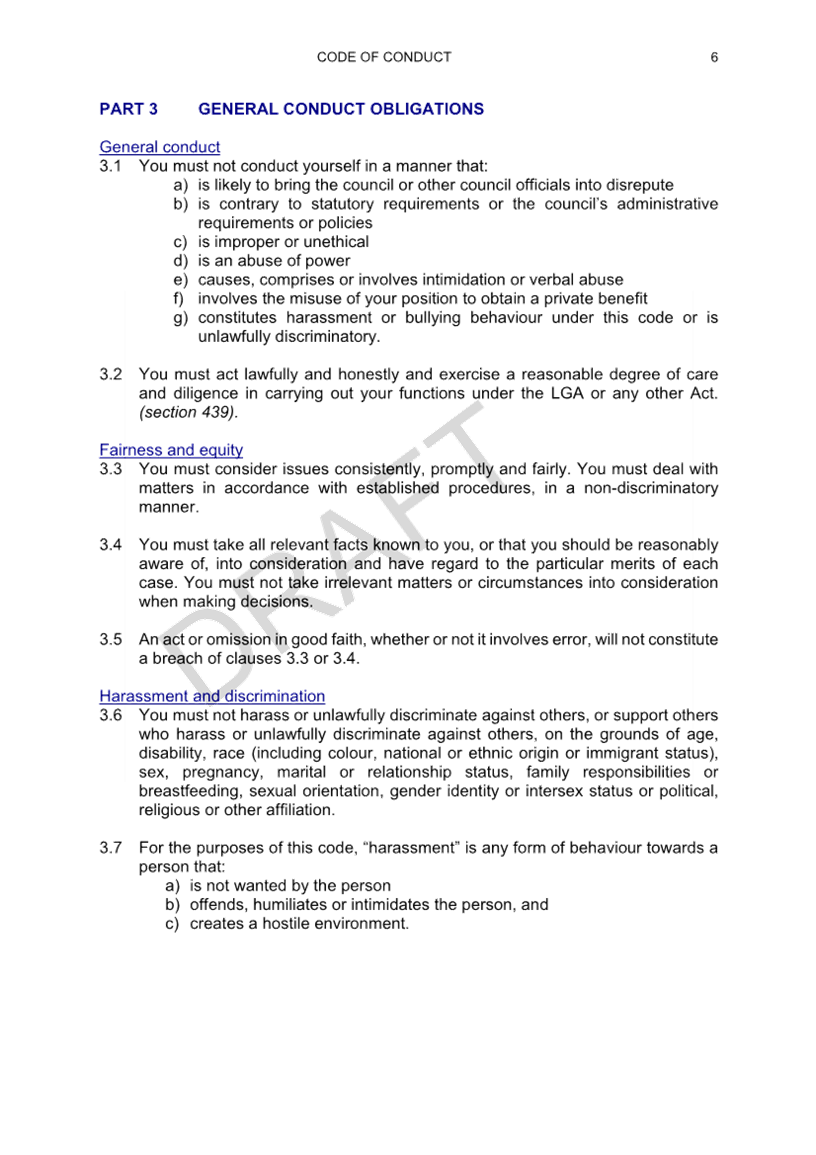
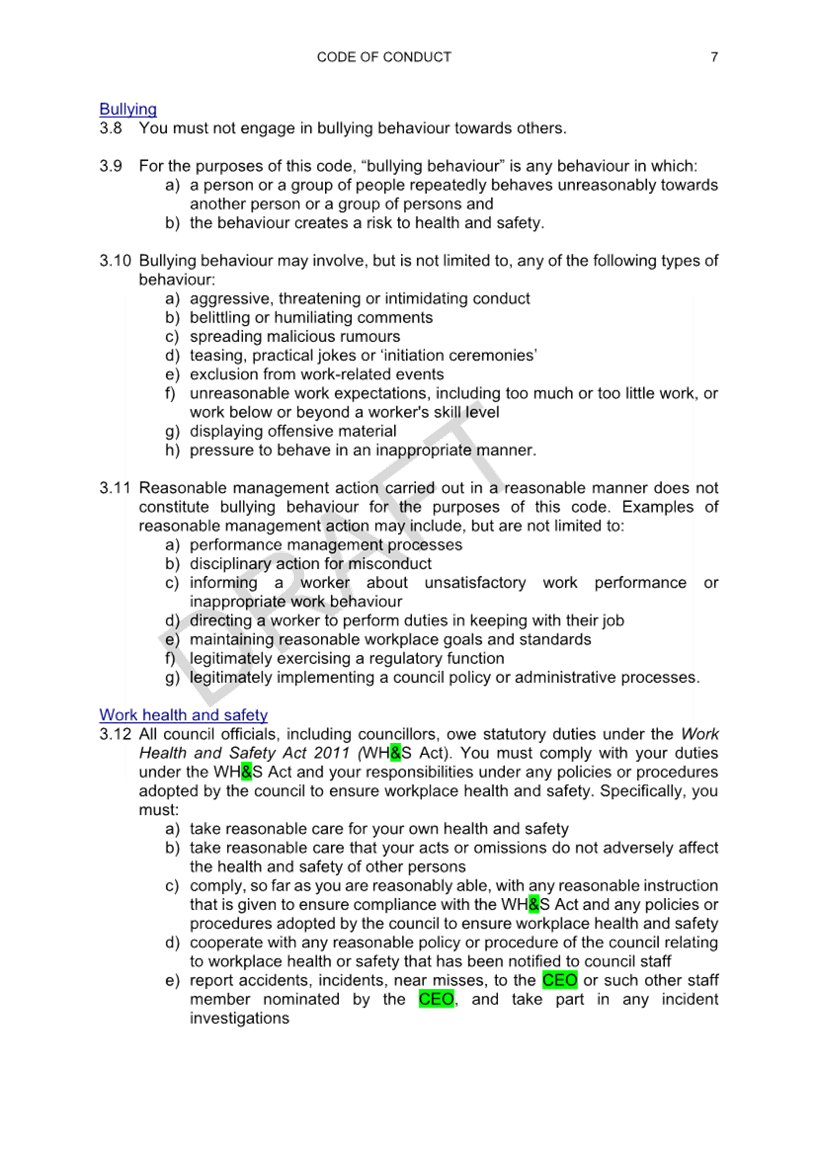
· Wording
is identified in red that has been updated to because it is out of date or to
correct a typographical error.
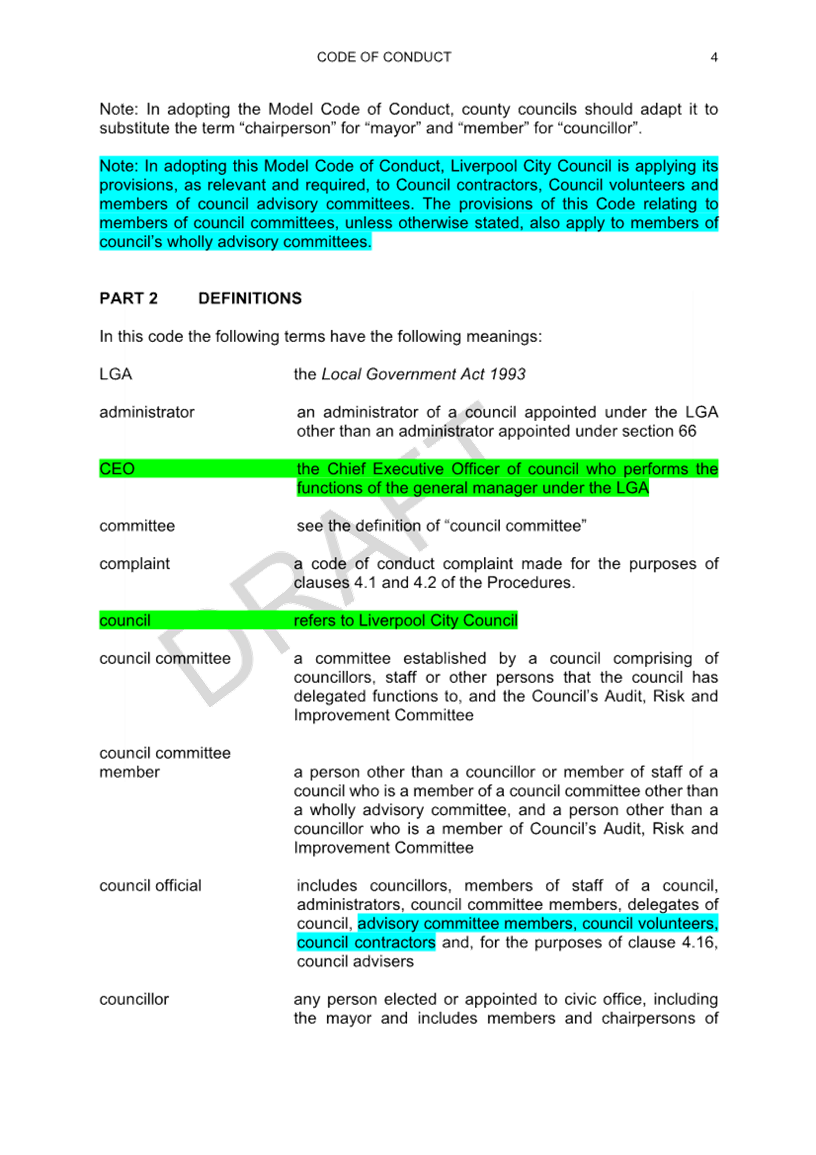
· Council’s Code has an additional advisory note at page 4 regarding
application of the Code to contractors, volunteers etc. This is consistent with
the Model Code and is not proposed to be changed.
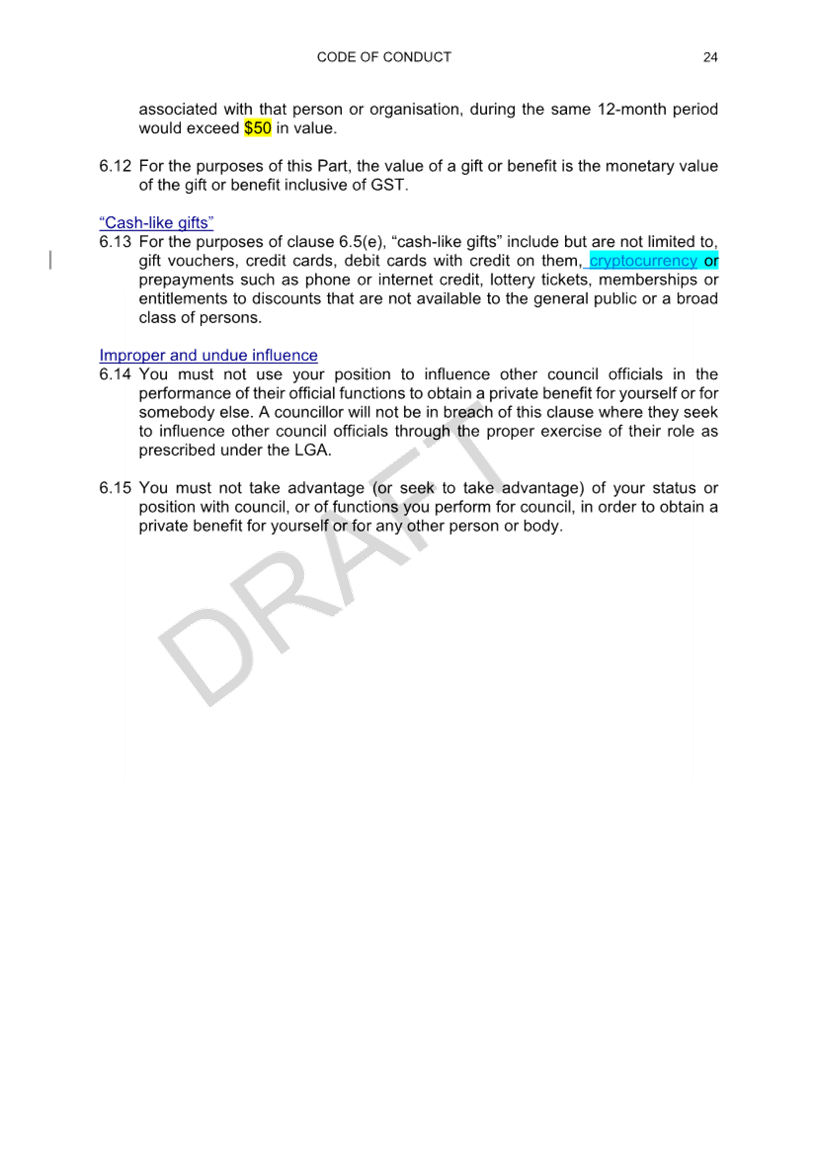
· Council’s Code includes cryptocurrency in the definition of a cash like
gift in paragraph 6.13 at page 4. This is consistent with the Model Code and is
not proposed to be changed.
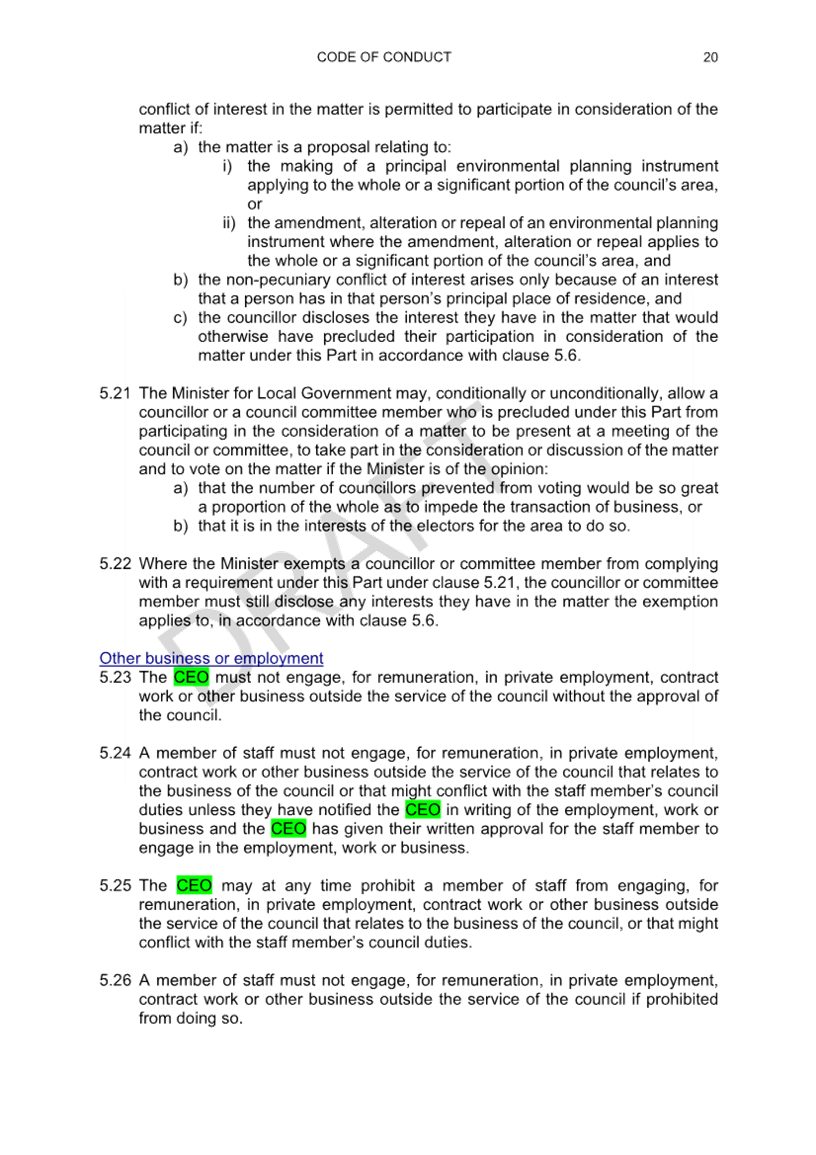
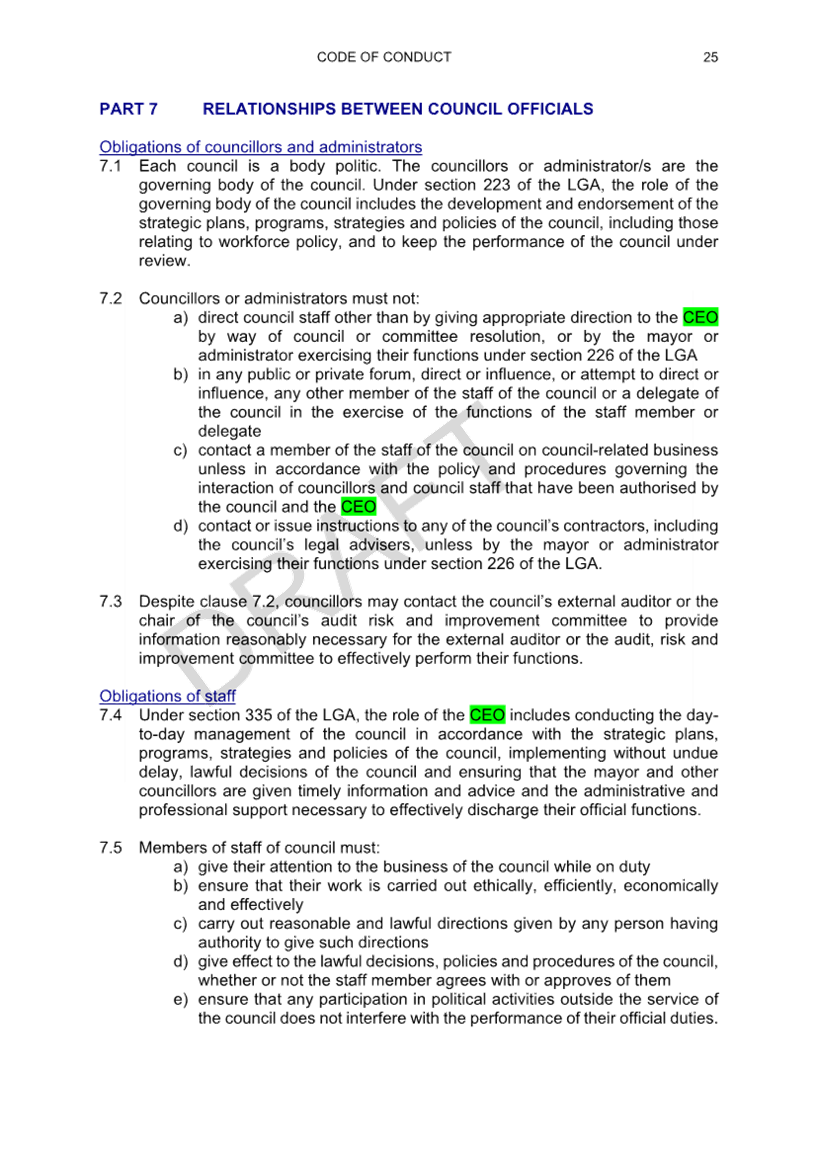
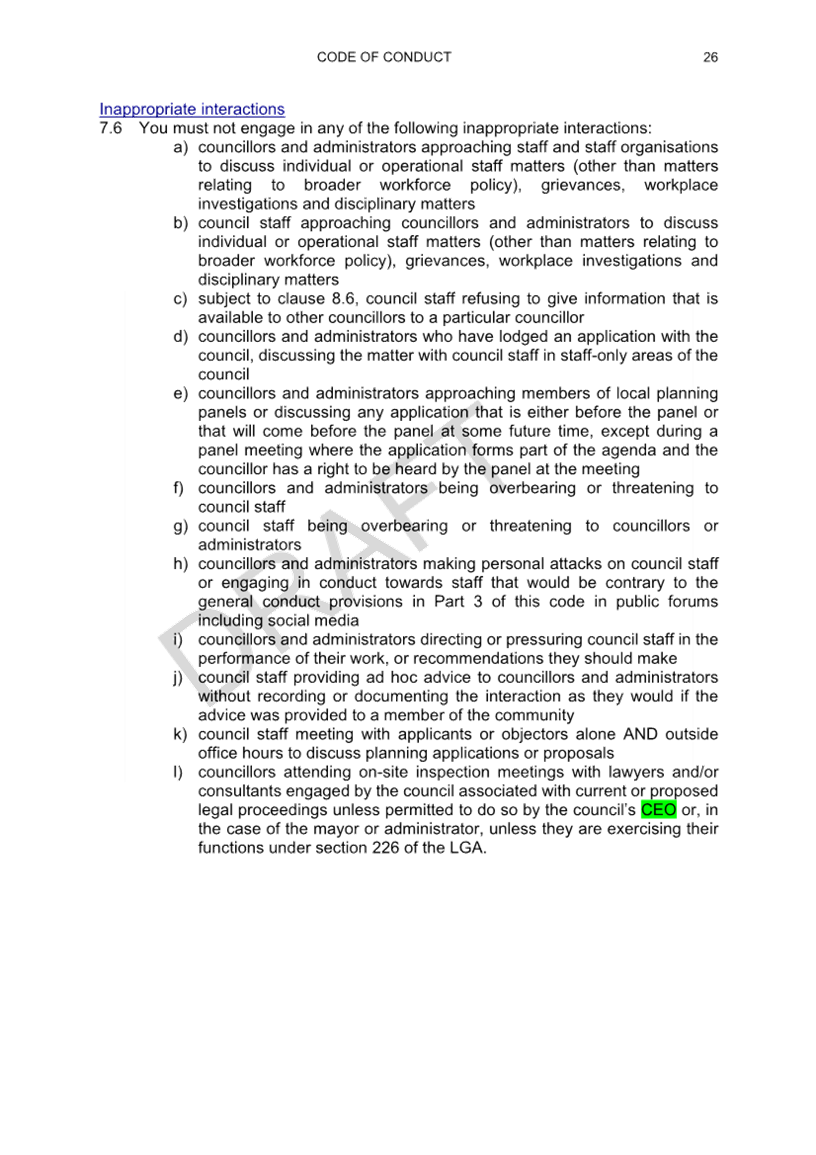
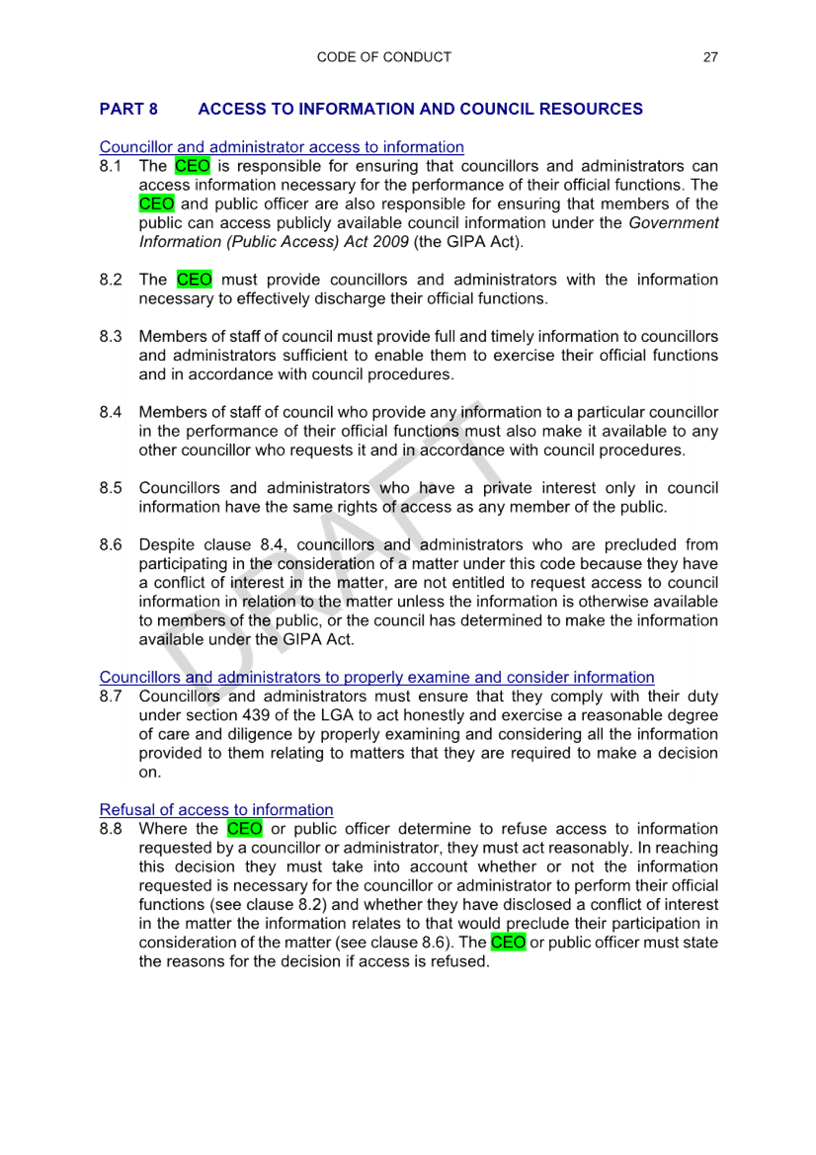
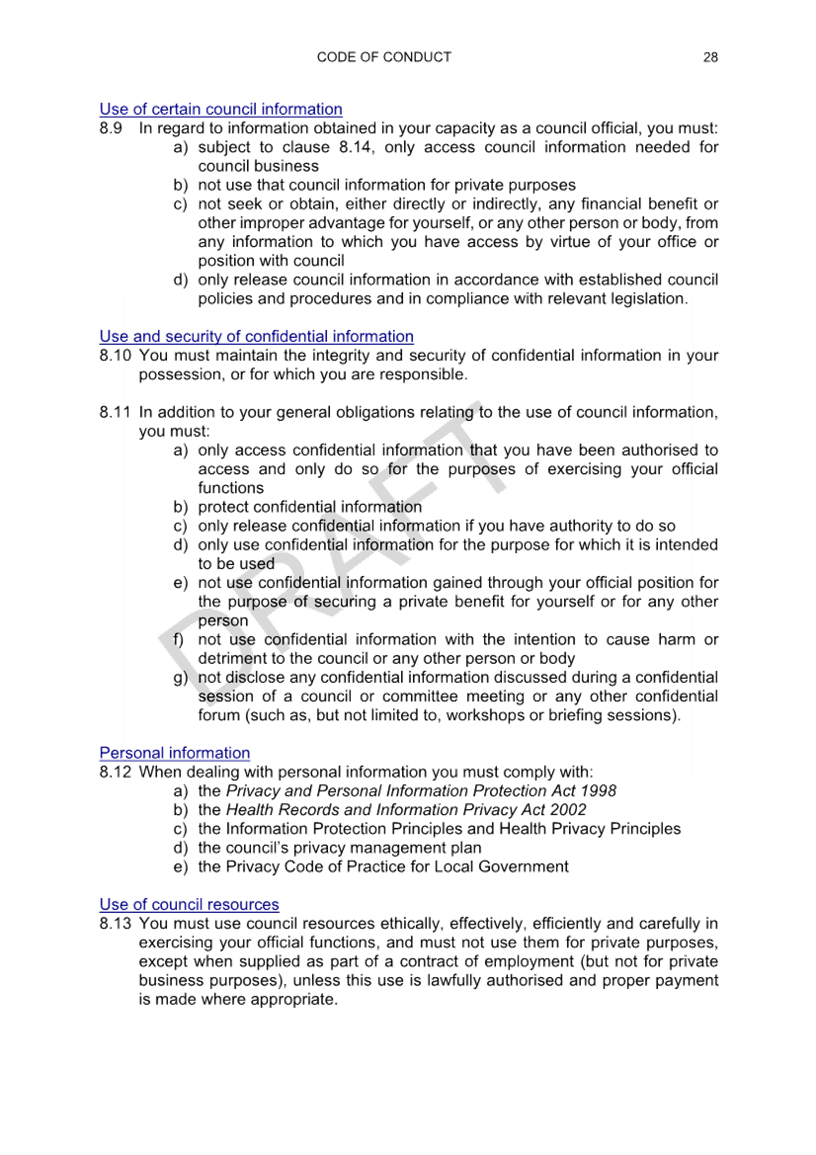
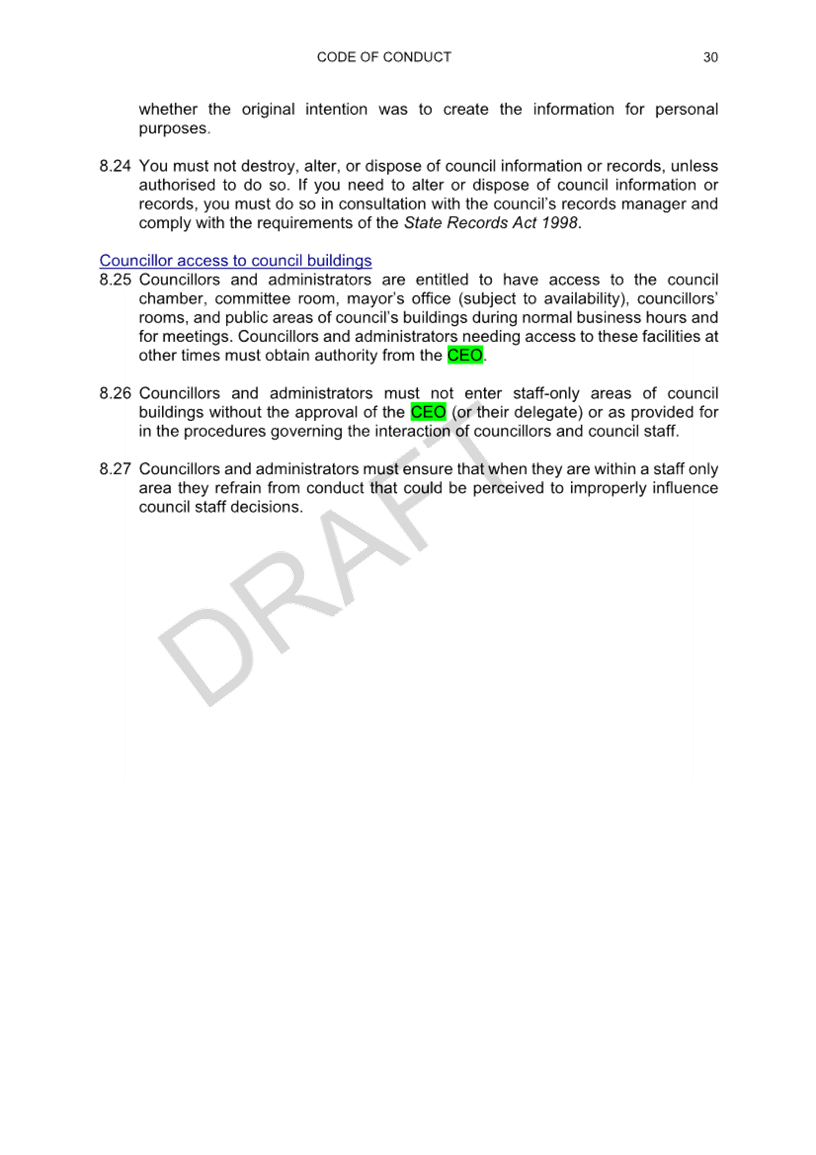
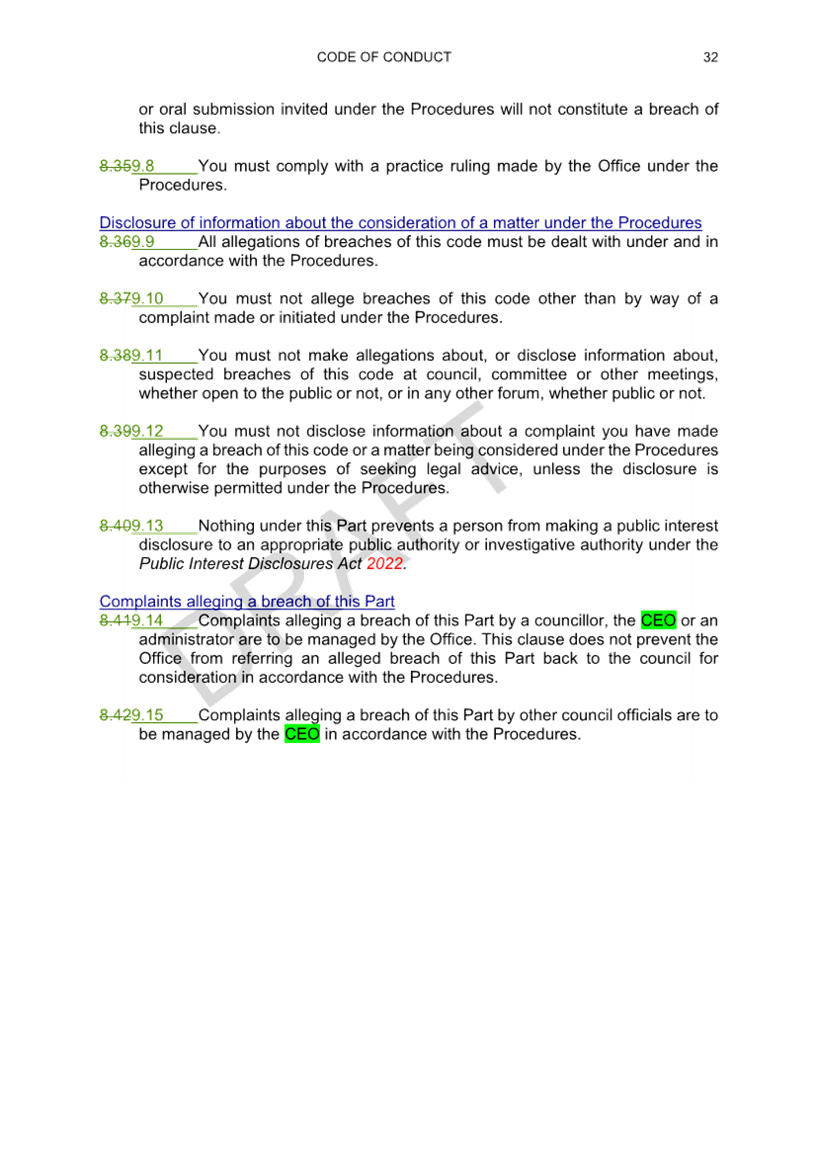
· Council’s Code references the CEO throughout the document rather than the
General Manager. It has been made clear in the definitions that Council’s
CEO carries out the functions of the General Manager. This is consistent with
the Model Code and it is proposed to retain the language.
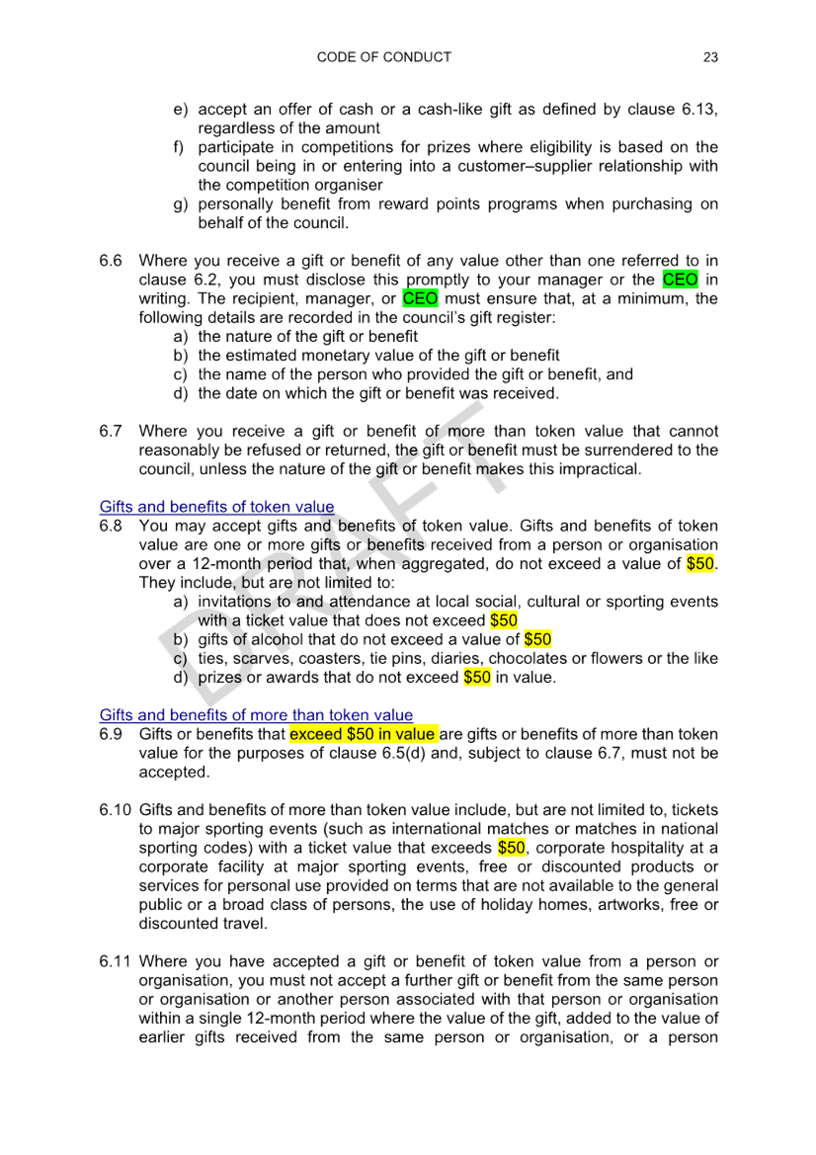
· Council’s Code identifies at paragraph 6.8
to 6.11 that a gift of more than $50 is
not a token gift. Whilst the Model Code has been updated to $100, the OLG has
advised Council’s that they have the option to retain the value at $50.
It is proposed to retain the $50 threshold.
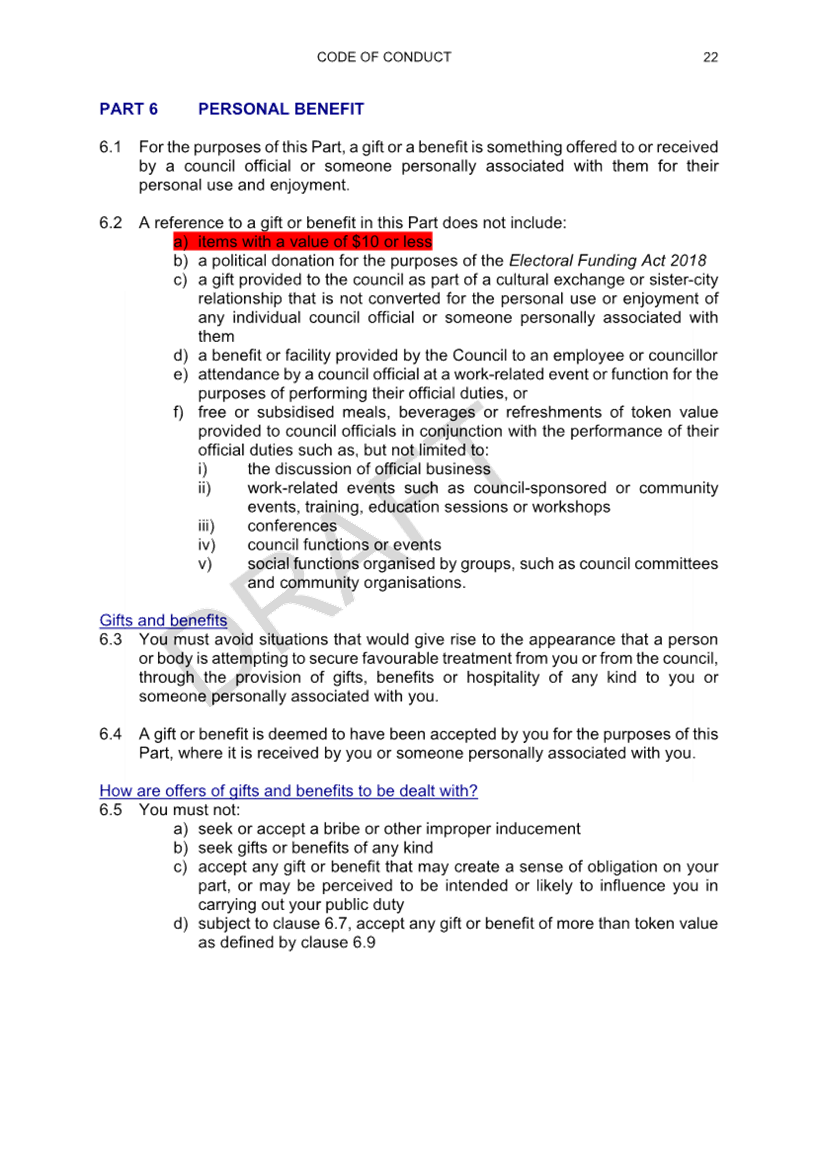
· Paragraph 6.2(a) provides that items with a value of less than $10 are not gifts
or benefits for the purposes of the Code of Conduct. It appears that this was
inadvertently omitted from Council’s current version of the Code and it
is proposed to insert the missing text.
The same exercise has been
conducted in relation to the Model Code of Conduct Procedures and attention is
drawn to the following:
· Wording
is identified in red that has been updated to because it is out of date or to
correct a typographical error.
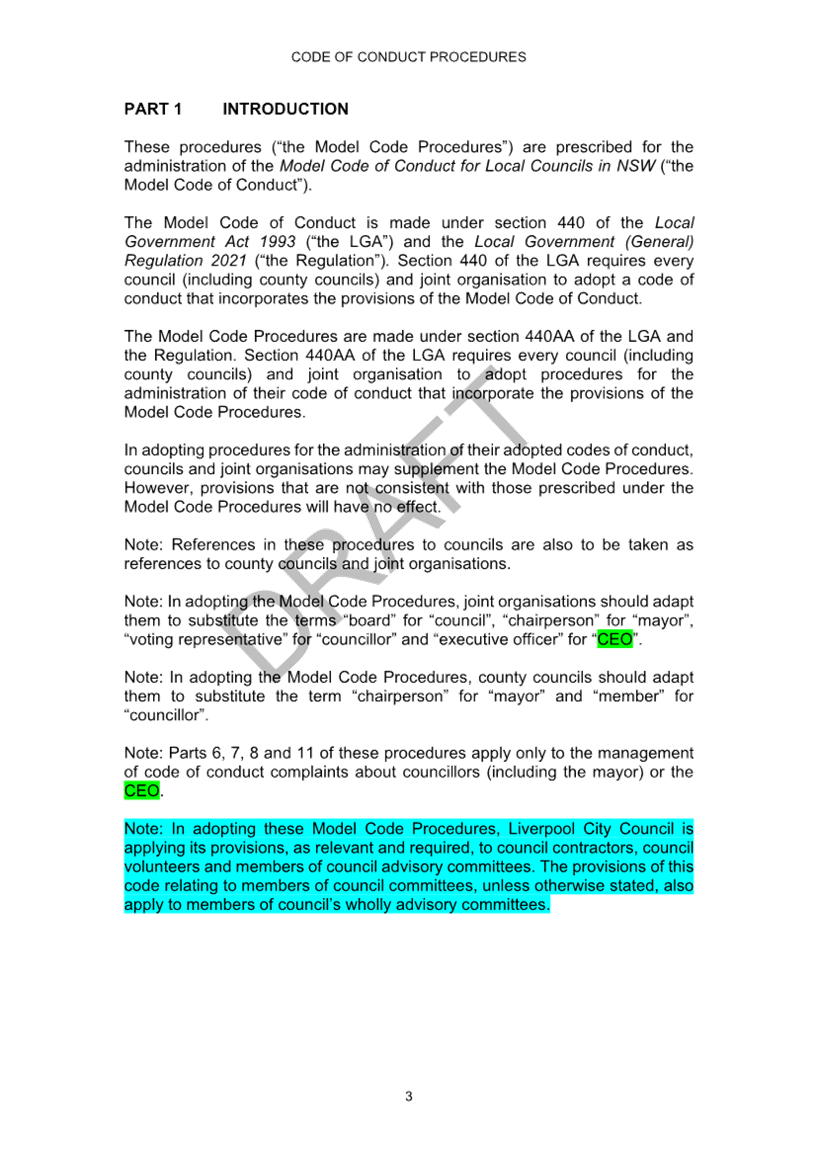
· Council’s Code has an additional advisory note at page 3 regarding
application of the Code to contractors, volunteers etc. This is consistent with
the Model Code and is not proposed to be changed.
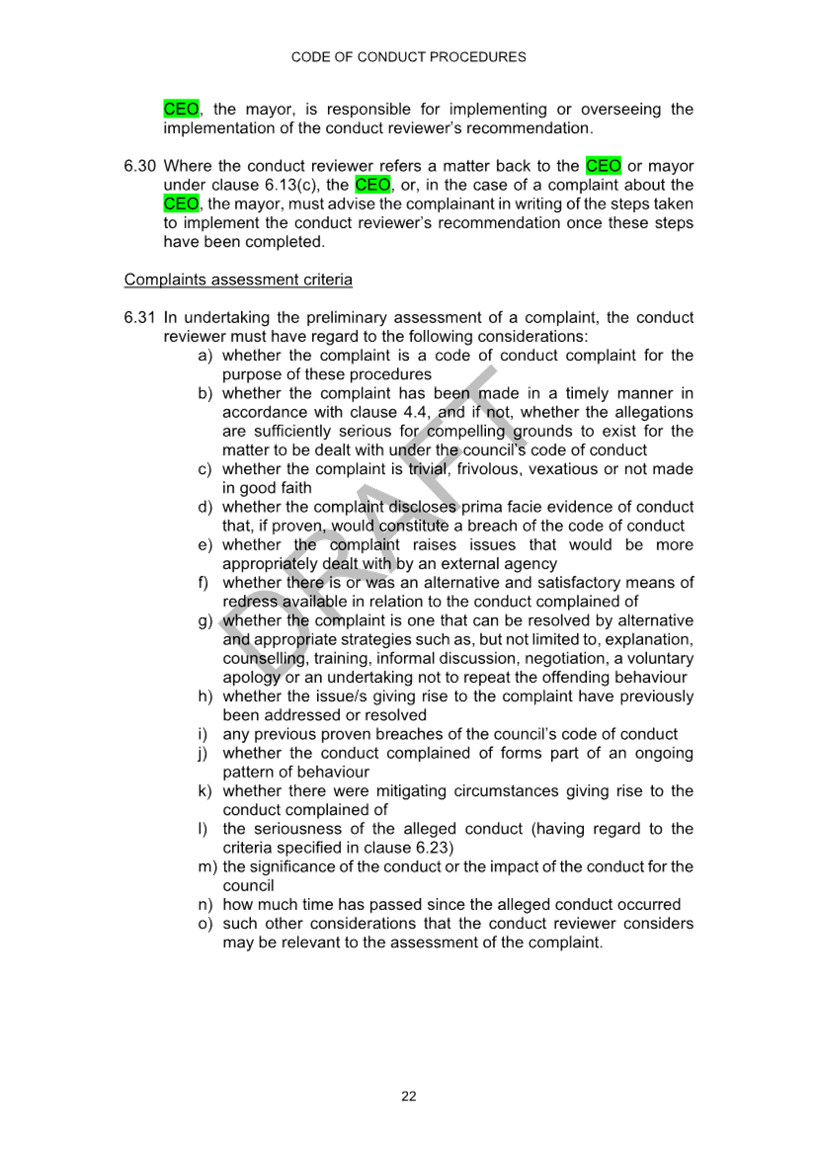
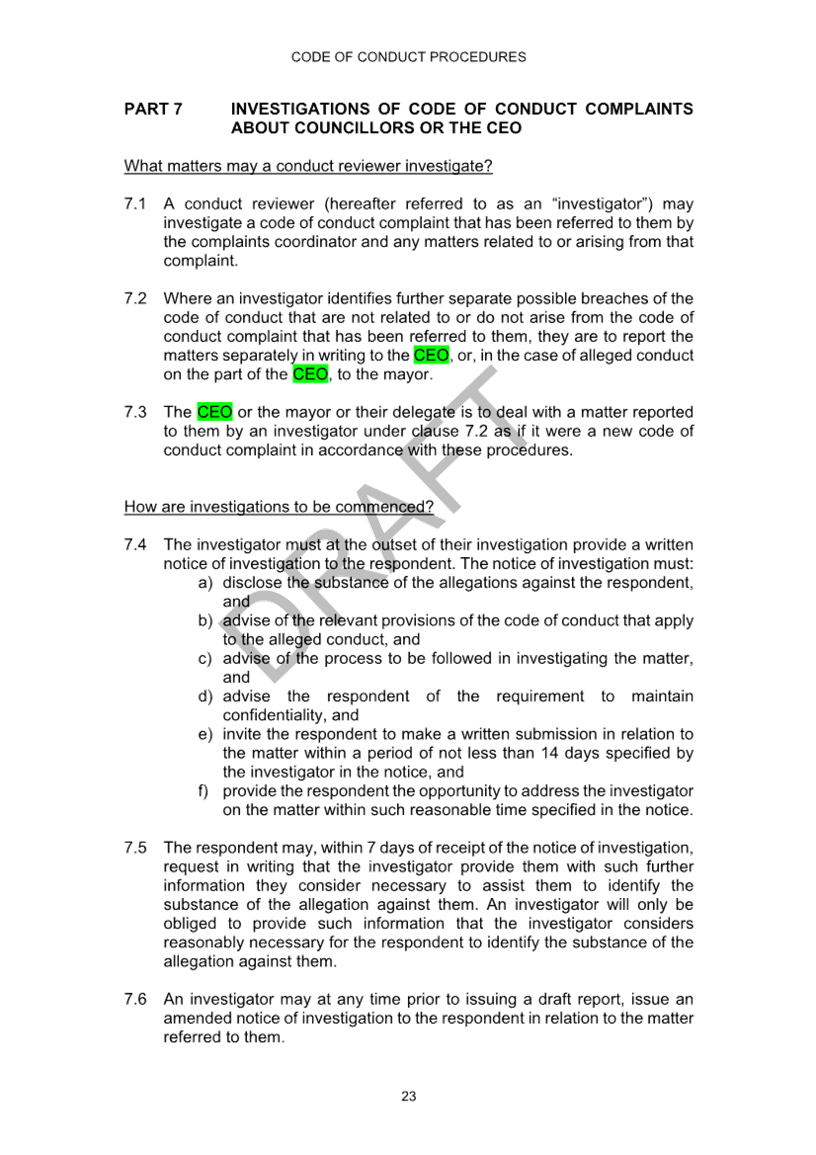
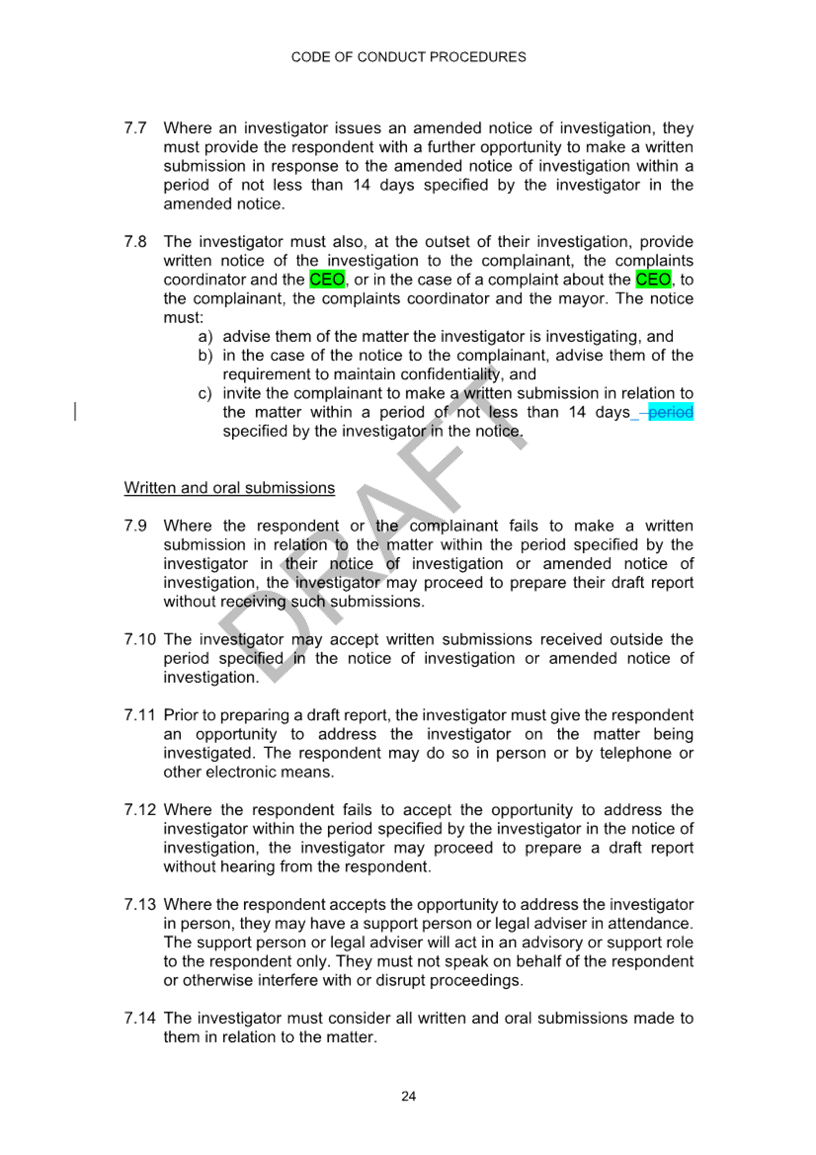
· It is proposed to delete the word “period” from paragraph 7.8 (c) at page 24
of Council’s Code as it is not included in the Model Code and appears to
have been included in error.
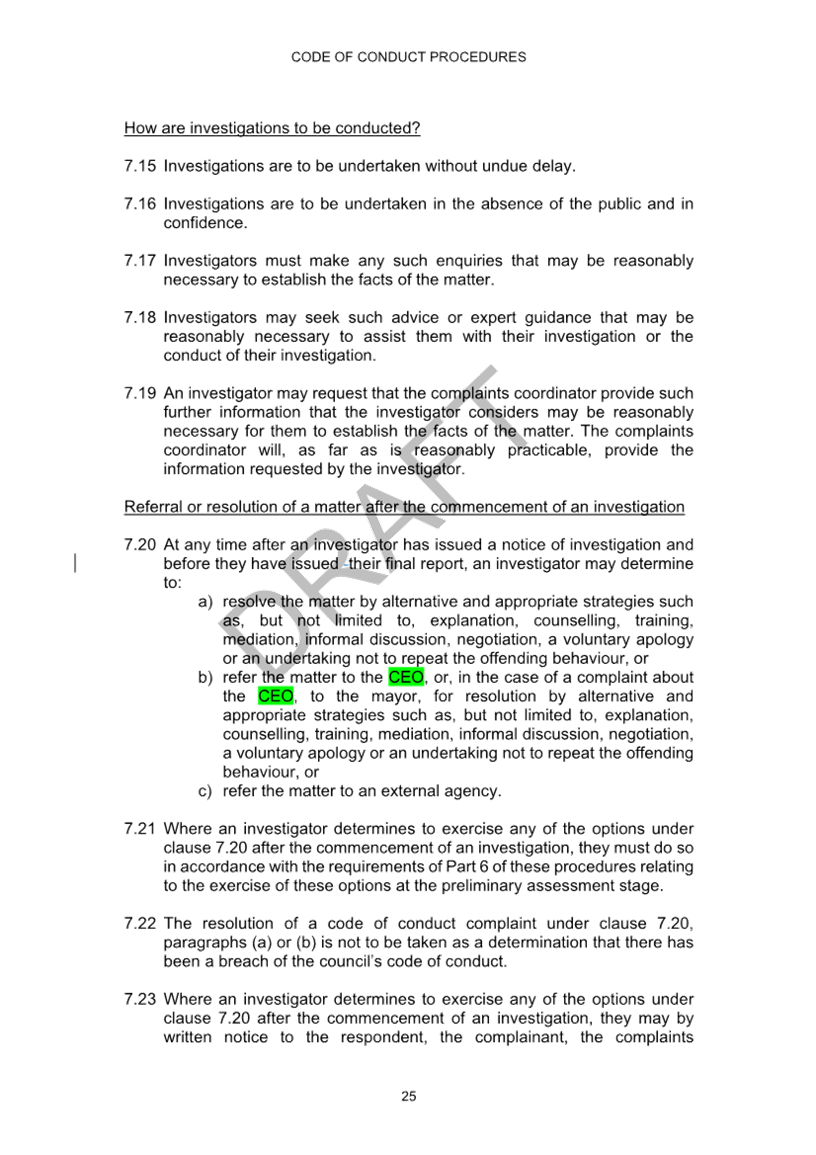
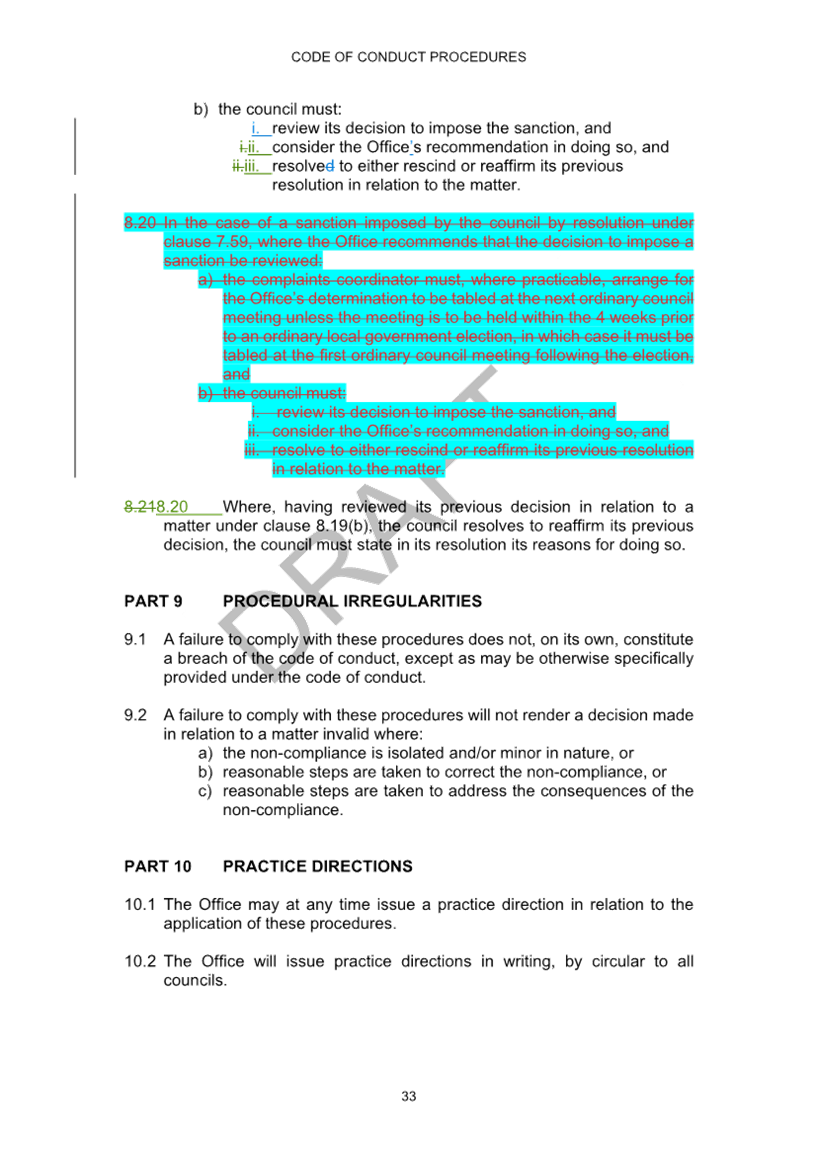
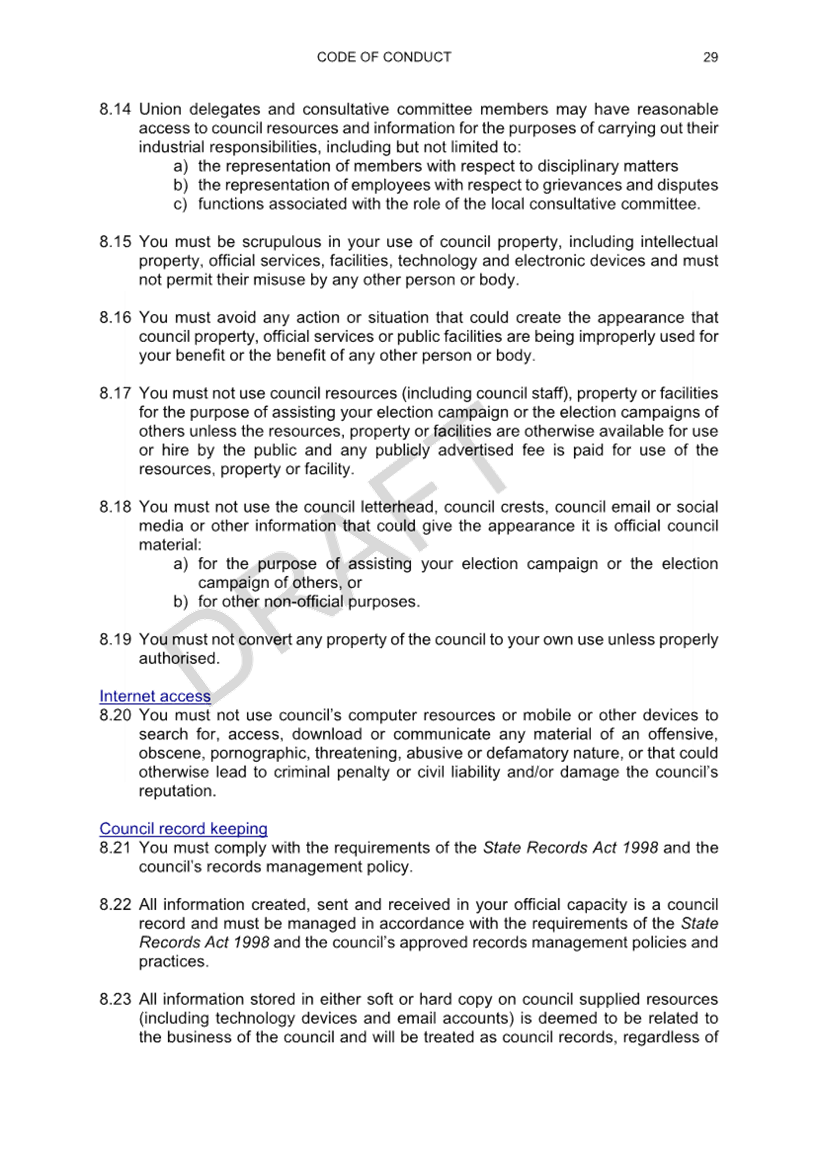
· It is proposed to delete paragraph 8.20 at page 33 of Council’s Code as the text was
removed from the 2020 version of the Model Code.
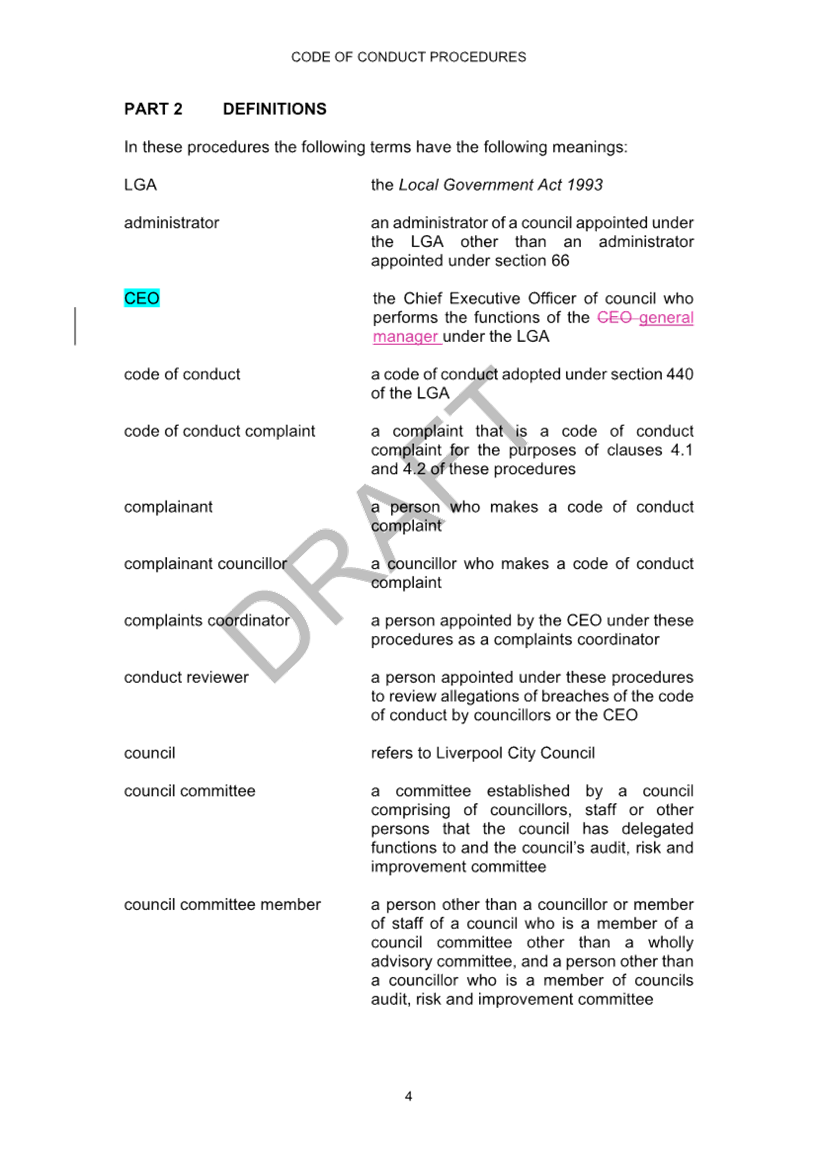
· Council’s Code references the CEO throughout the document rather than the
General Manager. It is proposed to amend the definition of CEO to make clear
that Council’s CEO carries out the functions of the General Manager. This
is consistent with the Model Code and it is proposed to retain the language.
There
are no financial implications relating to the development and implementation of
the Draft Code of Conduct and Code of Conduct Procedures and will be undertaken
by the Legal and Governance team within existing budgets.
|
Economic
|
There are no economic and financial considerations.
|
|
Environment
|
There are no environmental and sustainability
considerations.
|
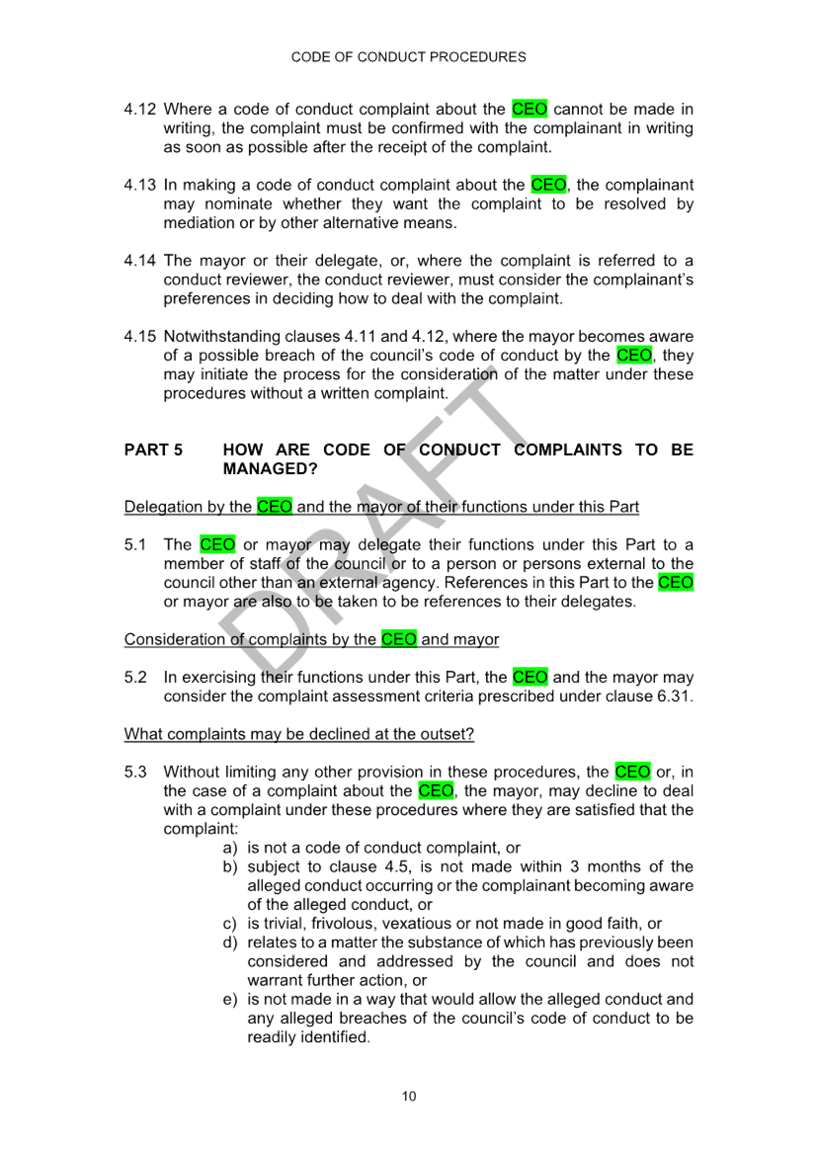
Social
|
There are no social and cultural considerations.
|
Civic
Leadership
|
Operate a well-developed governance system that demonstrates accountability,
transparency and ethical conduct.
|
|
Legislative
|
Local Government Act 1993
Local Government (General) Regulation 2021
Office of Local Government (OLG) Model Code of Conduct for Local Councils
in NSW
Office of Local Government (OLG) Procedures for the
Administration of the Model Code of Conduct for Local Councils in NSW
|
|
Risk
|
The risk is deemed to be Low as Councils
Draft Code of Conduct and Code of Conduct Procedures are consistent with the
Model Codes published by the Office of Local Government (OLG).
|
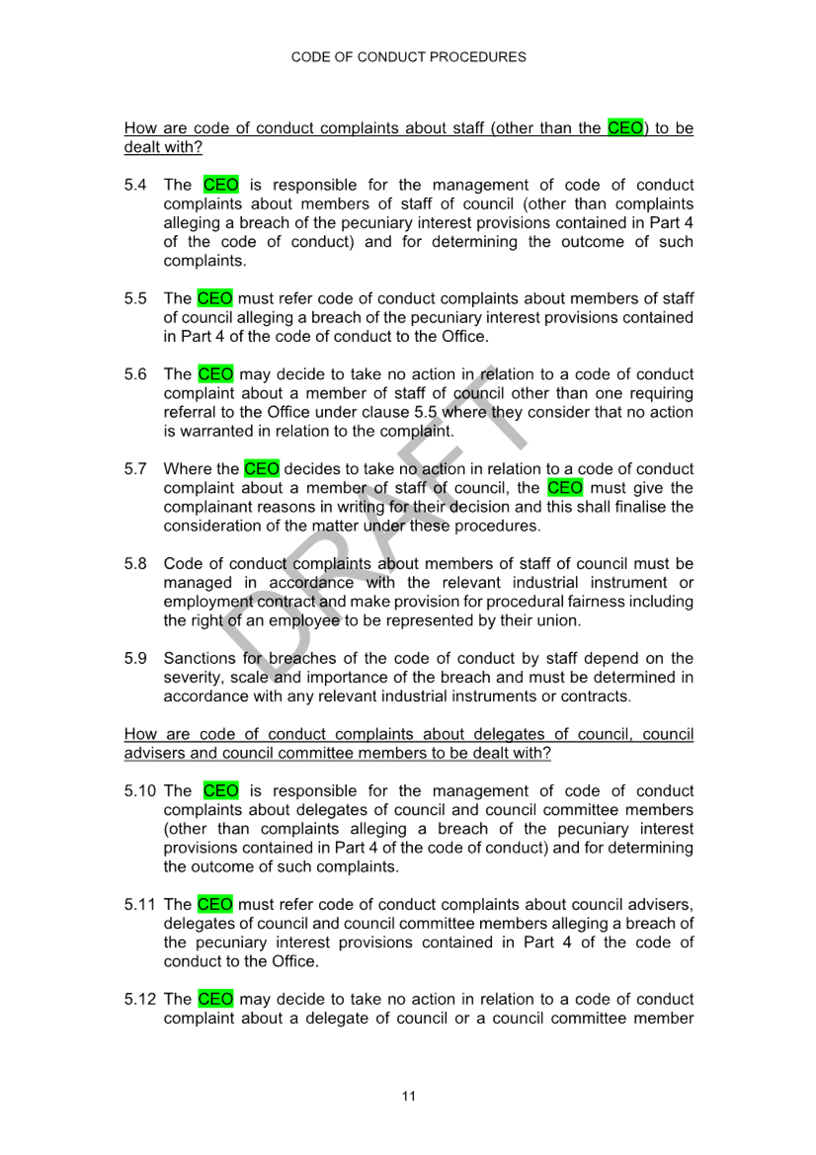
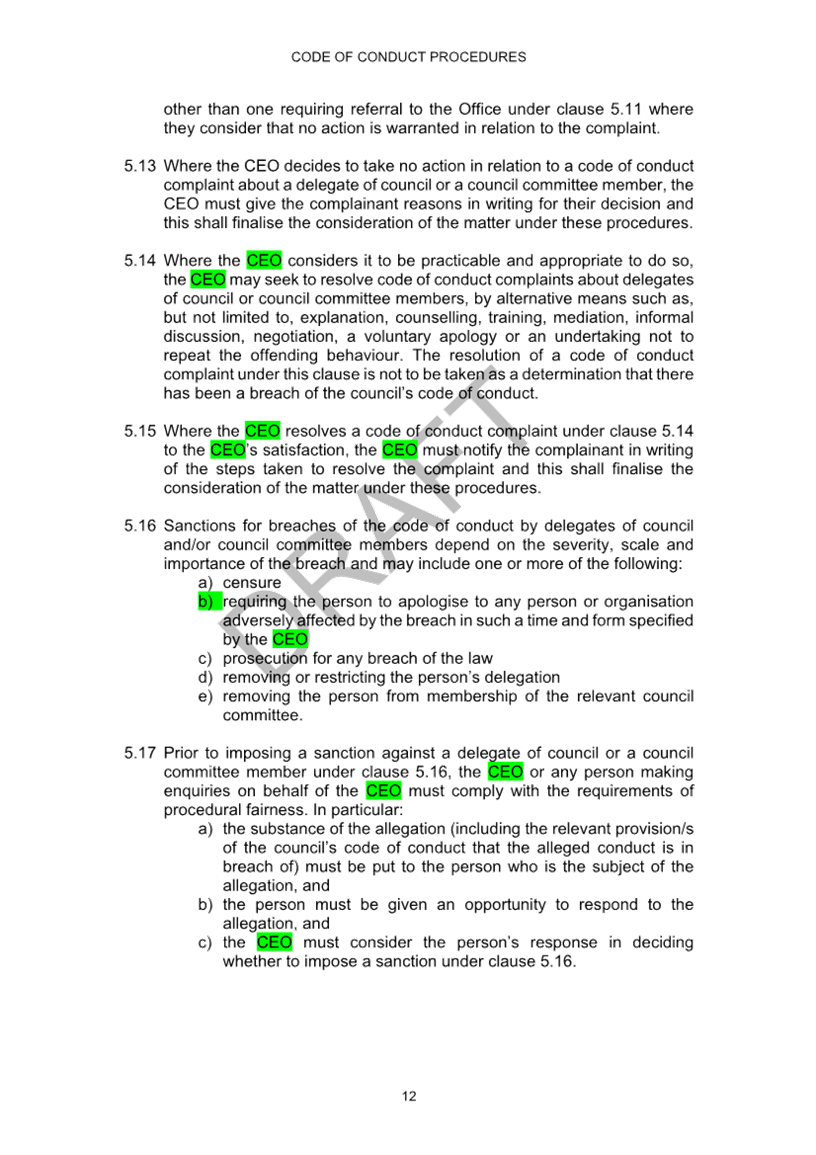
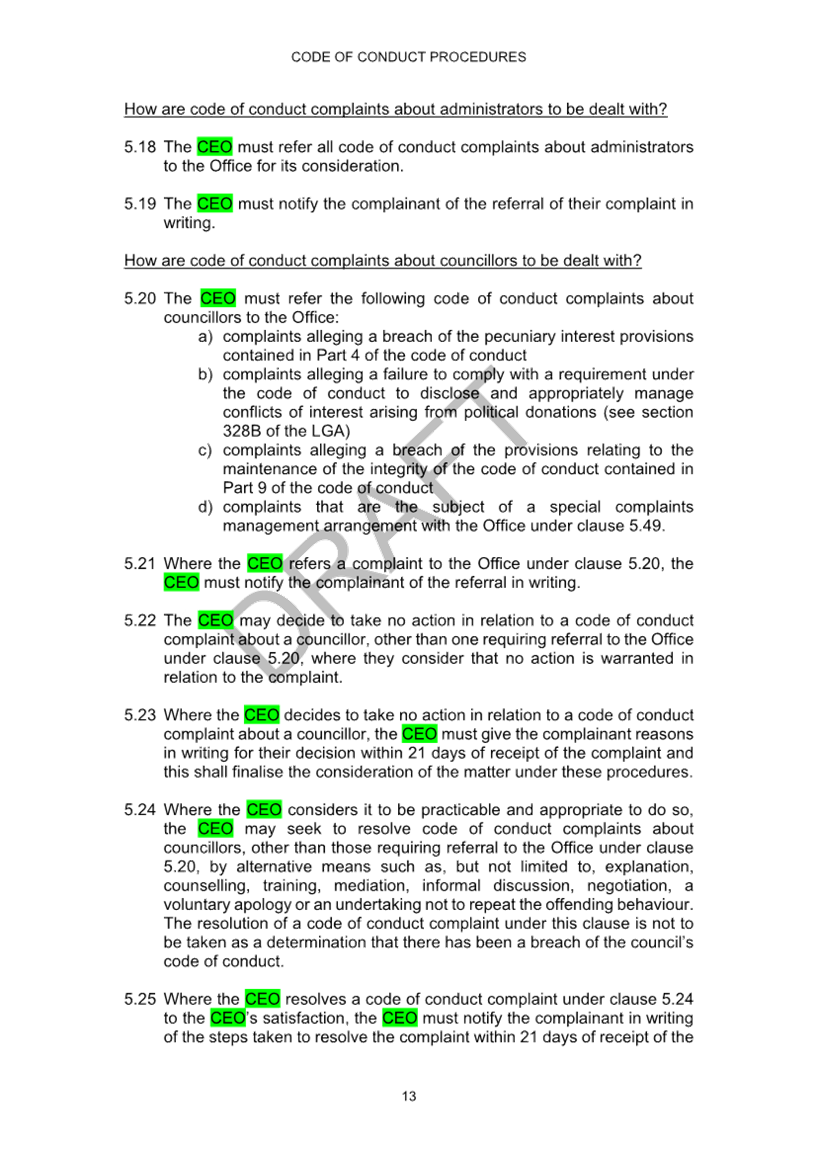
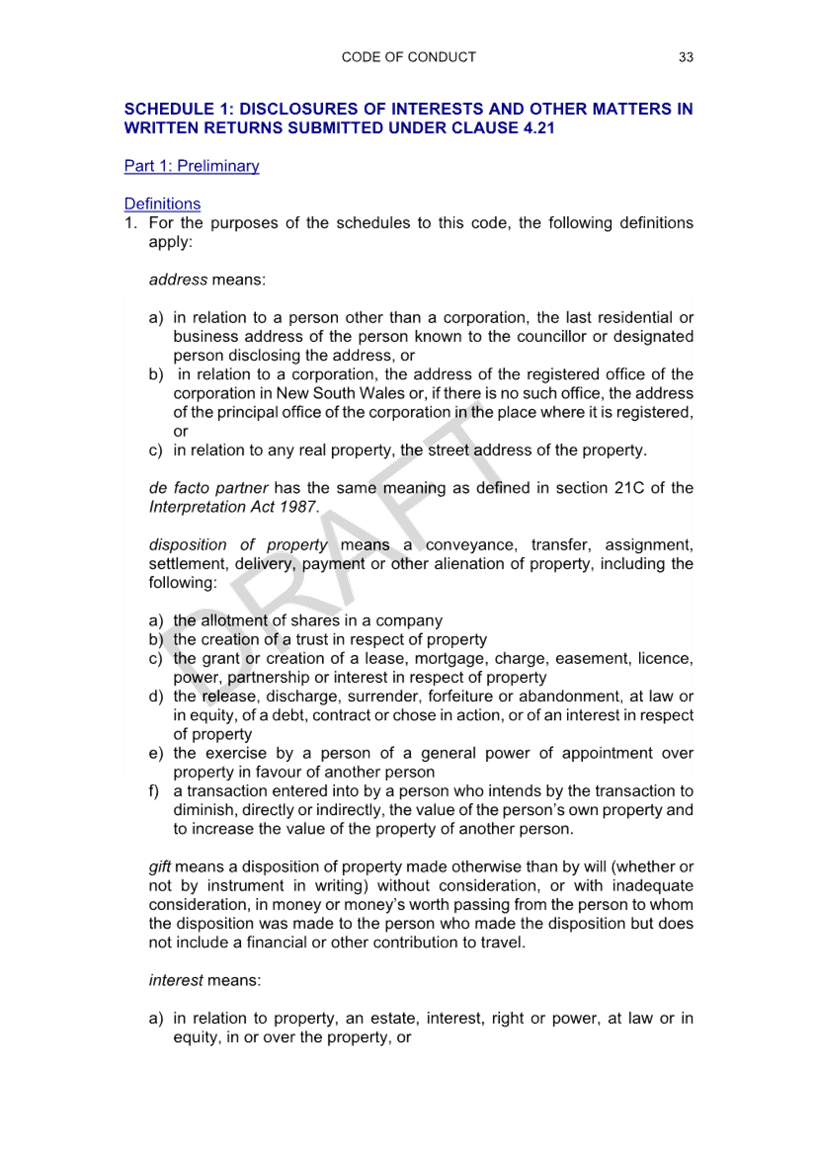
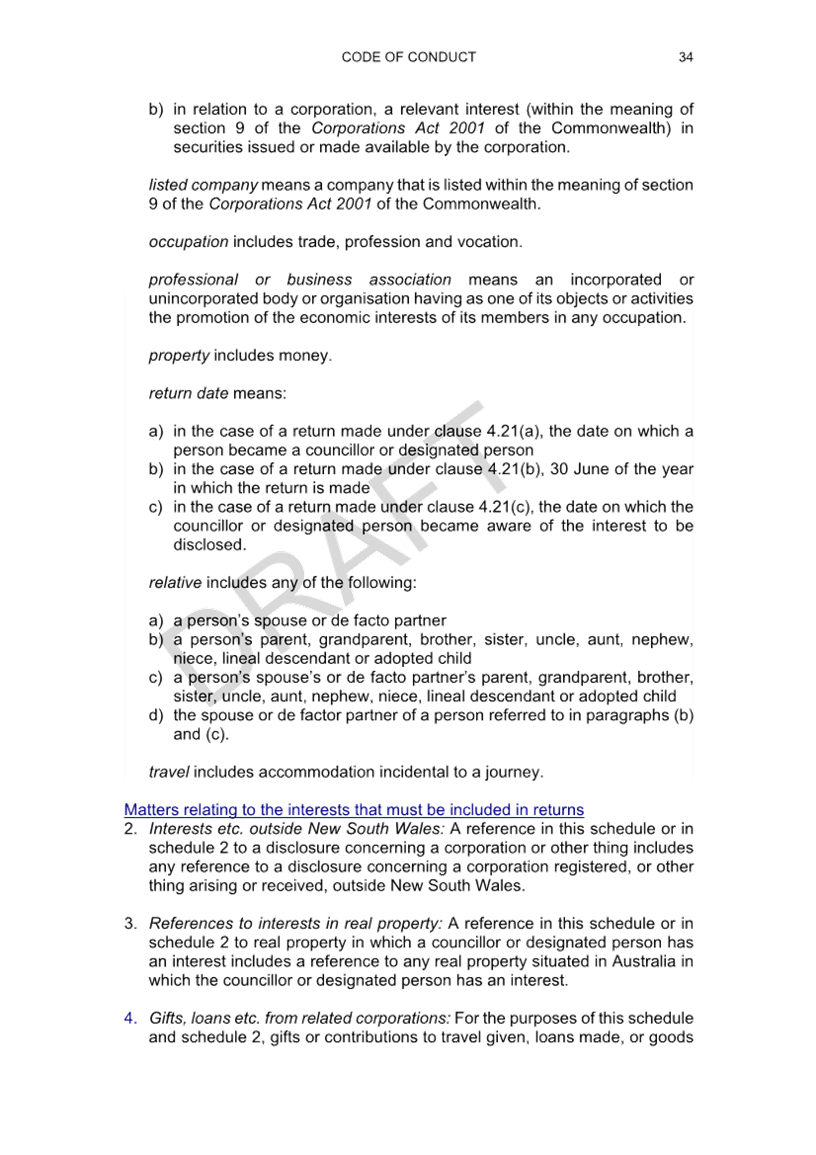
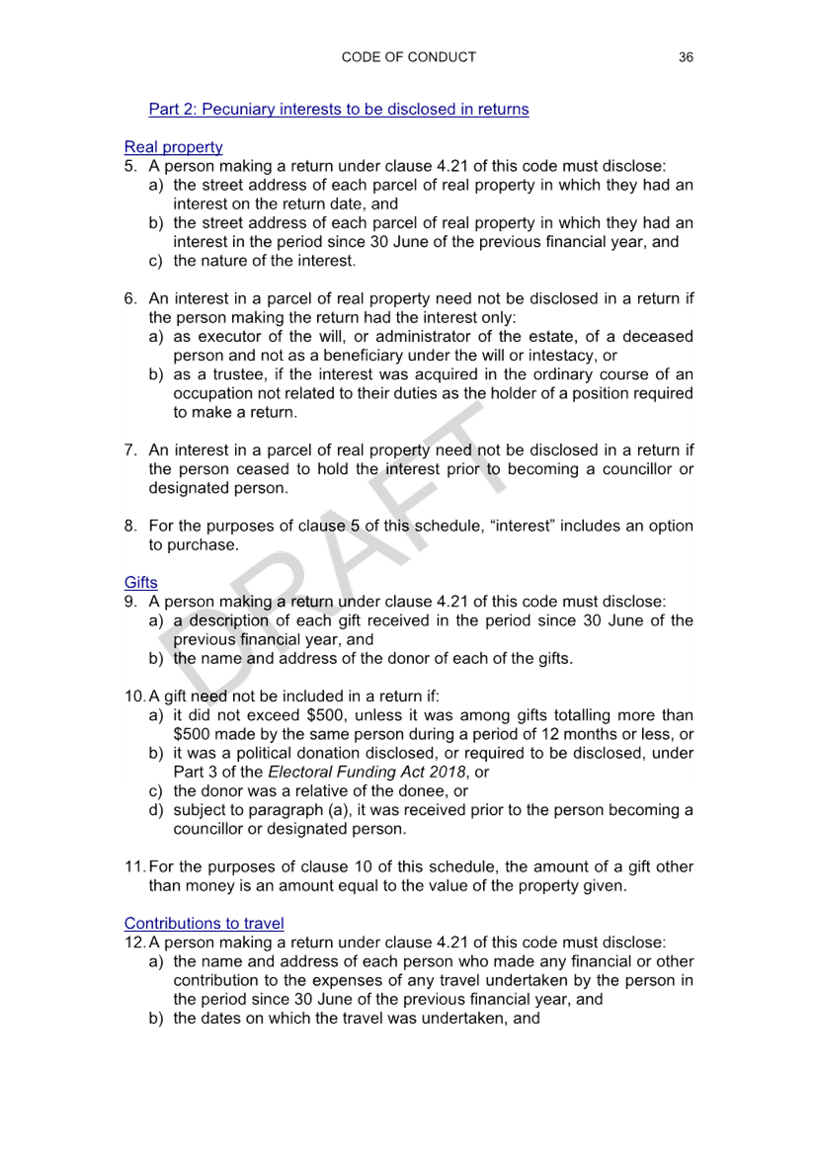
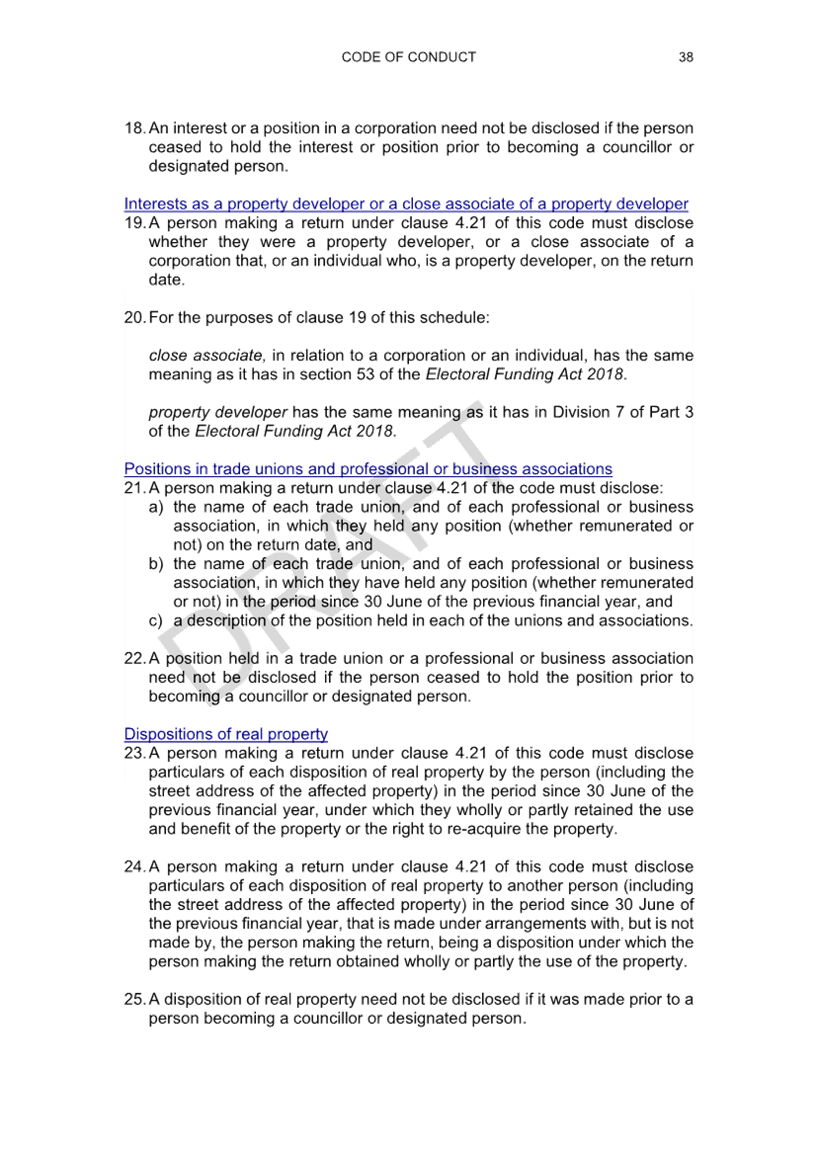
1. Draft
Code of Conduct with coloured markup January 2025
2. Draft
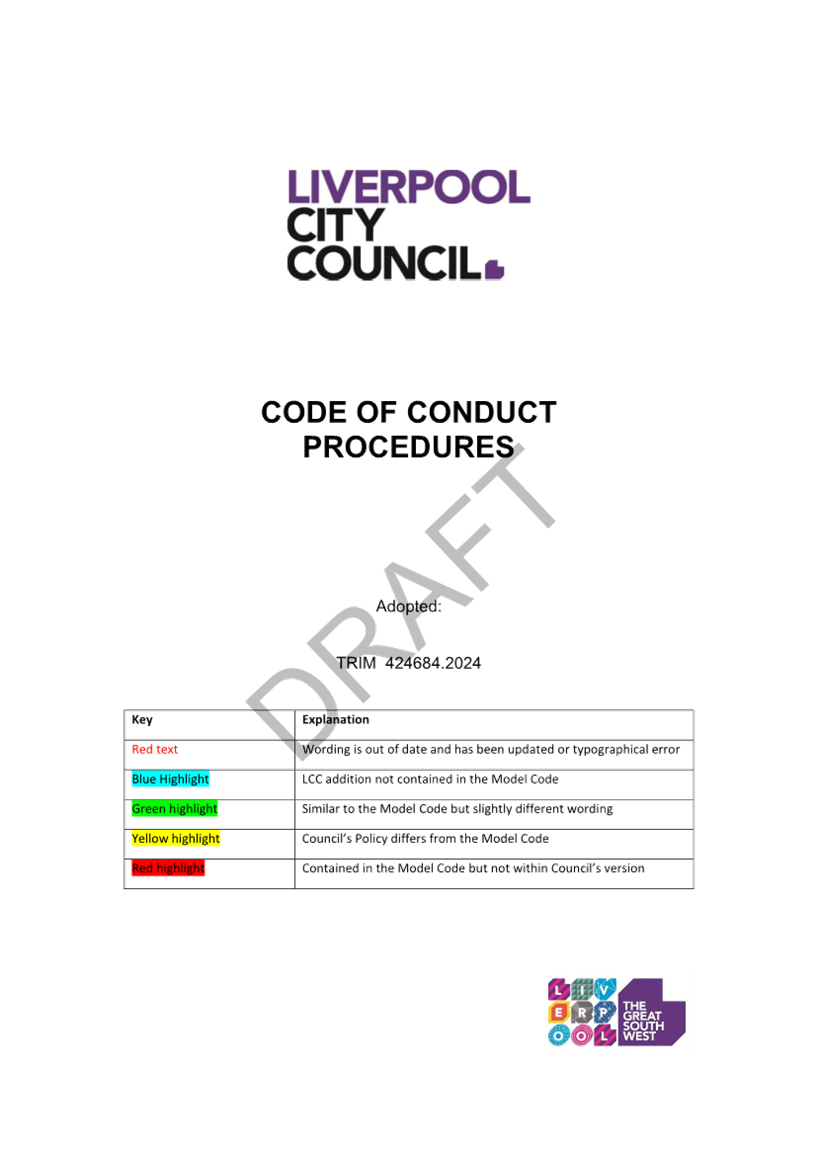
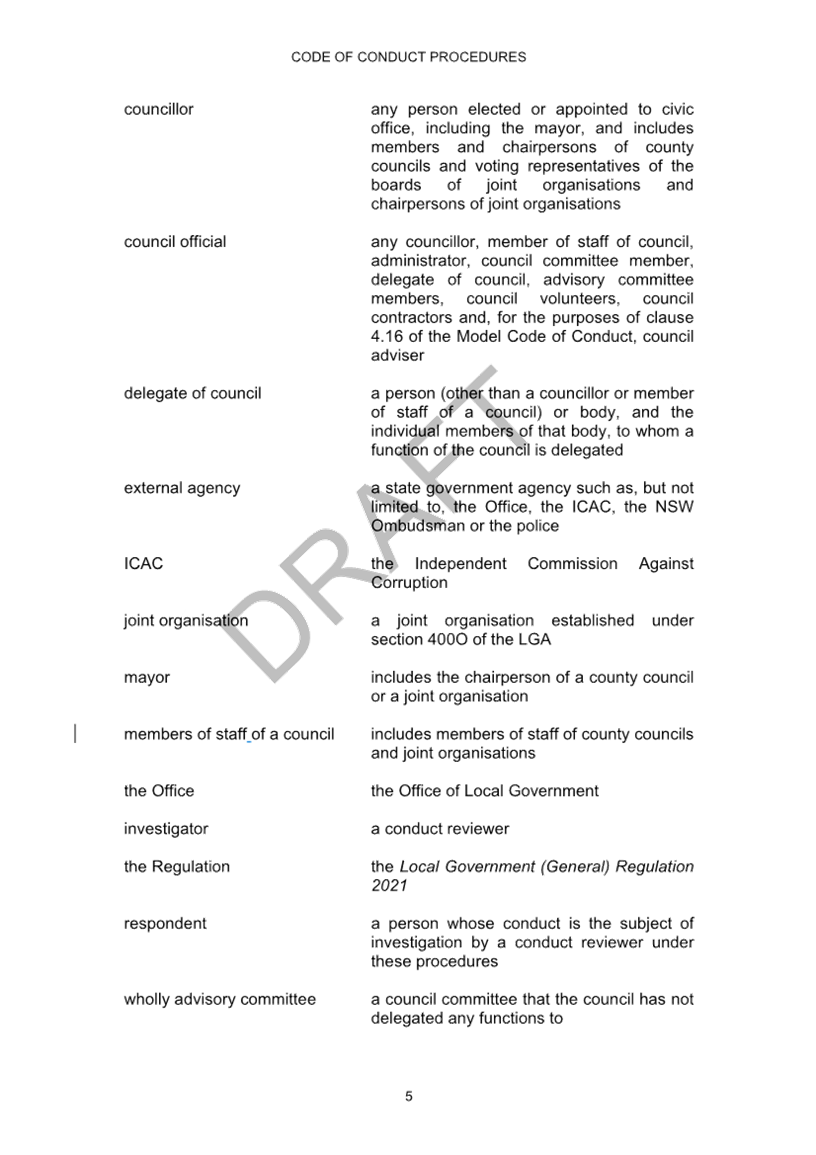
Code of Conduct Procedures with coloured markup January 2025
|
1
|
|
ITEM
05
|
Review
of the Code of Conduct and Code of Conduct Procedures
|
|
Attachment
1
|
Draft
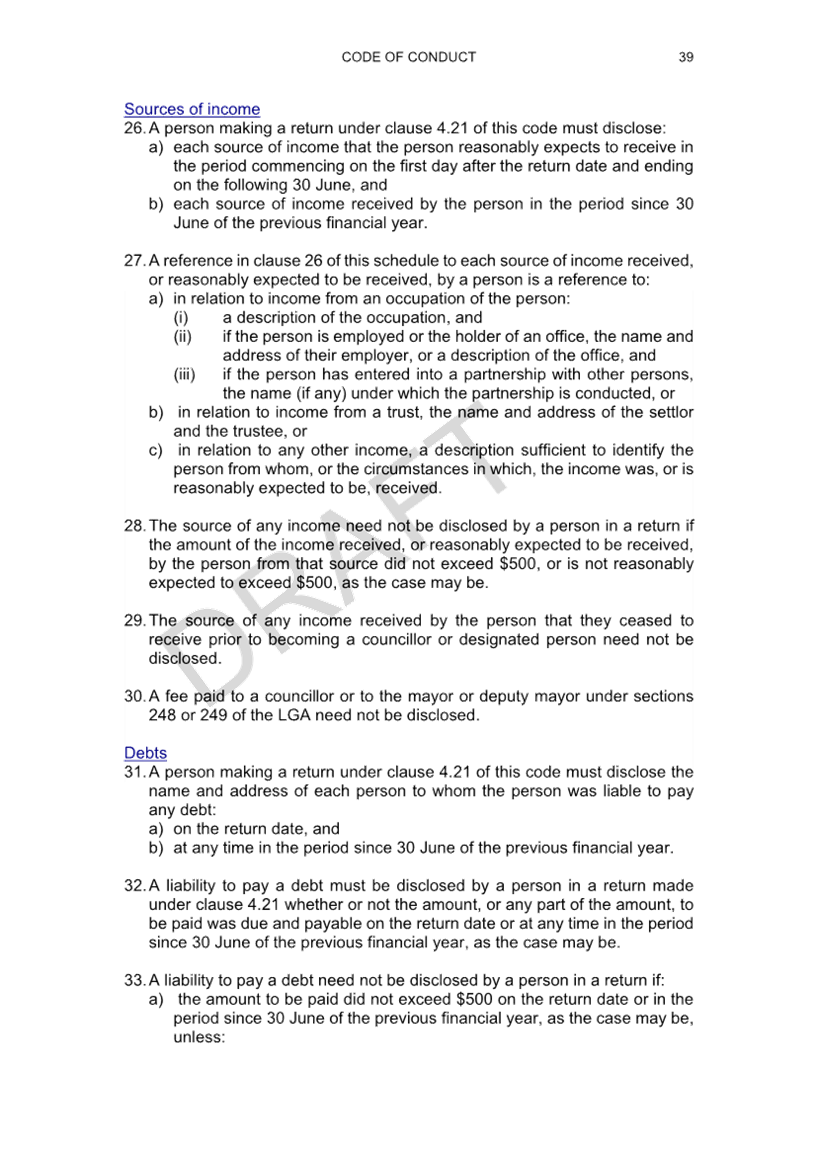
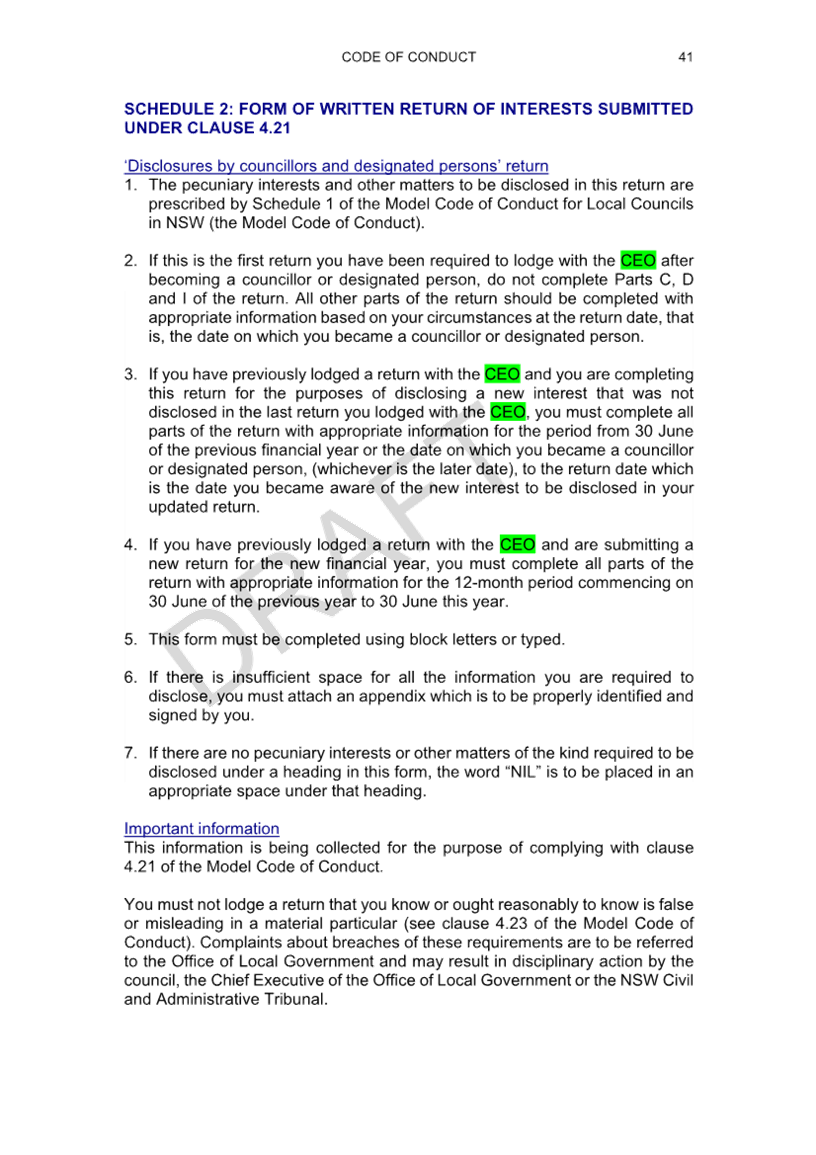
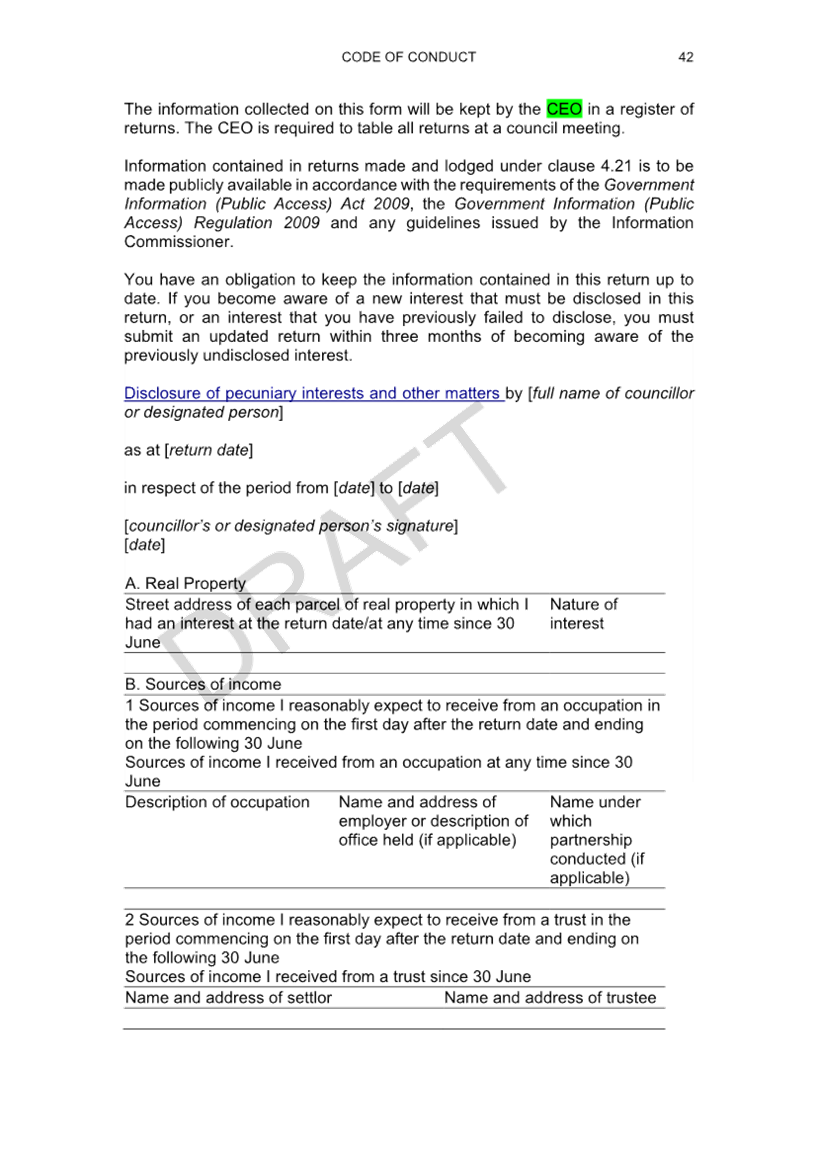
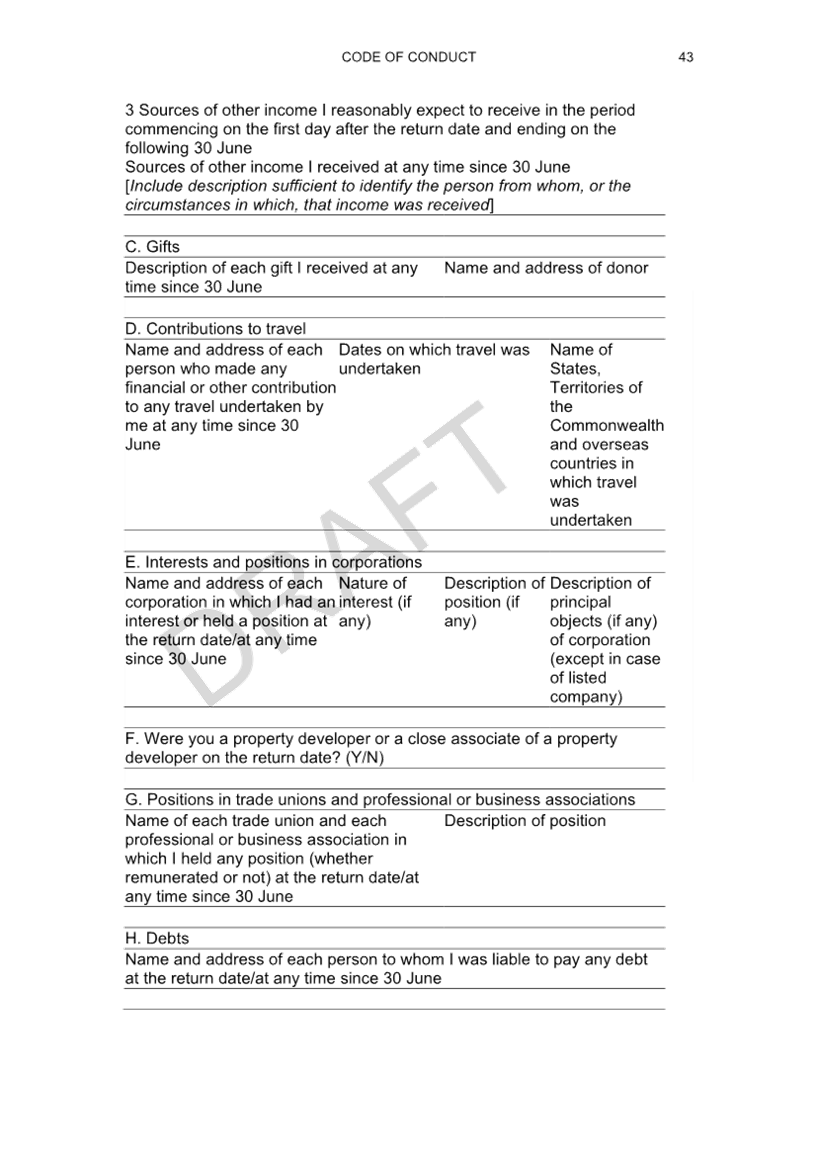
Code of Conduct with coloured markup January 2025
|













|
1
|
|
ITEM
05
|
Review
of the Code of Conduct and Code of Conduct Procedures
|
|
Attachment
2
|
Draft
Code of Conduct Procedures with coloured markup January 2025
|