Governance
Committee Meeting
10 June 2025
Infrastructure and Planning Committee Report
|
ITEM 02
|
14 Niland Way, Casula
|
|
Strategic
Objective
|
Visionary,
Leading, Responsible
Demonstrate
a high standard of transparency and accountability through a comprehensive
governance framework
|
|
File Ref
|
160152.2025
|
|
Report By
|
David Galpin
- General Counsel
|
|
Approved
By
|
Farooq
Portelli - Director Corporate Support
|
The
report outlines the proceedings and outcome of the appeal to the Land and
Environment Court against the deemed refusal of development consent for
DA-239/2023.
That the
Governance Committee:
1. Note the contents of the report.
Council’s
governing body considered the Legal Affairs Report at its meeting on 23 April
2025. Council requested a report outlining the proceedings and outcome of the
appeal to the Land and Environment Court against the deemed refusal of
development consent for DA-239/2023.
1. Commencement of proceedings
DA-239/2023
related to 14 Niland Way, Casula. The applicant sought development consent for the demolition of existing structures and
the construction of a two-storey childcare centre over a level of basement
parking at 14 Niland Way, Casula.
The appeal was filed based on a deemed refusal by
Council, as Council did not determine the application within 42 days. The
appeal was filed in time, that is within 6 months of the deemed refusal date.
2. Contentions
Council
raised eight principal contentions in the appeal proceedings, which are
summarised below.
1. No clause 4.6 request. The development exceeded the maximum
floor space ratio standard and the Applicant did not submit an application
under clause 4.6 of the Liverpool Local Environmental Plan to contravene
development standards.
2. Site suitability. The site was not suitable for the
development, as it could not be safely accessed.
3. Traffic impact. The development would have an adverse impact on
traffic safety and efficiency along Niland Way.
4. Bulk, scale and character. The bulk and scale of the proposed
development was not compatible with the character of the locality.
5. Overshadowing. The bulk and scale of the proposed development would
have resulted in overshadowing of 12 Niland Way.
6. Childcare requirements. Council identified inconsistencies with
State Environmental Planning Policy (Transport and Infrastructure) 2021
(T&I SEPP), the Education and Care Services National Regulation and the
Child Care Planning Guidelines.
7. Development Control Plan requirements. Council identified inconsistencies with
the objectives and provisions of the Liverpool Development Control Plan 2008
(LDCP).
8. Public Interest. Council argued that the development application was
contrary to the public interest because of contentions 1 to 7.
3. Conciliation conference
On 7 May 2024, the parties participated in
a conciliation conference pursuant to section 34 of the Land and Environment
Court Act 1979. The parties could not reach agreement with respect to the
development application and the conciliation conference was adjourned, then
subsequently terminated on 5 July 2025.
4. Expert evidence
The parties nominated their respective expert
witnesses under Rule 31.19, 31.20 and 31.24 of the Uniform Civil Procedure
Rules 2005 (UCPR) in the following fields to deal with and prepare a Joint
Expert Report in relation to each respective contention:
1. Town planning expert to deal with
contentions 1, 5, 6 and 7,
2. Urban design expert to deal with contention
4, and
3. Traffic engineer to deal with contentions
2, 3 and 6.
In circumstances where the parties’ experts
agree on issues that are in dispute, they have an overriding duty to assist the
Court in achieving the just, quick and cheap resolution of the proceedings.
Rule 31.23 of the UCPR notes that an Expert Witness
must comply with the code of conduct set out in Schedule 7. Schedule 7 notes
that “An expert witness is not an advocate for a party and has a
paramount duty, overriding any duty to the party to the proceedings or other
person retaining the expert witness, to assist the court impartially on matters
relevant to the area of expertise of the witness.”
5. Hearing
The proceedings were listed for a two-day hearing on
10 and 11 April 2025. The hearing began on site and continued in the Land and
Environment Court.
Council received 46 objector submissions during the
notification period for the development application, with 8 objectors
expressing an interest in addressing the Commissioner. On 10 April 2025, the
Court heard from 6 of the objectors.
A resident objector has no legal entitlement to
participate in a development appeal. However, the Court has the power under
section 38 of the Land & Environment Act 1979 to inform itself on any
matter in such a manner as it thinks appropriate and can therefore hear
residents’ concerns. It does so as a matter of practice.
The Court’s practice allows for a maximum of 6
resident objectors to address the Commissioner at the hearing. As Council is
restricted to 6 objectors, priority was given to the objectors that had made a
personal submission and advised Council that they would like to attend and
address the Commissioner on their concerns.
Council’s experts, after discussion with the
Applicant’s experts during their Joint Expert Reporting and at the
hearing, resolved all issues in dispute. The resolution was achieved by:
· the Applicant submitting amended plans, and
· the imposition of conditions of consent
that the Applicant accepted.
In relation to each of the contentions that Council
had raised:
No clause 4.6 request
Applicant submitted amended documentation which
illustrated that the Gross Floor Area (GFA) complied with maximum prescribed
Floor Space Ratio (FSR) under the Liverpool Local Environmental Plan 2008
(LLEP).
Site suitability
The amended documentation provided during
the hearing demonstrated the site was suitable in terms of compliance under the
T&I SEPP, LLEP and the LDCP. There were no legislative requirements
pursuant to which the development could be refused.
The amended DA and conditions provide for a footpath
allowing for safe pedestrian access to the site and surrounding local area. The
provision of the footpath satisfies the requirements of consideration C3 of the
NSW Child Care Planning Guideline 2021.
Traffic impact
The amended DA strictly enforces the requirement for
all vehicles to enter and exit the site through a left in, left out procedure
ensuing that two way traffic flow on Niland Way is limited. The amended DA
Conflict Analysis demonstrated a 2.16% chance of there being 2 vehicles
travelling along Niland Way in opposite directions at the same time whilst
vehicles are entering/existing the childcare center during the AM and PM peak
period based on the existing traffic flows.
Bulk, scale and character
The amended architectural plans demonstrated that the
proposed development would exhibit the typology of a two-storey dwelling,
consistent with the existing character of the street. The amended documentation
reduced the exceeding floor plate to comply with the required development
standards under the LLEP, and therefore the perceived bulk, scale and character
contention was resolved.
Additional landscaping is to be provided within the
front setback to reduce the perceive bulky dominance the proposed development
may have on the public domain.
Overshadowing
This issue was resolved along with the changes to
bulk, scale and character.
Childcare requirements
The proposed development is a centre-based childcare
facility under section 3.3 of State
Environmental Planning Policy (Transport and Infrastructure) 2021. The amended
development complies with the following standards set by sections 3.25 and 3.26
of the T&I SEPP:
· maximum floor space ration of 0.5:1 for
centre based childcare facility development in the R2 Zone,
· location relative to another early
education and care facility,
· indoor and outdoor unencumbered space and
indoor and outdoor unencumbered space under the Children (Education and Care
Services) Supplementary Provisions Regulation 2012,
· site area and site dimensions, and
· colour of building materials or shade
structures.
The amended development complied with the requirements
of regulations 107 and 108 of the Education and Care Services National
Regulation as set out in the following table.
|
Element
|
Standard
|
Proposal
|
Compliance
|
|
Unencumbered indoor
space
|
3.25m2
per child
Total
149.5m2 required for 46 children
|
156.0m2
|
Achieved
|
|
Unencumbered outdoor
space
|
7m2 per
child
Total 322.0m2
required for 46 children
|
331.0m2
|
Achieved
|
DCP requirements
In relation to parking, the proposed development
provides the number of car parking spaces required by the Liverpool Development
Control Plan 2008 (LDCP) and s 4.15(3A)(a) precludes the Court, in exercising
the functions of the consent authority, from requiring more onerous standards
than those stipulated by the LDCP.
4. Jurisdictional prerequisites
The following jurisdictional prerequisites and non
jurisdictional issues were also met or taken into consideration:
1. State Environmental Planning Policy
(Transport and Infrastructure) 2021 requirements for centre-based childcare
facilities are met, as set out above.
2. Requirements for indoor and outdoor
unencumbered space in regulations 107 and 108 of the Education and Care Services National Regulation are
met, as set out above.
3. State Environmental Planning Policy
(Resilience and Hazard) 2021
(a) Section 4.6(1) provides that a consent
authority must not consent to the carrying out of development unless:
i. It has considered whether the land is
contaminated, and
ii. If the land is contaminated, it is
satisfied that the land is suitable in its contaminated state (or will be
suitable, after remediation) for the purpose for which the development proposed
to be carried out, and
iii. If the land requires remediation to be made
suitable for the purpose for which the development is proposed to be carried
out, it is satisfied that the land will be remediated before the land is used
for that purpose.
(b) A detailed site investigation was provided
with the development application, with the report concluding that “following
the implementation of the recommendation and with due regard for the statement
of limitations the site is suitable for its intended land use as a childcare
facility”. The report provides recommendation concerning the method
of disposal of material and the quality of material imported to the site and
conditions have been imposed.
4. State Environmental Planning Policy
(Biodiversity and Conservation) 2021
(a) Chapter 6 applies as the site is within the
Georges River Catchment area.
(b) The development application is acceptable
having regard to the following:
i. Subject to the installation and maintenance
of sediment controls during building works, the development will have a neutral
effect on the quality of water entering a waterway.
ii. The development will not have an adverse
impact on water flow in a natural waterbody.
iii. There will be no discernible increase to
stormwater runoff that would adversely affect downstream land.
iv. The development does not incorporate
on-site stormwater retention, infiltration or reuse.
v. The development will have no impact on the
level and quality of the water table.
vi. The development makes adequate provision to
protects the quality and quantity of groundwater. It is noted that condition 29
requires the stormwater pretreatment to be incorporated in the management
system in compliance with Council’s Development Control Plan.
5. Liverpool Local Environmental Plan:
(a) The subject site is zoned R2 Low Density
Residential and Centre-based childcare facilities are permitted with consent in
the zone.
(b) The R2 zone objectives are matters for
consideration, not jurisdictional preconditions to the exercise of power: Al
Maha Pty Ltd v Huajun Investments Pty Ltd [2018] NSWCA 245 [217]. They do
not fall for consideration by the Court under section 34 of the Land and
Environment Court Act 1979. Notwithstanding the parties agree that the
development is consistent with all relevant objectives.
(c) Clause 4.4 provides for a maximum building
height of 8.5 metres for the subject site. The development application proposed
a building height below the maximum height limit.
(d) Clause 4.4 provides a maximum floor space
ratio of 0.5:1 for the subject property. The proposed development complies with
this development standard.
5. Concerns of residents
The concerns expressed by residents were addressed as
follows:
(a) Access to the site will be left in, left
out only which is subject to approval from Council’s Traffic Committee.
(b) The existing median strip is to be
relocated to prevent a right-hand turn into and out of the site.
(c) No street parking is permitted with any
failure to comply subject to the three-strike policy and the child will be
disenrolled from the centre.
(d) Conditions requiring the Applicant to
provide a pathway along Niland Way from the site to the southern intersection
of Niland Way and Mackellar Street, this will facilitate safe pedestrian access
to the site without the need to use the road.
(e) The development provides a surplus of car
parking spaces within the property boundary to alleviate the need for visitors
to park on Niland Way.
(f) The development satisfied the setback
control under the LDCP and the parties experts agree that the amended plans
(particularly the provision of greater landscaping) address Council concerns in
relation to character.
(g) The noise generated from the centre will
comply with the accepted best practice acoustic criteria with the installation
of an acoustic barrier along the boundaries of the site.
(h) There will be a limit on outdoor play with
two (2) hours in the morning and two (2) hours in the afternoon.
(i) Greater planting is provided to provide
further visual screening.
(j) The shadow diagrams and modelling identify
the southern neighbour living area, dining, kitchen windows will receive more
than three (3) hours of direct sunlight at the winter solstice which exceeds
the DCP controls.
6. Finalisation of proceedings
Given the parties’ experts agreed and that all
jurisdictional prerequisites had been met, the Court had the power to uphold
the appeal and grant development consent subject to the conditions of
development consent contained within Annexure A of the Judgement. All
conditions imposed were for a planning purpose, reasonably related to the
proposed development and were conditions that a reasonable consent authority
would issue in the circumstances. Accordingly, following advice from its
external Counsel, Council agreed that the proceedings could be finalised by way
of a section 34 agreement subject to the Conditions of Consent.
There
are no financial implications relating to this recommendation.
|
Economic
|
Facilitate economic development.
|
|
Environment
|
Environmental matters were considered as required
under the Environmental Planning and Assessment Act 1979.
|
Social
|
Support access and services for people with a disability.
Deliver high quality services for children and their families.
Social matters were considered as required under the
Environmental Planning and Assessment Act 1979.
|
Civic
Leadership
|
Operate a well-developed governance system that demonstrates
accountability, transparency and ethical conduct.
|
|
Legislative
|
Environmental Planning and Assessment Act 1979
Land and Environment Court Act 1979
|
|
Risk
|
The risk is deemed to be Low.
|
Nil
Governance
Committee Meeting
10 June 2025
|
ITEM 03
|
Finance Report - April 2025
|
|
Strategic
Objective
|
Visionary,
Leading, Responsible
Ensure
Council is accountable and financially sustainable through the strategic
management of assets and resources
|
|
File Ref
|
176182.2025
|
|
Report By
|
Vishwa Nadan
- Chief Financial Officer
|
|
Approved
By
|
Farooq
Portelli - Director Corporate Support
|
The
report provides an update on Council’s budget performance to April 2025.
The Governance Committee members are invited to note:
· That the 2024/25 year end net cost of
services (NCOS) position is now projected at a deficit $9.6 million.
· The current identified risks that can
affect both the NCOS and cash reserves, in particular the following:
o Sale of land to Moorebank Sports Club
o Built exercising its call option to
commence its development works adjacent to Liverpool Civic Place, and
o NSW Grants Commission paying FAG in advance
on or before 30 June 2025.
· Rates in arrears and debtors outstanding.
That the
Governance Committee receives
and notes the report.
Budget Performance
In
June 2024 the Council adopted its 2024-25 operating budget with estimated
revenue of $417.4 million and expenditure of $281.2 million. In terms of
the net operating result before grants and contributions provided for capital
purposes, Council budgeted for a conditional operating surplus of $2.6 million.
The
March Q3 Budget Review resulted in revision of the 30 June 2025 Net Cost of
Service (NCOS) position to an operating deficit of $9.6m. To recap, this result
includes:
· Council’s decision not to sell the 3
Hoxton Park Road Property which was going to generate $14m in cash and $8.4m in
profit from sale; and
· Budget adjustments identified as part of Q3
budget review which included $2m provision for redundancy payments and $1.5m
increase in provision for employee entitlements resulting from reinstatement of
lost flex time.
Risks
There are a number of risks being managed
which have the potential to change the projected budget result for the 2024/25
financial year. A summary of those risks is provided below.
|
Risk
|
Budget Impact
|
Cash Impact
|
Risk mitigation
|
Risks Level
|
|
1. Built Development do not exercise its call option
and commence works adjacent to Liverpool Civic Place by 30 June 2025.
|
$0
|
-$7.3m
|
Council is working closely with Built Development to
ensure the timely completion of actions precedent to enable exercise of the
call option and rights payment by 30 June ‘25.
|
Moderate
|
|
2. Sale of land to Moorebank Sports Club.
|
-$2.6m
|
-$8.0m
|
Council is progressing with Moorebank
Sports Club to finalise conditions precedent being completed to close the
sale by 30 June 2025.
|
Low
|
|
3. Net Loss from Disposal of Assets – As part of
the road renewal process, a portion of the road surface is scrapped off and
then replaced. The replacement cost is capitalised, however, there is a
written down value attached to the portion removed. The cost of write-off
depends on the condition of the road at time of renewal and depth of surface
removed. Budget includes a provision of $2.5 million, however, the actual
cost to June 2025 is not
known.
|
-$500k - $1m
|
-
|
Council is continually reviewing and assessing the
extent of road replacement and subsequent effect on write-offs.
|
Moderate
|
|
4. FAG Operating Grant – The NSW Grants
Commission paid 85% of estimated financial assistance grant for FY 2024/25 in
advance. Grants Commission could change its policy position to advance
payment for FY 2025/26.
|
-+ $1.5m
|
-+ $1.5m
|
Minimal action is possible other than
keeping in regular contact with OLG to ascertain outcome as soon as possible.
The financial impact is only based on 15% variation either upwards or downwards
on advance payment. If no advance payment is received by 30 June 2025, the
impact will be in order of $8.5m and will affect all Councils in NSW.
|
Moderate
|
|
5. Capital gain on FRN’s and TCorp investment is
subject to market conditions. The projected marked to market gain at 30 June
2025 could be lower than projected.
|
-$500k
|
-
|
Regular review of market conditions and contact with
Council’s Investment Advisors to determine likelihood of change and
effect on marked to market valuations.
|
Low
|
Based
on budget adjustments the NCOS on 30 June 2025 is projected at a deficit of
$9.6m.
Cash Reserves
At 30 April 2025, Council had $399.8 million in cash and investments
classified as follows:
|
|
30 June 2025
|
30 April 2025
|
30 June 2024
|
|
Externally Restricted Reserves
|
$339.1m
|
$386.9m
|
$353.3m
|
|
Internally Restricted Reserves
|
$32.2m
|
$6.4m
|
$6.9m
|
|
Investments in Civic Risk Mutual
|
$6.5m
|
$6.5m
|
$6.5m
|
|
Unrestricted cash
|
$4.9m
|
-
|
-
|
|
Total
|
$382.7m
|
$399.8m
|
$366.6m
|
Should Council not be able to mitigate the risks
identified above, there will be an impact on the budget result (NCOS) and cash
balance (reserves) at year end. The latter would significantly put at risk
Council’s ability to meet the financial covenants with commercial banks
and TCorp at 30 June 2025.
Outstanding
Rates & Major Debtors
· Total rates outstanding was $12.28m ($5.8m
from previous years and $6.5m for current year). Based on this Council is not
expected to meet OLG benchmark of <5% at 30 June 2025.
· Canterbury/ Bankstown Council (Voyager
Bridge Matter) - $2.8m
Nil
|
ITEM 04
|
Draft Disaster Relief Policy
|
|
Strategic Objective
|
Visionary,
Leading, Responsible
Ensure
Council is accountable and financially sustainable through the strategic
management of assets and resources
|
|
File Ref
|
180453.2025
|
|
Report By
|
Craig Lambeth - Manager
Community Recreation
|
|
Approved By
|
Tina Bono - Director
Community & Lifestyle
|
Historically, Council has made
donations to humanitarian causes across the globe, often in response to natural
and/or humanitarian crises. These donations are generally made on an ad-hoc
basis through a Mayoral Minute or Notice of Motion, without a supporting policy
framework.
To better manage these donations
and ensure transparency in the process of identifying and supporting
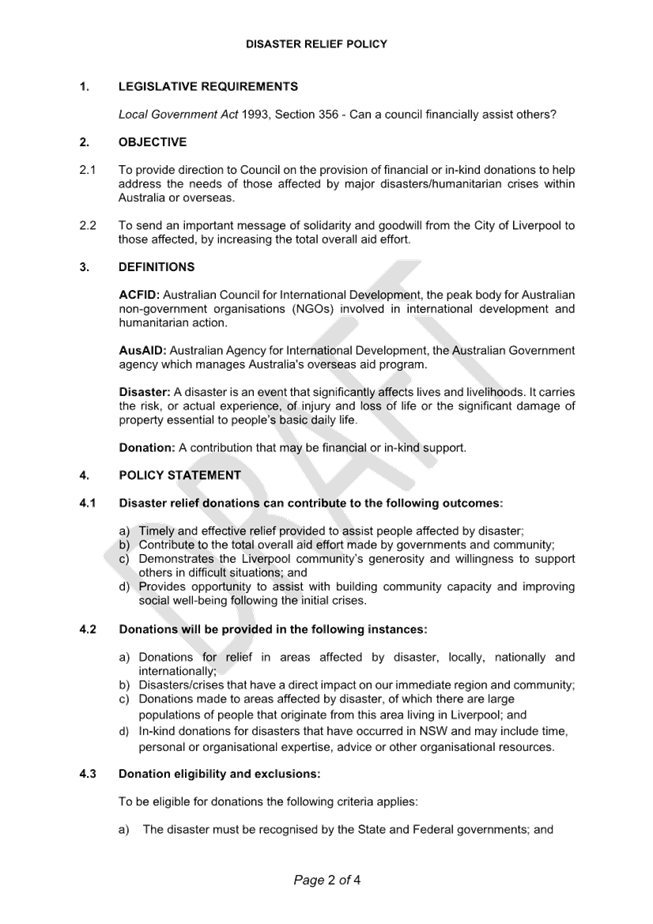
humanitarian efforts, a draft Disaster Relief Policy (the Policy) has been
developed.
The Policy provides a framework
under which financial donations can be made to help address the needs of those
affected by major disasters/humanitarian crises within Australia or overseas.
This report recommends Council
endorse the draft Disaster Relief Policy.
That Council:
1. Endorse
the draft Disaster Relief Policy;
2. Direct
the CEO to place the draft Disaster Relief Policy on public exhibition for a
period of 28 days; and
3. Receive a further report on the outcome of the public
exhibition process.
Background
Historically, Council has made
donations to humanitarian causes across the globe, often in response to natural
and/or humanitarian crises. These donations are generally made on an ad-hoc
basis through a Mayoral Minute or Notice of Motion, without a supporting policy
framework.
At its meeting on 23 April 2025,
Council resolved to:
1. Inform
the community of all similar overseas donations made previously and the
circumstances they were made; and
2. Direct the CEO for a workshop to
consider a Donations Policy.
Council
received a report which outlined similar donations made previously at its May
2025 meeting.
A
similar policy was drafted in 2019 and brought to the Council of the time for
consideration. However, the policy was not endorsed at that time and donations
continued to be made on an ad hoc basis.
Draft Disaster Relief Policy
To better manage these donations
and ensure transparency in the process of identifying and supporting
humanitarian efforts, a draft Disaster Relief Policy (the Policy) has been
developed.
The Policy provides a framework
under which financial donations can be made to help address the needs of those
affected by major disasters/humanitarian crises within Australia or overseas.
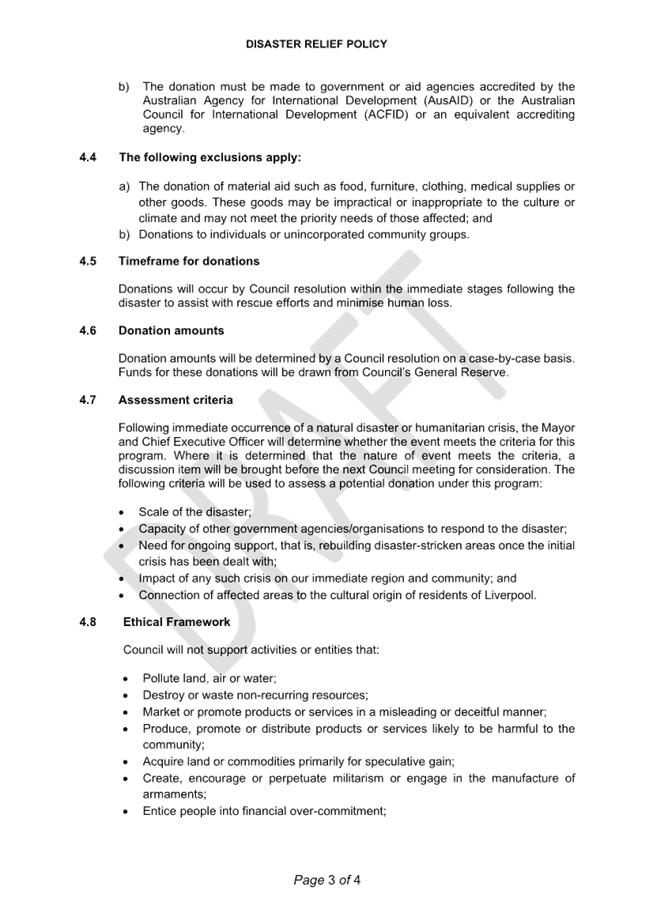
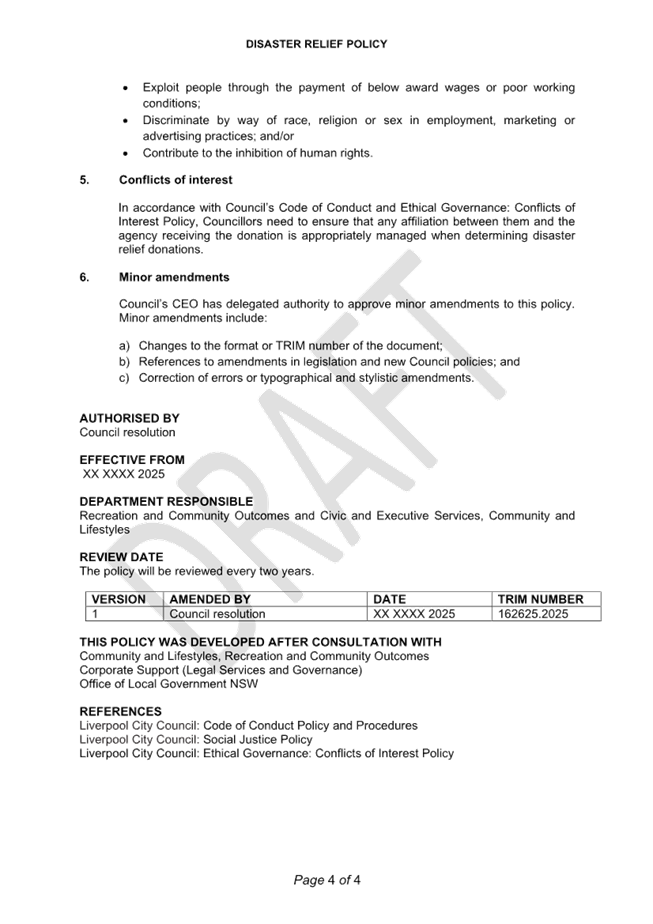
The Policy outlines the key
considerations for Council when donating to humanitarian causes, including:
· The
circumstances in which donations will be provided;
· Eligibility
and exclusions;
· Timeframe
for donations;
· Donation
amounts and a funding source (General Reserve);
· Assessment
criteria;
· Ethical
framework; and
· Conflicts
of interest.
Conclusion
Liverpool is an incredibly
diverse LGA. Making donations to global humanitarian efforts acknowledges the
local impact of global humanitarian crises to residents and their families
abroad.
By establishing a Disaster Relief
Policy, Council can ensure greater transparency and accountability when making
charitable donations to global humanitarian causes. The Policy provides a clear
set of guidelines for the nature and circumstances under which a donation can
be made and highlights Councils efforts to efficiently and effectively provide
financial support to disasters and crises around the world.
Costs associated with this
recommendation are outside of Council’s current budget and long-term
financial plan. The impact on the budget and long-term financial plan is
unclear as this would be variable based on the number of donations made in any
one financial year.
|
Economic
|
Funds for donations made under the Disaster Relief Policy will be drawn
from Council’s General Reserve at the time of the donation
|
|
Environment
|
There are no environmental and sustainability considerations.
|
Social
|
Promote
community harmony and address discrimination.
|
Civic Leadership
|
Undertake
communication practices with the community and stakeholders across a range of
media.
Foster
neighbourhood pride and a sense of responsibility.
Encourage
the community to engage in Council initiatives and actions.
Provide
information about Council’s services, roles and decision making
processes.
Operate
a well-developed governance system that demonstrates accountability,
transparency and ethical conduct.
|
|
Legislative
|
Local Government Act – Section 356
|
|
Risk
|
The risk is deemed to be Low.
There is a risk that developing this Policy will
have a detrimental impact on Council’s reputation amongst community
members, considering the ongoing negative community sentiment related to
recent donations.
|
1. Draft
Disaster Relief Policy 2025
Governance
Committee Meeting
10 June 2025
Strategic Performance Committee Report
|
ITEM 05
|
Delegations of the Chief Executive
Officer
|
|
Strategic
Objective
|
Visionary,
Leading, Responsible
Demonstrate
a high standard of transparency and accountability through a comprehensive
governance framework
|
|
File Ref
|
153441.2025
|
|
Report By
|
David Day -
Head of Governance
|
|
Approved
By
|
Farooq
Portelli - Director Corporate Support
|
A
review has been conducted of the delegations granted by Council’s
governing body to the Chief Executive Officer. The delegations are fit for
purpose and it is recommended that Council agree the attached delegations,
which are the same as those previously granted to the Chief Executive Officer
in June 2023.
That the
Governance Committee endorses the following for agreement by Council’s
governing body:
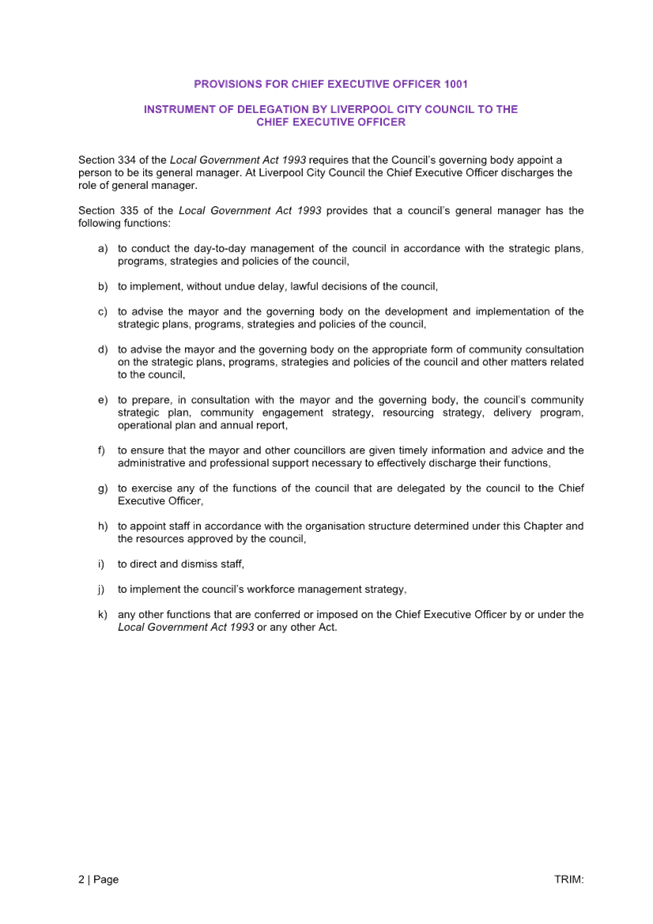
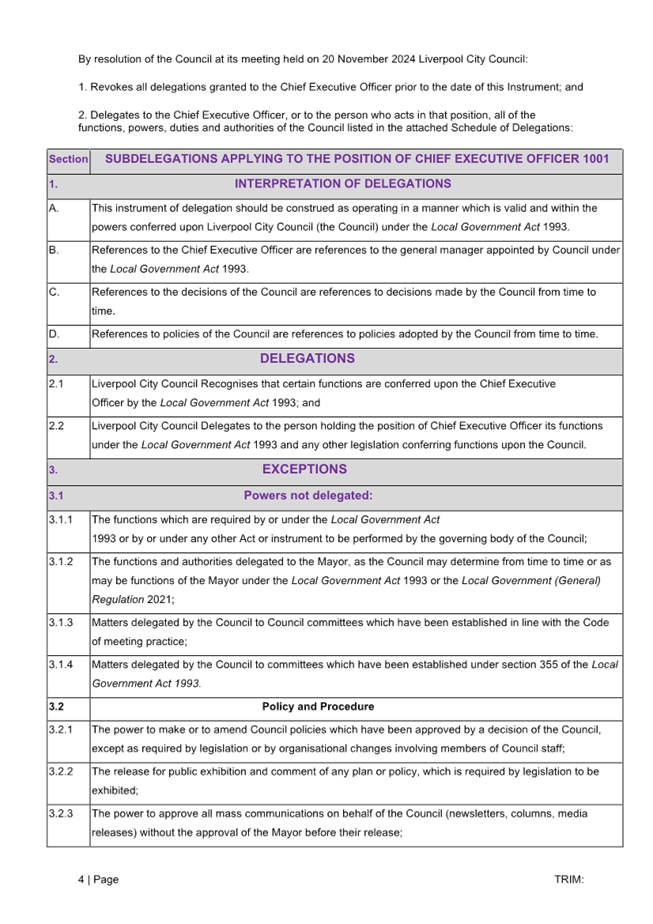
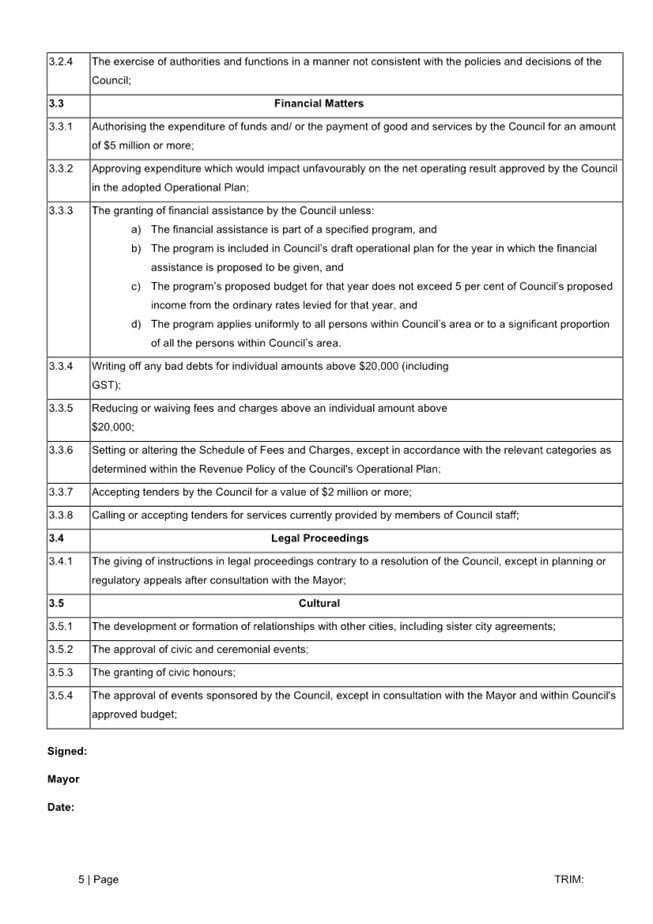
1. Delegate to the Chief Executive
Officer Council’s functions as set out in the Instrument of Delegation to
the Chief Executive Officer in Attachment 1 of this report; and
2. Authorise the Mayor to sign the
Instrument of Delegation to the Chief Executive Officer.
Chapter
12, Part 3 of the Local Government Act 1993 (LGA) deals with the delegation of
functions. It includes the following provisions:
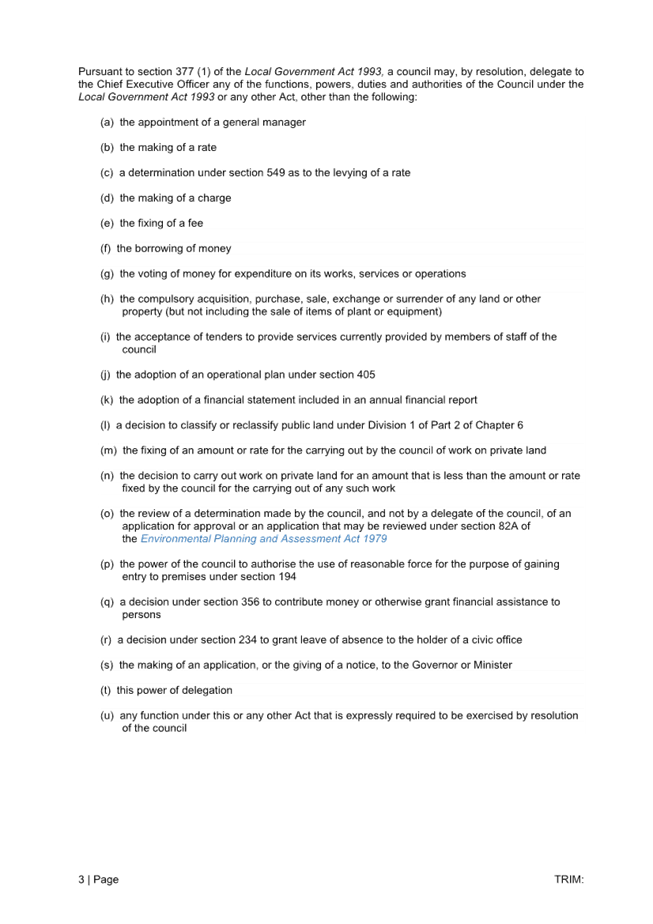
• Council
may delegate any of its functions to the general manager, or any other person
or body (not including another employee of the council), other than those
listed in section 377(1) of the Act. The functions that cannot be delegated are
specifically referenced in, and excluded from, the attached delegation to the
CEO.
• Council
may delegate to the general manager, or any other person or body (not including
another employee of the council), any function delegated to Council by the
Departmental Chief Executive, except where that is not permitted by the
instrument of delegation to the Council (LGA, section 377(2)).
• The
general manager may delegate any of the functions of the general manager, other
than the power of delegation, including functions that have been delegated to the
general manager by Council (LGA, section 378).
• Council
must review all its delegations during the first 12 months of each term of
office (LGA, section 380).
Council’s
Chief Executive Officer (the CEO) exercises the functions, role and delegations
of
“general
manager” under the Act.
This
review is concerned with delegations granted by Council to the Chief Executive
Officer and not with delegations that may have been granted to other persons or
bodies. It is noted, however, that Council generally establishes committees as
advisory bodies and does not delegate functions to those bodies.
Delegations
by Council to the CEO and sub-delegations to other staff identify the positions
that are empowered to make decisions and take action on behalf of Council,
establishing responsibilities and accountabilities. The delegations facilitate
the effective and efficient operation of Liverpool City Council by providing
the Chief Executive Officer with sufficient power and authority to manage,
control and administer the affairs of Council on a day-to-day basis. This is
consistent with the roles given to the general manager by section 335 of the
LGA to conduct the day-to-day management of the council and implement its
decisions.
The
delegations from Council to the CEO are granted to the fullest extent
permissible under the LGA, subject to specified exclusions:
• functions
that cannot, by legislation, be delegated, including those listed in section
377(1) of the LGA,
• functions
granted by Council to other persons or bodies,
• functions
that Council has chosen not to delegate, such as the acceptance of tenders for
a value of $2 million or more.
A
review of CEO delegations has confirmed that they operate effectively and are
fit for purpose. The general grant, subject to nominated exclusions, avoids the
inconvenience of having a host of specific delegations only to find that a
necessary function has not been delegated, with resulting delay to delivery of
Council’s objectives. No changes are proposed to the current CEO
delegation.
There
is an ongoing review of delegations granted by the Chief Executive Officer to
other council staff. The review aims to ensure that all positions within
Council have the right delegations to undertake their functions, improve
efficiencies and accountability where possible. The review of officer
delegations will continue after the Chief Executive Officer’s delegation
is endorsed.
There
are no financial implications relating to this recommendation.
|
Economic
|
There are no economic and financial considerations.
|
|
Environment
|
There are no environmental and sustainability
considerations.
|
Social
|
There are no social and cultural considerations.
|
Civic
Leadership
|
Operate a well-developed governance system that demonstrates
accountability, transparency and ethical conduct.
|
|
Legislative
|
Local Government Act 1993, Chapter 12, Part 3
Relevant provisions are outlined in the body of the
report.
|
|
Risk
|
There is no risk associated with this
report.
|
1. Draft
Delegations of the Chief Executive Officer